IADR Abstract Archives
Biofilm Formation on Glass Ionomer Cement-based Materials in Relation to Their Surface Properties and Fluoride Content
Objectives: Considering the evolution of glass ionomer cements (GICs) and their role as bioactive materials, the aim of this study was to evaluate the microbiological performances of different types of GIC-based restorative and luting materials related to their surface properties and fluoride content.
Methods: Standardized specimens (6.0mm diam, 2.0mm thick, 16/group) were prepared from: A: resin-modified GIC (RM-GIC), Ionolux AC; B: compomer, Glasiosite; C: GIC luting cement, Meron; D: high-viscosity GIC (HV-GIC) restorative material, Ionostar Plus; E: resin-based composite (RBC), Grandioso (all from Voco GmbH, Cuxhaven, G) and F: human enamel (reference).
Surface roughness (SR, profilometry), surface free energy (SFE, OWRK approach) and surface chemical composition (energy-dispersive Xray spectroscopy, EDS) were determined.
Specimens were stored for 7 days in artificial saliva, then sterilized. Salivary pellicle was obtained after 24h incubation then monospecific Streptococcus mutans biofilm was grown for either 48 (n=8) or 96h (n=8) using a modified drip-flow bioreactor. Adherent viable biomass was assessed using an MTT-based test.
Statistical analysis included verification of normality (Shapiro-Wilk) and homoscedasticity (Levene), then Two-way ANOVA was used considering the materials and the incubation time as fixed factors. Tukey's posthoc test was used to highlight significant differences between groups (p< 0.05).
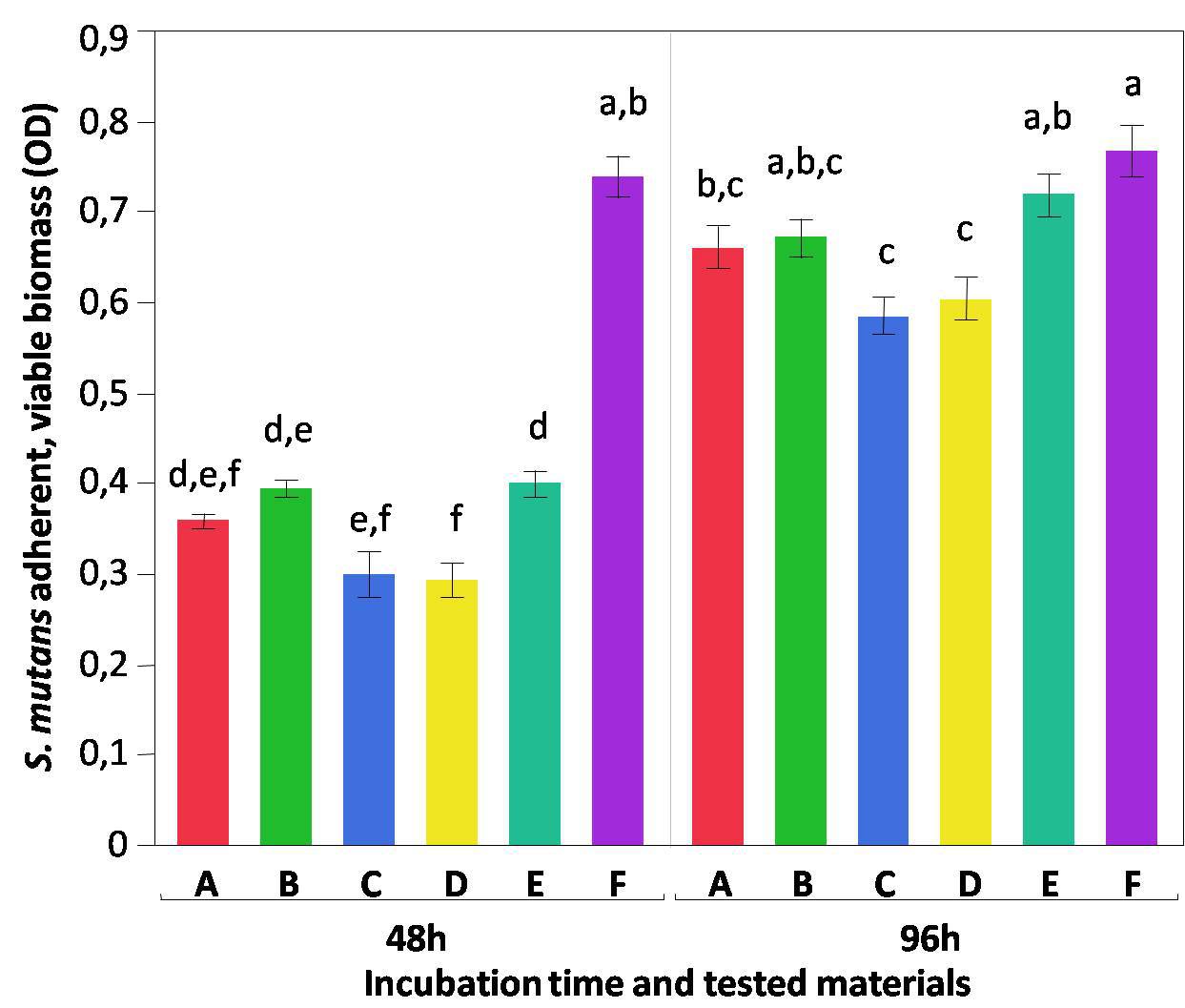
Results: SR showed significanlty lower roughness of B and E compared to the other groups (p<0.001). No significant differences in SFE could be found between the tested materials; enamel had higher SFE due to higher contribution of polar SFE. EDS showed high presence of fluoride on A, C and D surfaces (9-10% wt.). Biofilm formation on tested material surfaces after either 48h or 96h is shown in Figure 1 as mean OD+/-1standard error; different superscript letters indicate significant differences between groups.
No influence of SR and SFE on biofilm formation were found. Fluoride content decreased biofilm formation on GICs but not on RM-GIC.
Conclusions: The tested GIC and HV-GIC may be considered promising luting cement and restorative material from a microbiological point of view. Under the tested conditions, fluoride addition to a material does not imply automatic reduction of biofilm formation.
Methods: Standardized specimens (6.0mm diam, 2.0mm thick, 16/group) were prepared from: A: resin-modified GIC (RM-GIC), Ionolux AC; B: compomer, Glasiosite; C: GIC luting cement, Meron; D: high-viscosity GIC (HV-GIC) restorative material, Ionostar Plus; E: resin-based composite (RBC), Grandioso (all from Voco GmbH, Cuxhaven, G) and F: human enamel (reference).
Surface roughness (SR, profilometry), surface free energy (SFE, OWRK approach) and surface chemical composition (energy-dispersive Xray spectroscopy, EDS) were determined.
Specimens were stored for 7 days in artificial saliva, then sterilized. Salivary pellicle was obtained after 24h incubation then monospecific Streptococcus mutans biofilm was grown for either 48 (n=8) or 96h (n=8) using a modified drip-flow bioreactor. Adherent viable biomass was assessed using an MTT-based test.
Statistical analysis included verification of normality (Shapiro-Wilk) and homoscedasticity (Levene), then Two-way ANOVA was used considering the materials and the incubation time as fixed factors. Tukey's posthoc test was used to highlight significant differences between groups (p< 0.05).
Results: SR showed significanlty lower roughness of B and E compared to the other groups (p<0.001). No significant differences in SFE could be found between the tested materials; enamel had higher SFE due to higher contribution of polar SFE. EDS showed high presence of fluoride on A, C and D surfaces (9-10% wt.). Biofilm formation on tested material surfaces after either 48h or 96h is shown in Figure 1 as mean OD+/-1standard error; different superscript letters indicate significant differences between groups.
No influence of SR and SFE on biofilm formation were found. Fluoride content decreased biofilm formation on GICs but not on RM-GIC.
Conclusions: The tested GIC and HV-GIC may be considered promising luting cement and restorative material from a microbiological point of view. Under the tested conditions, fluoride addition to a material does not imply automatic reduction of biofilm formation.
IMAGES
2530170_File000000.jpg
2530170_File000000.jpg