IADR Abstract Archives
APPLICATION STRATEGIES OF UNIVERSAL ADHESIVE SYSTEM ON DURABILITY OF RESTORATIVE MATERIALS OBTAINED BY CAD CAM TO DENTIN.
Objectives: The objective of this study was to evaluate the influence of the application of the universal adhesive system (Scotchbond Universal 3M/ESPE) to the dentin on the strength and bonding durability of a ceramic based on lithium disilicate and a nanoceramic resin by the micro-shear test.
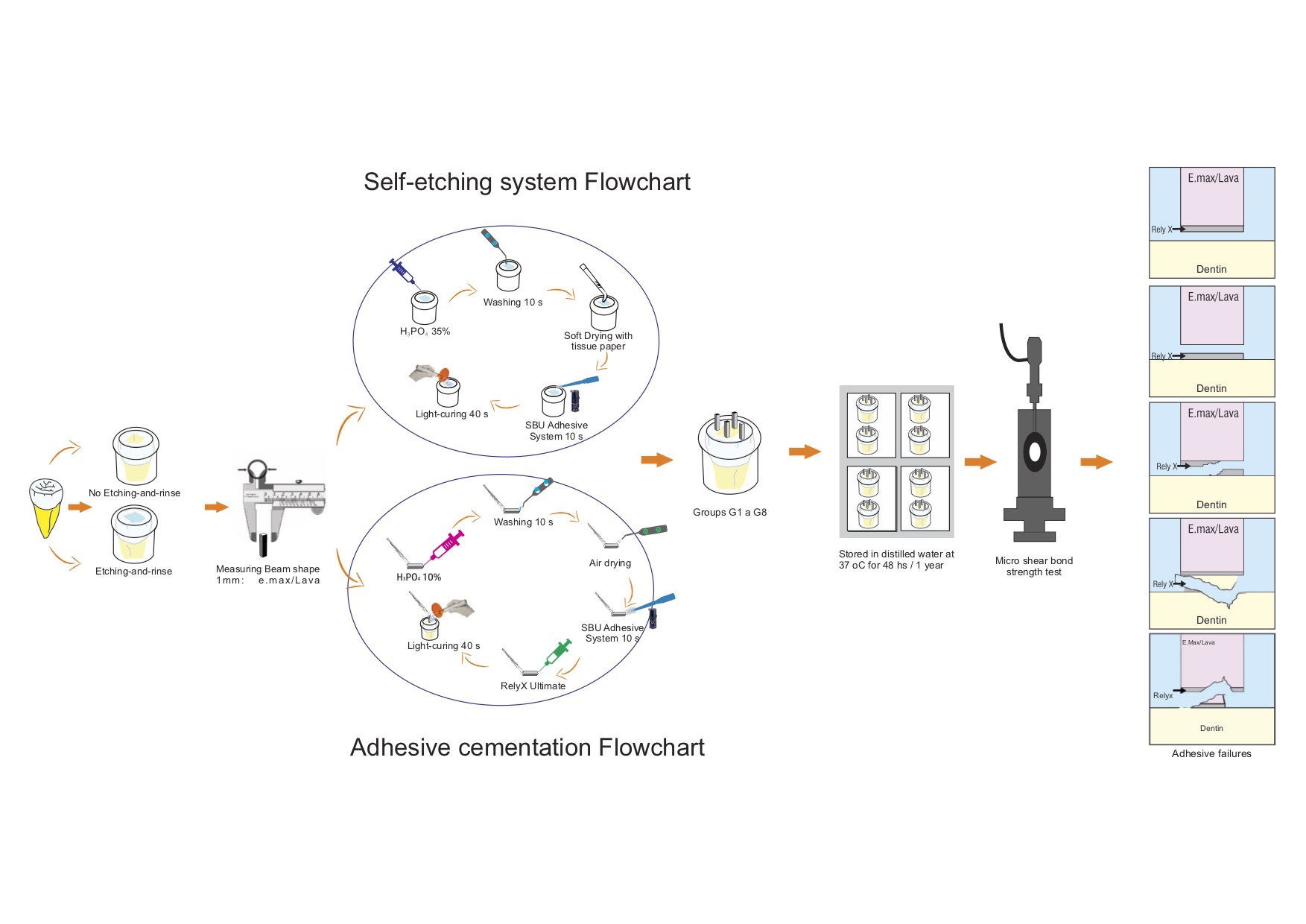
Methods: A total of 40 healthy third molars, sectioned to expose flat occlusal medium dentin and separated into 4 groups (n = 10) were selected according to dentin treatments (application of phosphoric acid prior to universal Scotchbond Universal adhesive or not) and indirect materials obtained by CAD CAM (lithium disilicate ceramics - IPS e.max CAD and nanoceramic resin - Lava Ultimate). Ceramic sticks of lithium disilicate and nanoceramic resin with 1 mm2 of area were cemented with resin cement Rely XTM Ultimate on the dentin surface and stored in distilled water for 48h or 12 months at 37oC. The micro-shear test was performed in a Universal Assay machine at a speed of 0.5 mm / min.
Results: The values were recorded in MPa and submitted to analysis of variance at three criteria with significance level of 5%. The results indicated that the interaction between restorative material, dentin treatment and time was not significant (p = 0.841). However, the storage time significantly affected the bond strength (p = 0.016), and for all the groups, the values of union strength were verified after 12 months.
Conclusions: It was concluded that, regardless of the mode of application of the universal adhesive system and the type of restorative material, the bond strength to the dentin decreased over time.
Methods: A total of 40 healthy third molars, sectioned to expose flat occlusal medium dentin and separated into 4 groups (n = 10) were selected according to dentin treatments (application of phosphoric acid prior to universal Scotchbond Universal adhesive or not) and indirect materials obtained by CAD CAM (lithium disilicate ceramics - IPS e.max CAD and nanoceramic resin - Lava Ultimate). Ceramic sticks of lithium disilicate and nanoceramic resin with 1 mm2 of area were cemented with resin cement Rely XTM Ultimate on the dentin surface and stored in distilled water for 48h or 12 months at 37oC. The micro-shear test was performed in a Universal Assay machine at a speed of 0.5 mm / min.
Results: The values were recorded in MPa and submitted to analysis of variance at three criteria with significance level of 5%. The results indicated that the interaction between restorative material, dentin treatment and time was not significant (p = 0.841). However, the storage time significantly affected the bond strength (p = 0.016), and for all the groups, the values of union strength were verified after 12 months.
Conclusions: It was concluded that, regardless of the mode of application of the universal adhesive system and the type of restorative material, the bond strength to the dentin decreased over time.
IMAGES
3015885_File000000.jpg
3015885_File000000.jpg