IADR Abstract Archives
Artificial Intelligence vs Conventional Methods in Digital Smile Designing
Objectives: To compare error differences and patient acceptance between artificial intelligence (AI) and conventional smile designing methods.
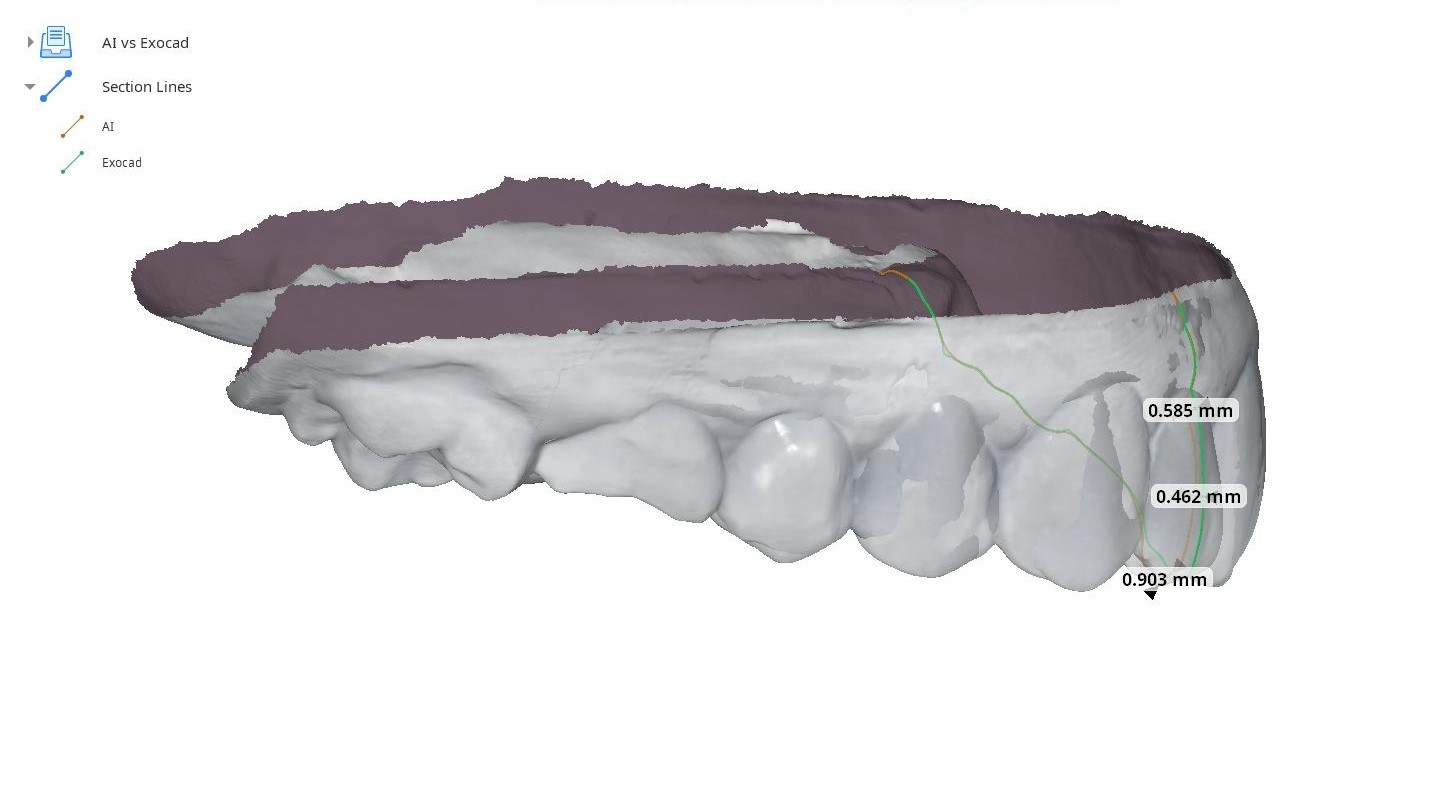
Methods: A 13-year-old female came to the clinic with broken and pitted central incisors. She had caries, enamel breakdown, and white patches related to her anterior and posterior teeth, which was typical of Molar Incisor Hypomineralization (MIH). Two digital smile designs were suggested for composite veneers, one using artificial intelligence software (SmileFy, Inc.) and the other using EXOCADTM software. The two designs were converted to meditMesh files to be superimposed on each other using Medit software (Medit Corp., Seoul, Korea). The superimposition was based on the unrestored upper second molars using the three-point alignment method. The difference between the two designs was measured by a cross-section plane placed vertically, exactly in the middle of each anterior tooth (#13:#23). Contour tracing of the teeth was carried out, and linear measurements were taken at the labial surface in the incisal, middle, and cervical thirds. Mesial and distal measurements at horizontal cross-section planes in the middle third were taken as well. Error differences and patient acceptance between the AI and EXOCAD designs were determined.
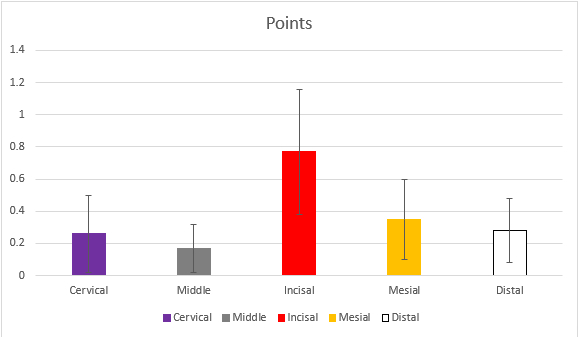
Results: The error difference between AI and EXOCAD design was 0.37±0.59. Comparison between surface points has shown that the incisal point had the highest significant difference of 0.77±0.39 when compared to other points (p =0.005). Comparison between teeth has shown that the upper right lateral incisor had the highest difference of 0.71±0.43 when compared to other teeth (p =0.115). Patient acceptance was 8/10 and 10/10 for AI and EXOCAD designs, respectively, with a mean difference of two on the visual analogue scale (VAS).
Conclusions: The use of AI software in smile designing is promising, yet it still requires more training to reach higher accuracy levels to satisfy the patient’s needs.
Methods: A 13-year-old female came to the clinic with broken and pitted central incisors. She had caries, enamel breakdown, and white patches related to her anterior and posterior teeth, which was typical of Molar Incisor Hypomineralization (MIH). Two digital smile designs were suggested for composite veneers, one using artificial intelligence software (SmileFy, Inc.) and the other using EXOCADTM software. The two designs were converted to meditMesh files to be superimposed on each other using Medit software (Medit Corp., Seoul, Korea). The superimposition was based on the unrestored upper second molars using the three-point alignment method. The difference between the two designs was measured by a cross-section plane placed vertically, exactly in the middle of each anterior tooth (#13:#23). Contour tracing of the teeth was carried out, and linear measurements were taken at the labial surface in the incisal, middle, and cervical thirds. Mesial and distal measurements at horizontal cross-section planes in the middle third were taken as well. Error differences and patient acceptance between the AI and EXOCAD designs were determined.
Results: The error difference between AI and EXOCAD design was 0.37±0.59. Comparison between surface points has shown that the incisal point had the highest significant difference of 0.77±0.39 when compared to other points (p =0.005). Comparison between teeth has shown that the upper right lateral incisor had the highest difference of 0.71±0.43 when compared to other teeth (p =0.115). Patient acceptance was 8/10 and 10/10 for AI and EXOCAD designs, respectively, with a mean difference of two on the visual analogue scale (VAS).
Conclusions: The use of AI software in smile designing is promising, yet it still requires more training to reach higher accuracy levels to satisfy the patient’s needs.
IMAGES
4170266_File000000.JPG
4170266_File000002.jpg
4170266_File000000.JPG
4170266_File000002.jpg