IADR Abstract Archives
Modeling bone density changes due to dental implant thread rounding radii
Objectives: Identify the effect of the thread rounding radius on bone density changes around dental implants through FEA.
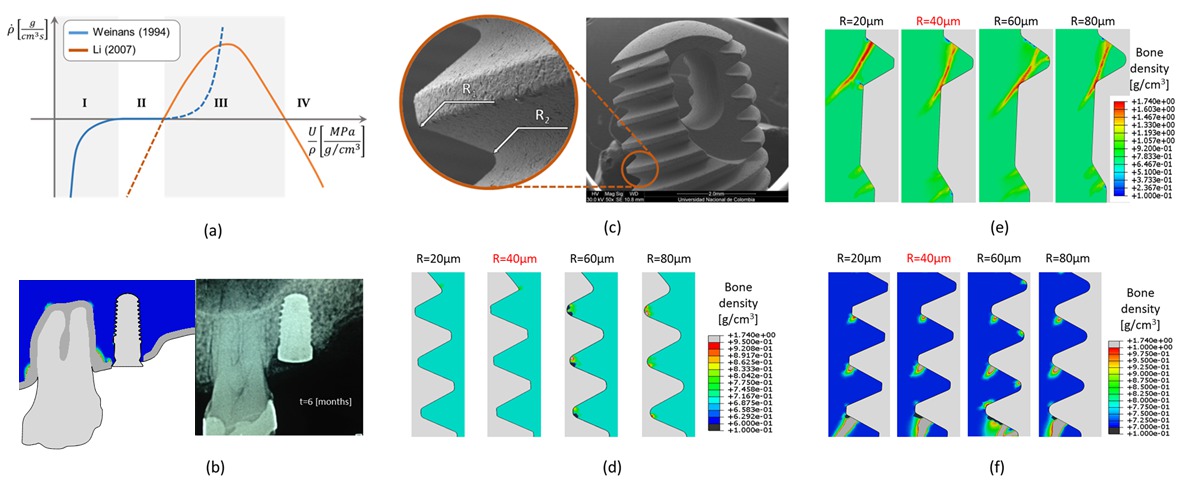
Methods: Bone remodeling is a complex process which involves a coordinated action between cells, biochemical factors and extracellular matrices. Bone adapts to mechanical loading, thus based on the models developed by Weinans (blue in figure 1.a) and Li (orange in fig. 1.a), we have implemented a new model (continuous line in fig.1.a) that predicts bone density changes (ρ″) in response to mechanical stimulus (U/ρ), taking into account an underload resorption zone (I), a lazy zone (II), a bone-growth zone (III) and an overload resorption zone (IV).
The case study is the placement of a commercial dental implant in position #27 (fig.1.b). The simulation takes place in stage 2 surgery, where both the implant and the adjacent molar (#26) receive a 200N vertical load. Rounding radii of 20, 40, 60 and 80 µm were simulated (R1=R2 in fig.1.c).
The code for the model was written in Fortran®, the 2D mesh was made up of quadrilateral and triangular elements and the time simulated was the necessary for bone density stabilization.
Results: The time for bone density stabilization has a non-linear dependency of the rounding radius. The shorter time was obtained for the commercial implant rounding radius.
The highest rounding radius favored the bone densification in the upper thread roots distant to the adjacent molar, whereas the other radii caused either bone resorption or no change at all (fig.1.d).
The highest rounding radius contributed to smaller resorption zones in the lower thread roots proximal to the adjacent molar (fig.1.e).
The 60µm rounding radius was the only one that favored the bone densification in the upper thread roots proximal to the adjacent molar (fig.1.f).
Conclusions: Keeping the mechanical stimulus in an interval that improves bone densification will also favor the implant osseointegration.
For the case study, the highest rounding radius shows the most favorable osseointegration properties. Nevertheless, each case study should be examined independently.
The asymmetric density changes around the studied dental implant show that the load applied to the adjacent molar has an important effect on osseointegration.
Methods: Bone remodeling is a complex process which involves a coordinated action between cells, biochemical factors and extracellular matrices. Bone adapts to mechanical loading, thus based on the models developed by Weinans (blue in figure 1.a) and Li (orange in fig. 1.a), we have implemented a new model (continuous line in fig.1.a) that predicts bone density changes (ρ″) in response to mechanical stimulus (U/ρ), taking into account an underload resorption zone (I), a lazy zone (II), a bone-growth zone (III) and an overload resorption zone (IV).
The case study is the placement of a commercial dental implant in position #27 (fig.1.b). The simulation takes place in stage 2 surgery, where both the implant and the adjacent molar (#26) receive a 200N vertical load. Rounding radii of 20, 40, 60 and 80 µm were simulated (R1=R2 in fig.1.c).
The code for the model was written in Fortran®, the 2D mesh was made up of quadrilateral and triangular elements and the time simulated was the necessary for bone density stabilization.
Results: The time for bone density stabilization has a non-linear dependency of the rounding radius. The shorter time was obtained for the commercial implant rounding radius.
The highest rounding radius favored the bone densification in the upper thread roots distant to the adjacent molar, whereas the other radii caused either bone resorption or no change at all (fig.1.d).
The highest rounding radius contributed to smaller resorption zones in the lower thread roots proximal to the adjacent molar (fig.1.e).
The 60µm rounding radius was the only one that favored the bone densification in the upper thread roots proximal to the adjacent molar (fig.1.f).
Conclusions: Keeping the mechanical stimulus in an interval that improves bone densification will also favor the implant osseointegration.
For the case study, the highest rounding radius shows the most favorable osseointegration properties. Nevertheless, each case study should be examined independently.
The asymmetric density changes around the studied dental implant show that the load applied to the adjacent molar has an important effect on osseointegration.
IMAGES
2315948_File000001.jpg
2315948_File000001.jpg