IADR Abstract Archives
A Digital Protocol for Qualitative and Quantitative RPD Fit Analysis
Objectives: The aim of this study was to develop a digital protocol for qualitative and quantitative RPD fit analysis.
Methods: A single experimental prototype resin-model of an edentulous maxilla bearing three custom 3D geometric tooth-form shapes was constructed (3D-printing) and repeatedly (x10) digitised using a Trios-3 intraoral scanner (3Shape™A/S,Copenhagen,Denmark). A custom RPD framework CAD was performed on a single scan (Scan-M1) of the digitised resin-model and was then produced into a single SLM(CoCr) framework. Following sprue-removal from the cameo surface, the framework intaglio surface was repeatedly (x5) digitised using a laboratory scanner (E3,3Shape™A/S,Copenhagen,Denmark). A single framework-scan (Scan-F1) and Scan-M1 (STL-files) were imported into a free inspection software (GOM-Inspect,2018-Hotfix5,Rev.115656,GOM GmbH,Braunschweig,Germany). A custom digital protocol for model-framework fit-evaluation was then devised via virtual framework-to-model seating. The final virtual seating position was defined as the point where three non-colinear primary model-framework contacts were visually established. The mean fitting distance was calculated from 220 equidistant vertical framework-to-model measuring locations. Protocol and operator uncertainty evaluation was performed by repeated (x10) single-operator execution followed by ANOVA. As an alternative, the framework-to-model gap was repeatedly (x10) recorded by weighing (Class-1 microbalance) silicone films (Variotime extra-light-flow,Kulzer,Germany). Scanning reproducibility was also performed by digital superimposition of: a) Scan-M1 versus the remaining 9 model-scans and b) Scan-F1 versus the remaining 4 framework-scans followed by Feltz & Miller tests.
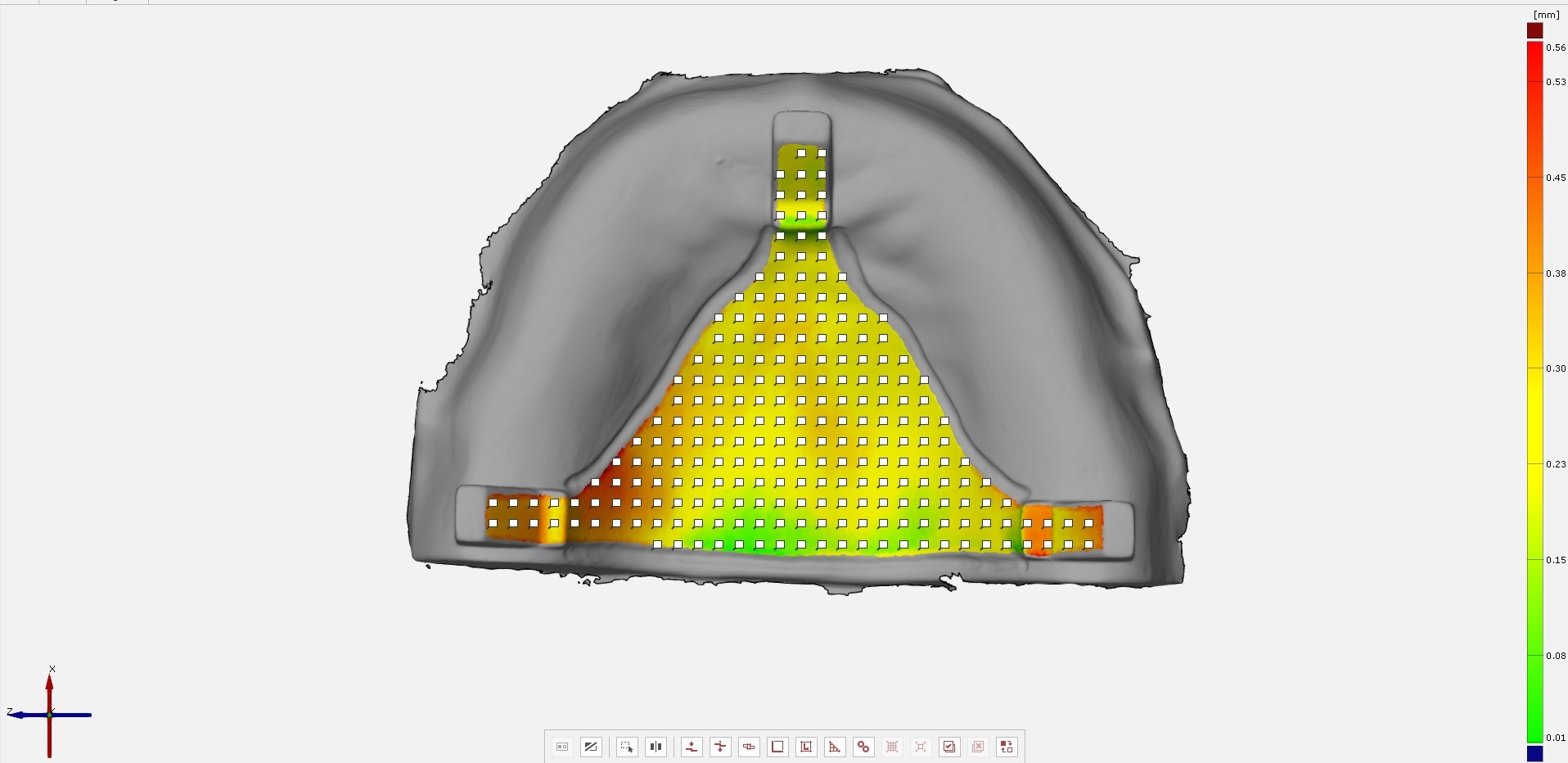
Results: Detailed qualitative colour distance-maps were created. Mean framework-to-model distances range: 230.8-327.1μm. ANOVA indicated the presence of significant (p<0.001) differences amongst these values for the proposed digital protocol. Feltz & Miller tests found no indication that a) the two protocols (digital VS weighing) and b) the two scanners (intraoral VS laboratory) differ in measurement repeatability (p=0.70).
Conclusions: The proposed digital protocol may be used supplementary to weighing in qualitative and quantitative fit analysis of RPD fabrication via various processing routes.
Methods: A single experimental prototype resin-model of an edentulous maxilla bearing three custom 3D geometric tooth-form shapes was constructed (3D-printing) and repeatedly (x10) digitised using a Trios-3 intraoral scanner (3Shape™A/S,Copenhagen,Denmark). A custom RPD framework CAD was performed on a single scan (Scan-M1) of the digitised resin-model and was then produced into a single SLM(CoCr) framework. Following sprue-removal from the cameo surface, the framework intaglio surface was repeatedly (x5) digitised using a laboratory scanner (E3,3Shape™A/S,Copenhagen,Denmark). A single framework-scan (Scan-F1) and Scan-M1 (STL-files) were imported into a free inspection software (GOM-Inspect,2018-Hotfix5,Rev.115656,GOM GmbH,Braunschweig,Germany). A custom digital protocol for model-framework fit-evaluation was then devised via virtual framework-to-model seating. The final virtual seating position was defined as the point where three non-colinear primary model-framework contacts were visually established. The mean fitting distance was calculated from 220 equidistant vertical framework-to-model measuring locations. Protocol and operator uncertainty evaluation was performed by repeated (x10) single-operator execution followed by ANOVA. As an alternative, the framework-to-model gap was repeatedly (x10) recorded by weighing (Class-1 microbalance) silicone films (Variotime extra-light-flow,Kulzer,Germany). Scanning reproducibility was also performed by digital superimposition of: a) Scan-M1 versus the remaining 9 model-scans and b) Scan-F1 versus the remaining 4 framework-scans followed by Feltz & Miller tests.
Results: Detailed qualitative colour distance-maps were created. Mean framework-to-model distances range: 230.8-327.1μm. ANOVA indicated the presence of significant (p<0.001) differences amongst these values for the proposed digital protocol. Feltz & Miller tests found no indication that a) the two protocols (digital VS weighing) and b) the two scanners (intraoral VS laboratory) differ in measurement repeatability (p=0.70).
Conclusions: The proposed digital protocol may be used supplementary to weighing in qualitative and quantitative fit analysis of RPD fabrication via various processing routes.
IMAGES
3933015_File000000.jpg
3933015_File000000.jpg