IADR Abstract Archives
Hyaluronic Acid/Cellulose Film Delivery Facilitates Oral Wound Healing
Objectives: Evidences demonstrate that hyaluronic acid (HA) promotes oral wound healing. Currently, the gel-type of HA is widely employed in therapeutic uses. However, the limitations of gel-type delivery, such as rapid degradation and low adhesiveness, may compromise pharmacological action of HA in the oral environment. The purpose of this study was to elucidate the effect of HA film with addition of carboxymethyl cellulose (CMC) on oral wound healing.
Methods: HA films with a molecular weight of 0.8 MDa and HA films with addition of 10% CMC were prepared. And the undiluted eluates from HA and HA/CMC films were prepared. The cell viability of human gingival fibroblasts (HGF) were assessed by FACS assay for 24 h. Expression of pro-inflammatory biomarkers (IL-6 and IL-8) and tissue regeneration biomarkers (FGF-2, COL1α1, and TGF-β1) was assessed by RT-PCR. Cell scratch wound assay was performed for evaluating wound healing efficacy.
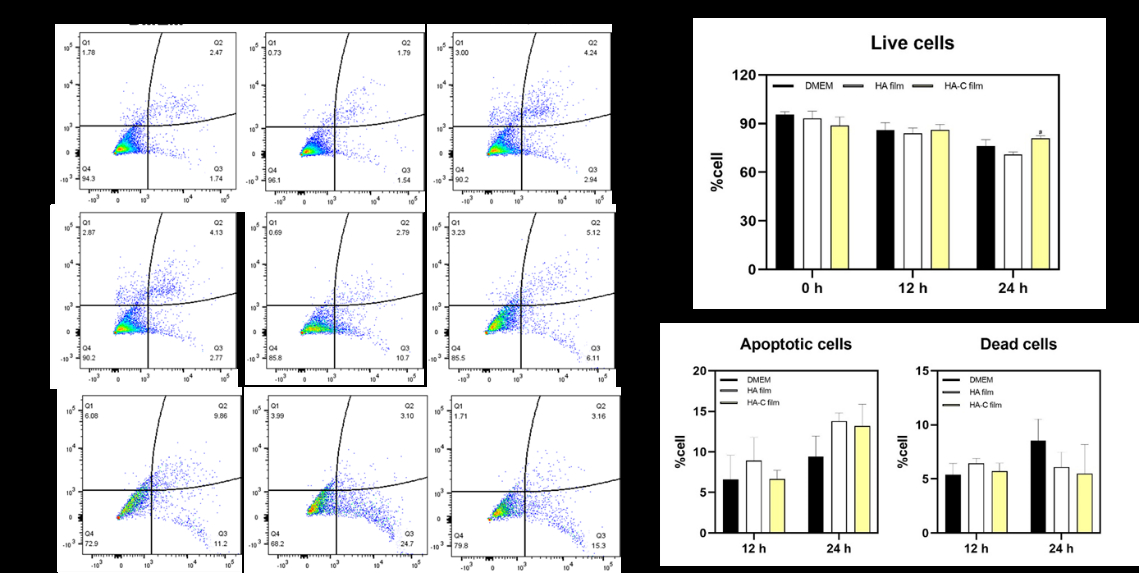
Results: FACS assay confirmed that both films did not affect the cell viabilities of HGF. Regarding pro-inflammatory biomarkers, HA/CMC film showed lower level of IL-8 expression compared to HA film (p < 0.05). Regarding tissue regeneration biomarkers, HA/CMC film showed higher level of COL1α1 expression and lower level of TGF-β1 expression compared to HA film. In cell scratch wound assay, both films showed significantly lower open wound area compared to the control (p < 0.05). However, there was no significant differences in wound healing between HA and HA/CMC films.
Conclusions: Within the limits of this study, HA/CMC film promoted oral wound healing with lower level of inflammatory responses.
Methods: HA films with a molecular weight of 0.8 MDa and HA films with addition of 10% CMC were prepared. And the undiluted eluates from HA and HA/CMC films were prepared. The cell viability of human gingival fibroblasts (HGF) were assessed by FACS assay for 24 h. Expression of pro-inflammatory biomarkers (IL-6 and IL-8) and tissue regeneration biomarkers (FGF-2, COL1α1, and TGF-β1) was assessed by RT-PCR. Cell scratch wound assay was performed for evaluating wound healing efficacy.
Results: FACS assay confirmed that both films did not affect the cell viabilities of HGF. Regarding pro-inflammatory biomarkers, HA/CMC film showed lower level of IL-8 expression compared to HA film (p < 0.05). Regarding tissue regeneration biomarkers, HA/CMC film showed higher level of COL1α1 expression and lower level of TGF-β1 expression compared to HA film. In cell scratch wound assay, both films showed significantly lower open wound area compared to the control (p < 0.05). However, there was no significant differences in wound healing between HA and HA/CMC films.
Conclusions: Within the limits of this study, HA/CMC film promoted oral wound healing with lower level of inflammatory responses.
IMAGES
3932564_File000000.jpg
3932564_File000000.jpg