IADR Abstract Archives
Effect of Different Effervescent Vitamins on the Color of Composite Materials
Objectives: The potential discoloration of composite restorative materials induced by effervescent vitamins has not been examined previously. The aim of this study is to investigate the coloring effects of three different effervescent tablets on two different composites.
Methods: Three distinct vitamin effervescent tablets and two different composites were employed in our research. The composite samples were divided into four groups of ten samples each. A clinical spectrophotometer was used for color measurements. The L*a*b* System of the International Commission on Illumination is used for the measurements.Three replicate readings were made for each sample, and mean L*, a*, and b* values were obtained. Color values (E*) were calculated.The baseline color measurements were made after immersion in distilled water, and the samples were randomly divided into 3 groups (n = 10). Composites were soaked in three different coloring solutions for 10 days. Solutions were renewed daily. The final color measurement was taken at the end of the study. The Shapiro-Wilk test was used to determine whether the ΔE2000 values fit the normal distribution, and a two-way analysis of variance was used to examine the data (ANOVA). Tukey tests were used for post-hoc comparisons. All tests were performed with SPSS 16 (IBM SPSS Statistics 22.0 (IBM Corp. 2013. IBM SPSS Statistics for Windows, Version 22.0. Armonk, USA) package program (p = 0.05).
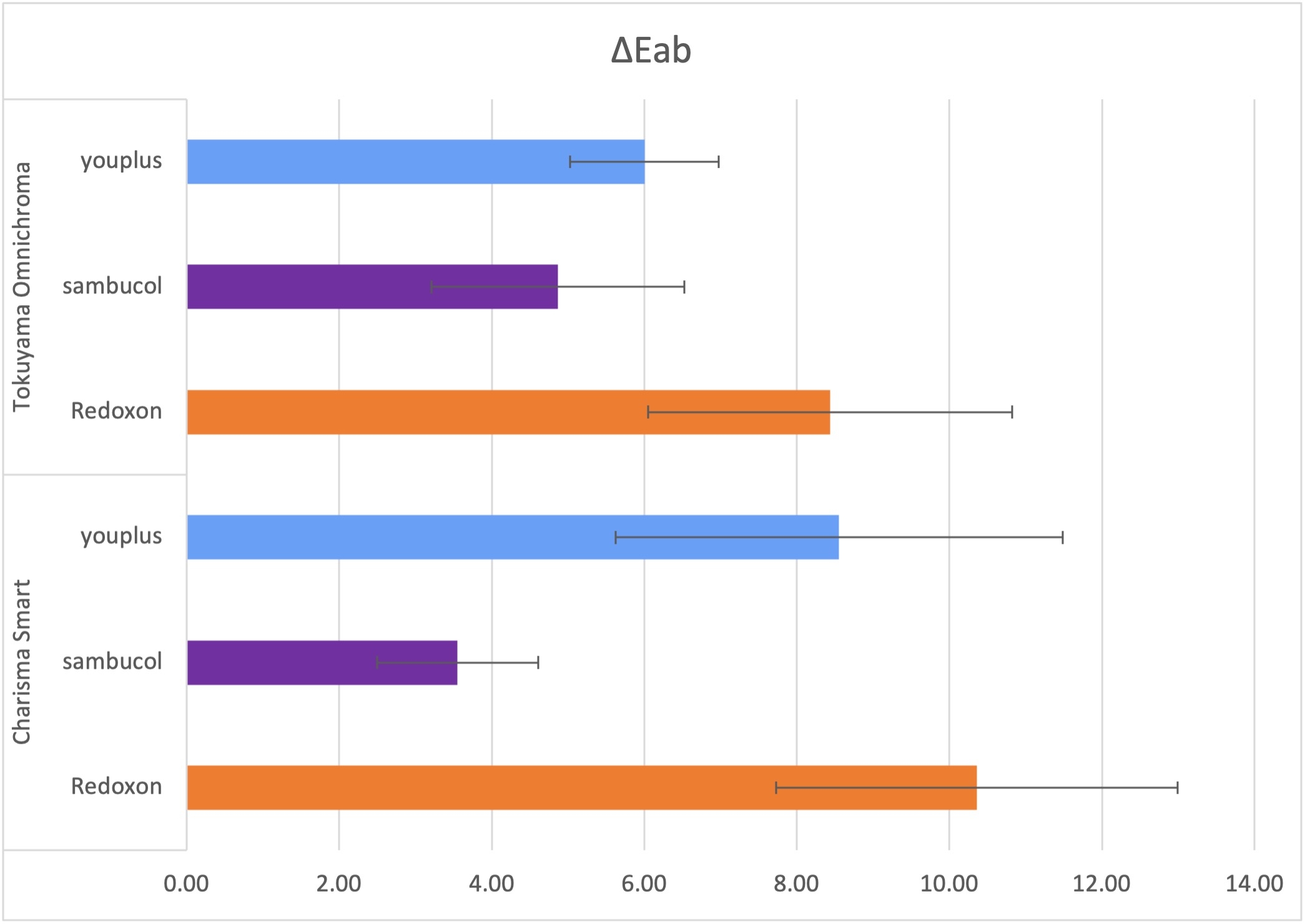
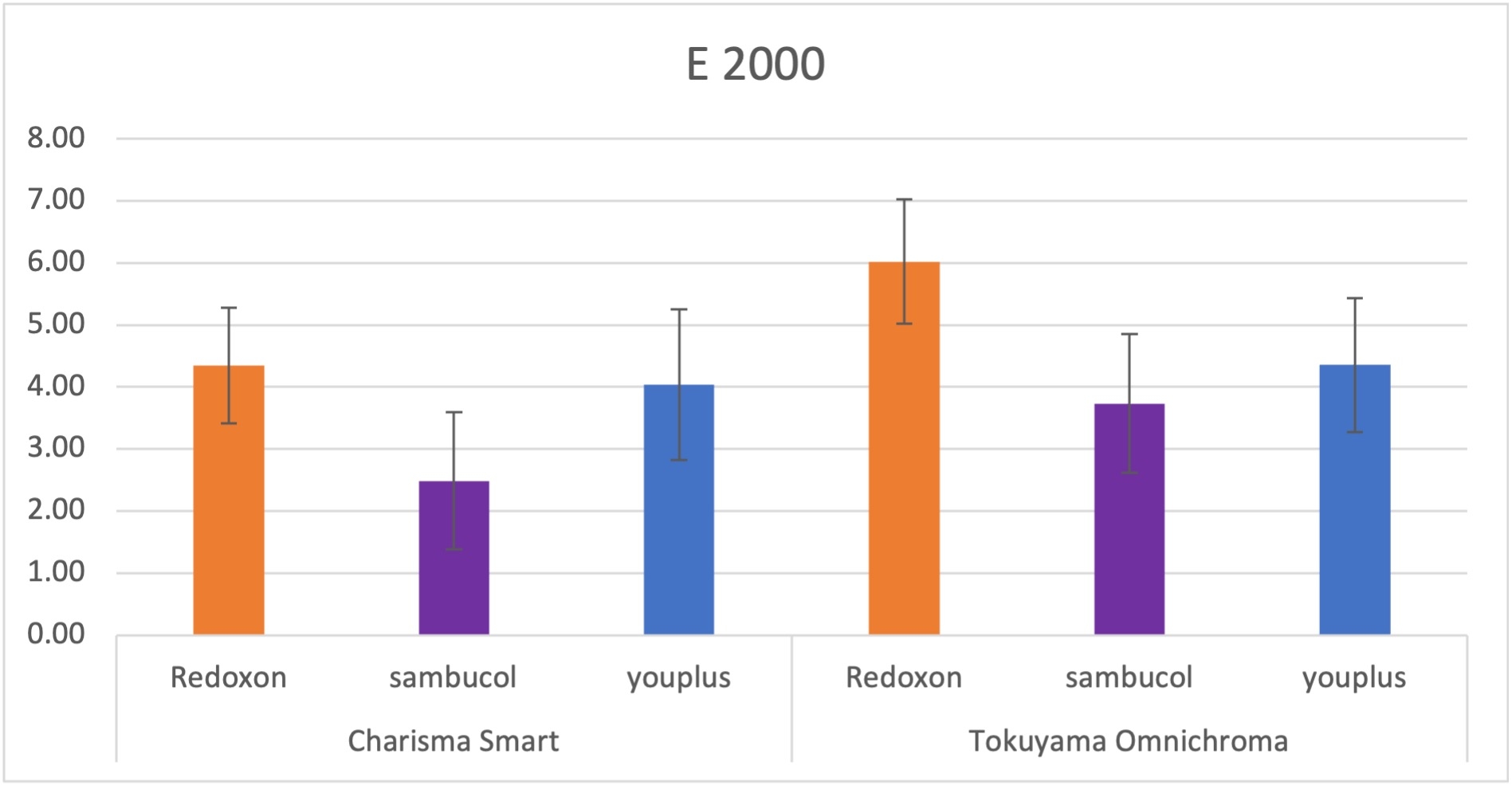
Results: All E 2000 values were above the 1.8 acceptability value. The Redoxon-Tokuyama group displayed the greatest degree of color change; ΔE2000=6.02 (±1.59). In the Charisma Sambucol group, the least color change was noticed ΔE2000= 2.48(± 0.73). Tokuyama Omnichroma samples demonstrated statistically greater overall color shifts than Charisma Smart samples (p<0.001). In terms of the vitamins, there was a statistical difference between all groups (p<0.001) (Redoxon ΔE2000= 5.15, Youplus ΔE2000=4.1, Sambucol ΔE2000= 3.1).The vitamin-composite interaction did not show a statistical significance (p= 0.146).
Conclusions: Long-term usage of effervescent vitamins may induce color changes in composite fillings. This subject requires clinical research.
Methods: Three distinct vitamin effervescent tablets and two different composites were employed in our research. The composite samples were divided into four groups of ten samples each. A clinical spectrophotometer was used for color measurements. The L*a*b* System of the International Commission on Illumination is used for the measurements.Three replicate readings were made for each sample, and mean L*, a*, and b* values were obtained. Color values (E*) were calculated.The baseline color measurements were made after immersion in distilled water, and the samples were randomly divided into 3 groups (n = 10). Composites were soaked in three different coloring solutions for 10 days. Solutions were renewed daily. The final color measurement was taken at the end of the study. The Shapiro-Wilk test was used to determine whether the ΔE2000 values fit the normal distribution, and a two-way analysis of variance was used to examine the data (ANOVA). Tukey tests were used for post-hoc comparisons. All tests were performed with SPSS 16 (IBM SPSS Statistics 22.0 (IBM Corp. 2013. IBM SPSS Statistics for Windows, Version 22.0. Armonk, USA) package program (p = 0.05).
Results: All E 2000 values were above the 1.8 acceptability value. The Redoxon-Tokuyama group displayed the greatest degree of color change; ΔE2000=6.02 (±1.59). In the Charisma Sambucol group, the least color change was noticed ΔE2000= 2.48(± 0.73). Tokuyama Omnichroma samples demonstrated statistically greater overall color shifts than Charisma Smart samples (p<0.001). In terms of the vitamins, there was a statistical difference between all groups (p<0.001) (Redoxon ΔE2000= 5.15, Youplus ΔE2000=4.1, Sambucol ΔE2000= 3.1).The vitamin-composite interaction did not show a statistical significance (p= 0.146).
Conclusions: Long-term usage of effervescent vitamins may induce color changes in composite fillings. This subject requires clinical research.
IMAGES
3899416_File000000.jpg
3899416_File000001.jpg
3899416_File000000.jpg
3899416_File000001.jpg