IADR Abstract Archives
Real-time investigation of the curing kinetics of visible light-curing resin based composites available on the European market
Objectives: Recent publications demonstrated the applicability of dielectric analysis (DEA) for real-time curing monitoring of visible light-curing resin based composites (VLC RBC) to investigate curing kinetics and characterize changes in the resin composition. The aim of this comparative study was to compare the curing behaviour of 26 different VLC RBC (tested also in two different shades) available on the European market using DEA. Furthermore, it was tested if the DEA method is suitable for quality assurance methods by detecting changes in the initial ion viscosity of the different composite types.
Methods: A DEA 231 Epsilon with Mini Idex sensors (Netzsch Gerätebau, Selb, Germany) was used to measure the ion viscosity with a frequency of 1,000 Hz at a temperature of 36°C. Every measurement was repeated 5 times (n=5). The initial ion viscosity of the VLC RBC (16 micro-, 7 nano-hybrid-, 2 bulkfill composites and 12 flowables) was measured prior to curing for 1 minute. Then the VLC RBC were cured using a Bluephase 20i in High Modus (Ivovlar Vivadent AG, Schaan, Liechtenstein) for 30s.
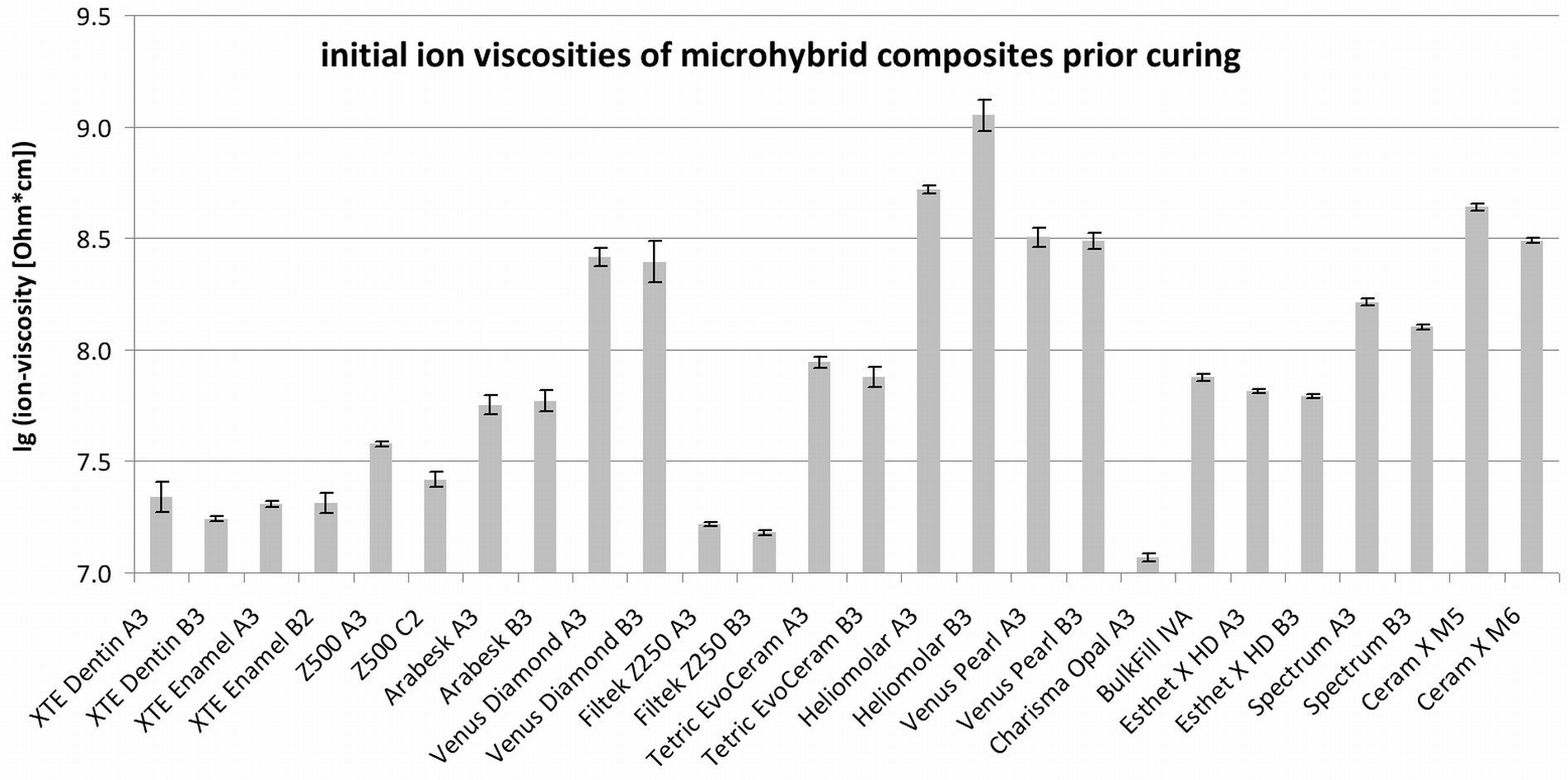
Results: The investigated VLC RBC can be clearly distinguished from each other with respect to initial ion viscosity (quality assurance application, see figure) by DEA investigation. The analysis of their curing behaviours provides significantly different kinetics parameters with respect to shade (A3 cures faster than B2, B3 or C2) and with respect to monomer composition (RBC containing Bis-EMA cure slower). Data scatter was much lower in the primary curing phase until vitrification than in the highly cured state where there is hardly any ion mobility. In this respect the DEA is a complementary method to the cure monitoring with FT-IR showing high scatter in the primary curing phase. Generally the data scatter increased with the filler content.
Conclusions: DEA is a reliable, simple and sensitive method to detect batch variations in the quality assurance of the production of VLC RBC as well as a tool for curing kinetics characterisation of VLC RBC with respect to monomer composition in VLC RBC development.
Methods: A DEA 231 Epsilon with Mini Idex sensors (Netzsch Gerätebau, Selb, Germany) was used to measure the ion viscosity with a frequency of 1,000 Hz at a temperature of 36°C. Every measurement was repeated 5 times (n=5). The initial ion viscosity of the VLC RBC (16 micro-, 7 nano-hybrid-, 2 bulkfill composites and 12 flowables) was measured prior to curing for 1 minute. Then the VLC RBC were cured using a Bluephase 20i in High Modus (Ivovlar Vivadent AG, Schaan, Liechtenstein) for 30s.
Results: The investigated VLC RBC can be clearly distinguished from each other with respect to initial ion viscosity (quality assurance application, see figure) by DEA investigation. The analysis of their curing behaviours provides significantly different kinetics parameters with respect to shade (A3 cures faster than B2, B3 or C2) and with respect to monomer composition (RBC containing Bis-EMA cure slower). Data scatter was much lower in the primary curing phase until vitrification than in the highly cured state where there is hardly any ion mobility. In this respect the DEA is a complementary method to the cure monitoring with FT-IR showing high scatter in the primary curing phase. Generally the data scatter increased with the filler content.
Conclusions: DEA is a reliable, simple and sensitive method to detect batch variations in the quality assurance of the production of VLC RBC as well as a tool for curing kinetics characterisation of VLC RBC with respect to monomer composition in VLC RBC development.
IMAGES
2254672_File000000.jpg
2254672_File000000.jpg