IADR Abstract Archives
3D Printing Alginate Hydrogels for Cleft Palate Repair
Objectives: Cleft lip & palate is the second most common birth defect found amongst new-borns, affecting approximately 1 in 1,000 live births and has implications for oral health. 3D printing has previously enabled the production of bespoke implants from patient imaging data which could be applied as an ideal solution for cleft palate. Alginate is a natural polysaccharide which is well known for its biocompatibility which has interesting viscoelastic properties that suit 3D printing. The aim of this project is therefore to assess the suitability of 3D printing sodium alginate hydrogels as a novel method to treat cleft palate.
Methods: Sodium alginate and calcium chloride were mixed separately into distilled water with a stirrer until completely dissolved. The sodium alginate and calcium solutions were then loaded into syringes and mixed rapidly to produce homogenous, partially crosslinked alginate samples. An Allevi 2 bioprinter was used to print partially crosslinked samples and the results were assessed visually. The optimal concentration was then characterised using a rheometer to assess its viscoelastic properties using a variety of rotational and oscillatory tests. Samples were then secondarily crosslinked, their compressive behaviour analysed using the rheometer and their young's moduli calculated.
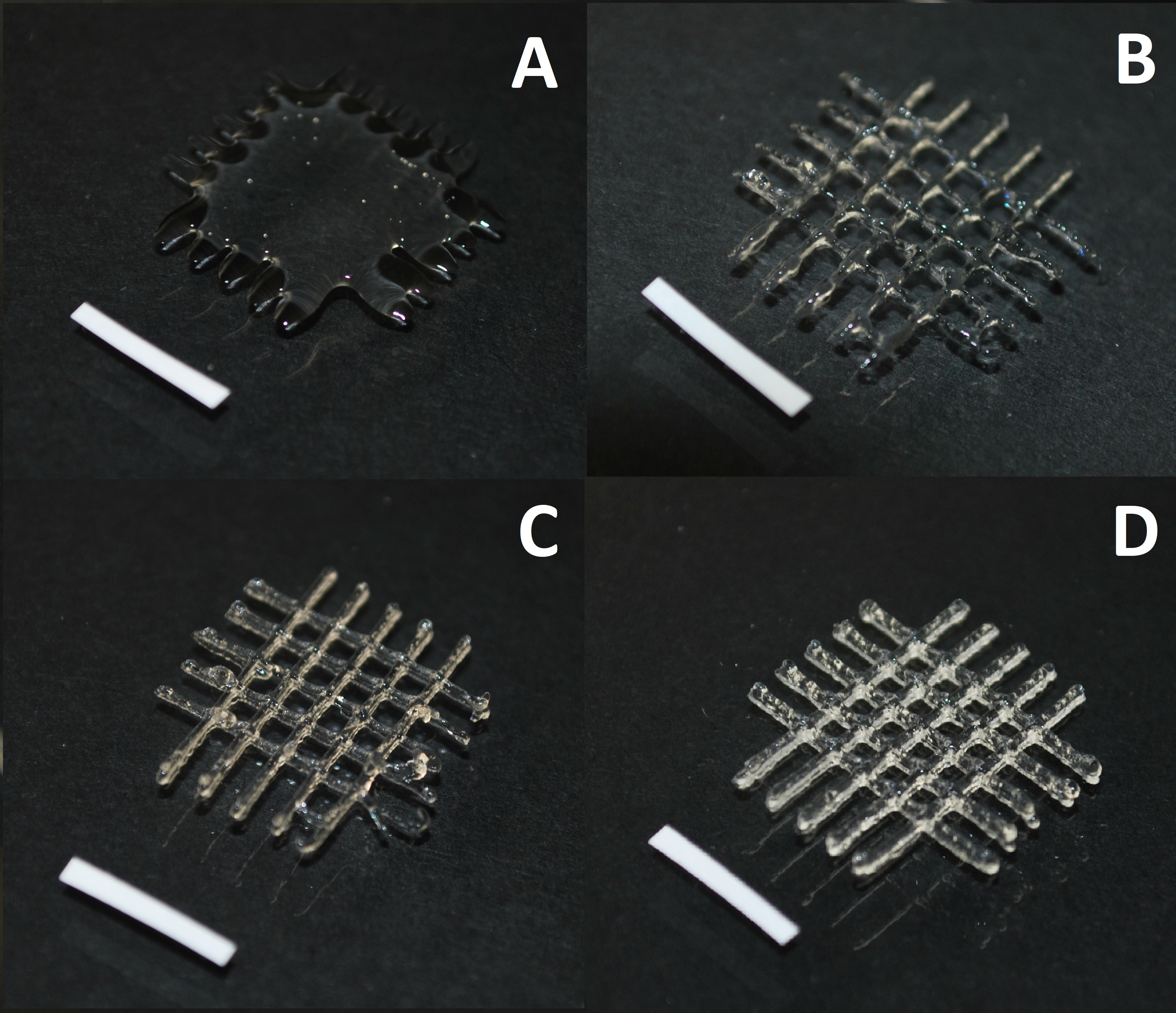
Results: Crosslinked samples were found to be inhomogeneous with large amounts of calcium however were too weak to retain their shape with low amounts of calcium. A niche existed in the centre that satisfied printability and print fidelity (Figure 1). As alginate concentration and crosslinking amount increased, viscosity increased exponentially. Partially crosslinked samples are capable of behaving viscously and elastically depending on the shear rates applied. Greater molarities of secondary crosslinker and crosslinking times produced samples with increased young's moduli.
Conclusions: Alginate-calcium hydrogels have been shown to be viable 3D printing materials which have the mechanical properties to support layer-by-layer production. Rheology results show that partially crosslinked gels are viscoelastic and thixotropic which allows ease of printing and high shape fidelity retention. Compression tests show that after secondary crosslinking, the mechanical properties of alginate are similar to that of the soft palate.
Methods: Sodium alginate and calcium chloride were mixed separately into distilled water with a stirrer until completely dissolved. The sodium alginate and calcium solutions were then loaded into syringes and mixed rapidly to produce homogenous, partially crosslinked alginate samples. An Allevi 2 bioprinter was used to print partially crosslinked samples and the results were assessed visually. The optimal concentration was then characterised using a rheometer to assess its viscoelastic properties using a variety of rotational and oscillatory tests. Samples were then secondarily crosslinked, their compressive behaviour analysed using the rheometer and their young's moduli calculated.
Results: Crosslinked samples were found to be inhomogeneous with large amounts of calcium however were too weak to retain their shape with low amounts of calcium. A niche existed in the centre that satisfied printability and print fidelity (Figure 1). As alginate concentration and crosslinking amount increased, viscosity increased exponentially. Partially crosslinked samples are capable of behaving viscously and elastically depending on the shear rates applied. Greater molarities of secondary crosslinker and crosslinking times produced samples with increased young's moduli.
Conclusions: Alginate-calcium hydrogels have been shown to be viable 3D printing materials which have the mechanical properties to support layer-by-layer production. Rheology results show that partially crosslinked gels are viscoelastic and thixotropic which allows ease of printing and high shape fidelity retention. Compression tests show that after secondary crosslinking, the mechanical properties of alginate are similar to that of the soft palate.
IMAGES
3239776_File000000.jpg
3239776_File000000.jpg