IADR Abstract Archives
A Comparative Study of the Mechanical Properties of Some Experimental Resin Composites Containing Silver nanoparticles and Bioactive Glass S45S
Objectives: To investigate the influence of replacement of silica by silver nanoparticles (AgNPs) and bioactive glasses (BAG) on mechanical properties of hybrid resin composite compared (RBC) with commercially available RBC
Methods: Resin based composites (RBC) with 70 wt. % total filler content were prepared while substituting 5–15% of the silica with bioactive glasses and silver nanoparticles. Commercially available RBC FiltekTM Z250 was used as control. RBCs were divided into five groups on the basis of composition and concentration of additives and were designated as G1, G2, G3, G4 and G5, respectively. Mean and standard deviation of three point bending flexural strength, elastic modulus, Vickers hardness and compressive strength (n=6) were determined and compared with each other. Statistical analysis was done using One Way ANOVA and post hoc Tukey test.
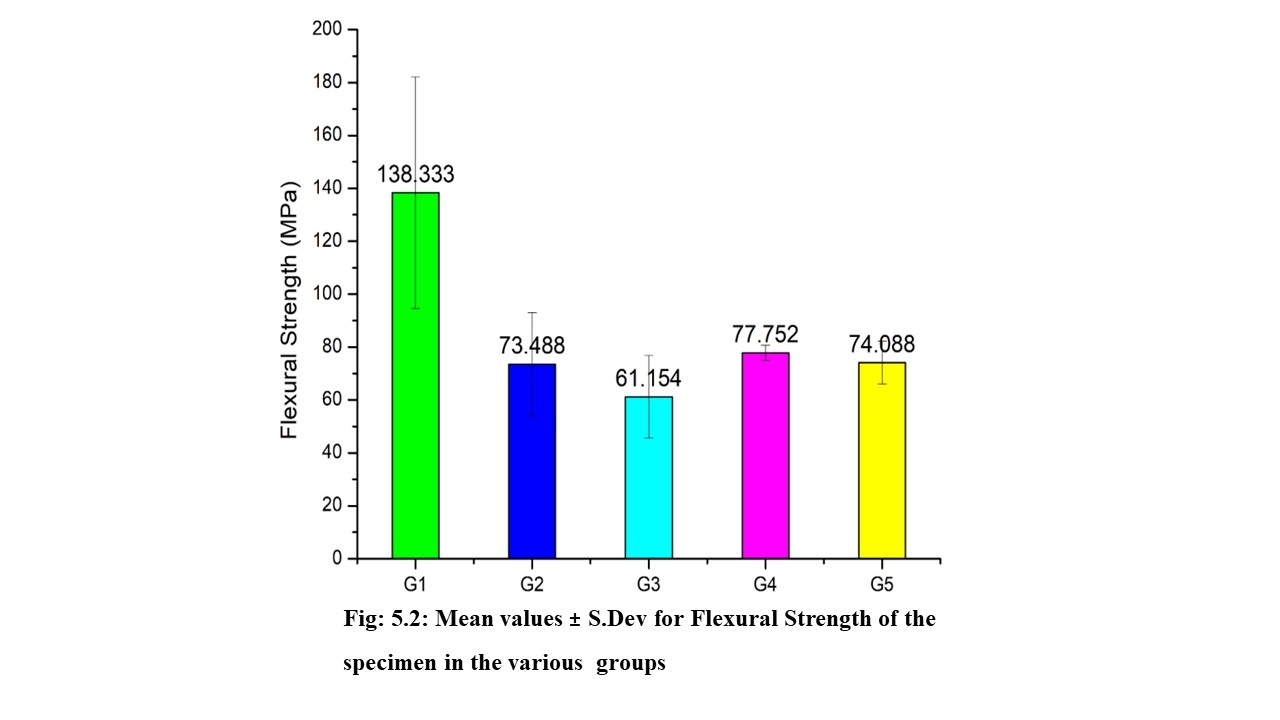
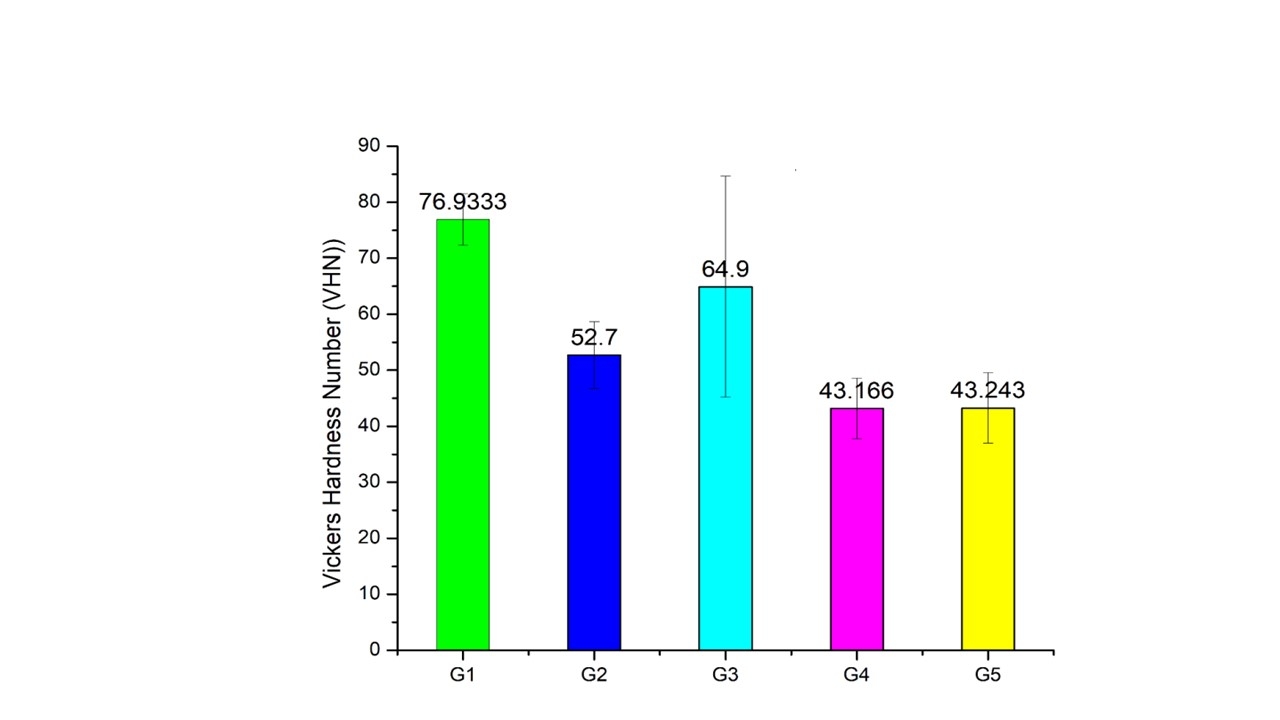
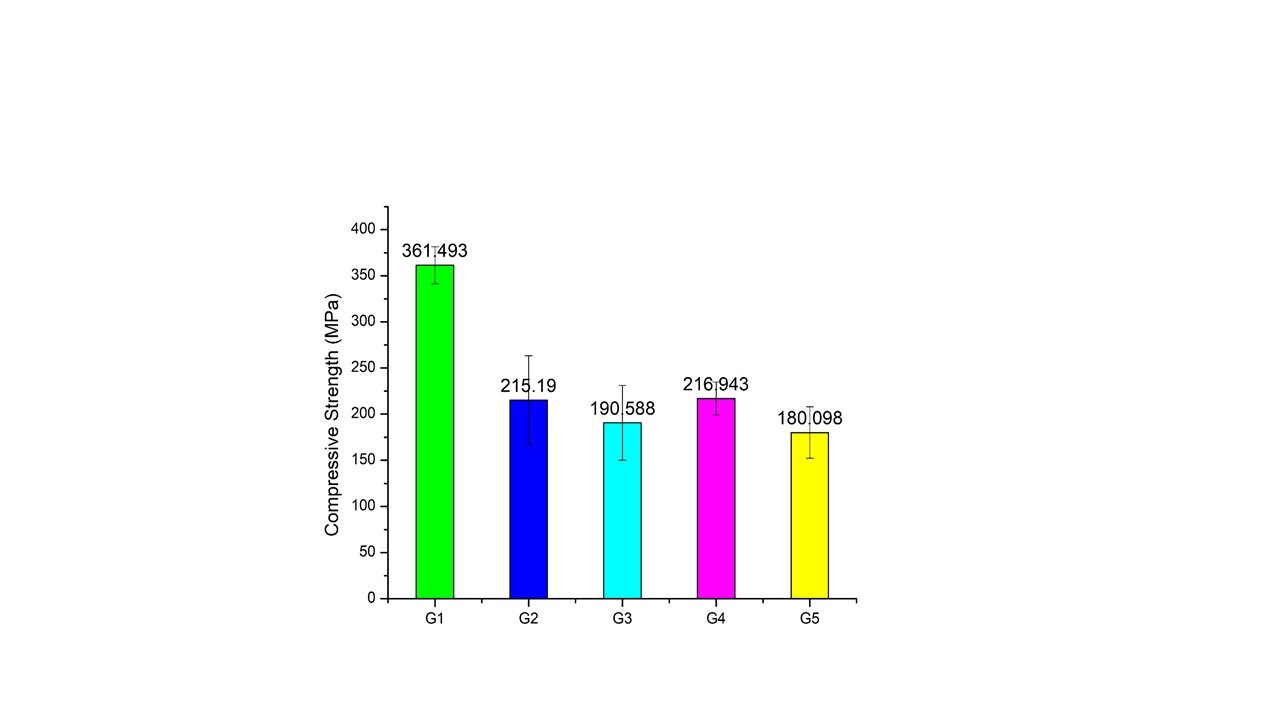
Results: Flexural strength of the RBCs was not affected significantly by the replacement of silica with BAG and AgNPs (p>0.05) except for G3 which showed decrease in strength (p>0.05). No significant difference was identified in elastic modulus values (p>0.05). Vickers hardness was decreased in G4 and G5 when compared to G3 (p>0.05). Compressive strength decreased with the addition of BAG and AgNPs in G3 and G5 when compared to G4 (p>0.05). Significant difference (p<0.05) was identified between values for all the mechanical properties tested of G1 and rest of the groups. The favorable mechanical properties of G1 compared to rest of the groups were attributed to higher filler content and microstructure.
Conclusions: Overall BAG and AgNPs containing RBCs synthesized in this study revealed suitable mechanical properties in certain parameters while showing inferior properties in certain other mechanical parameters. The mechanical properties tested for the various experimental RBC groups were significantly lower than the commercially available RBC therefore experimental RBCs might be useful in clinical situations such as restoration of class III, class V cavities in permanent dentition and restoration of deciduous teeth.
Methods: Resin based composites (RBC) with 70 wt. % total filler content were prepared while substituting 5–15% of the silica with bioactive glasses and silver nanoparticles. Commercially available RBC FiltekTM Z250 was used as control. RBCs were divided into five groups on the basis of composition and concentration of additives and were designated as G1, G2, G3, G4 and G5, respectively. Mean and standard deviation of three point bending flexural strength, elastic modulus, Vickers hardness and compressive strength (n=6) were determined and compared with each other. Statistical analysis was done using One Way ANOVA and post hoc Tukey test.
Results: Flexural strength of the RBCs was not affected significantly by the replacement of silica with BAG and AgNPs (p>0.05) except for G3 which showed decrease in strength (p>0.05). No significant difference was identified in elastic modulus values (p>0.05). Vickers hardness was decreased in G4 and G5 when compared to G3 (p>0.05). Compressive strength decreased with the addition of BAG and AgNPs in G3 and G5 when compared to G4 (p>0.05). Significant difference (p<0.05) was identified between values for all the mechanical properties tested of G1 and rest of the groups. The favorable mechanical properties of G1 compared to rest of the groups were attributed to higher filler content and microstructure.
Conclusions: Overall BAG and AgNPs containing RBCs synthesized in this study revealed suitable mechanical properties in certain parameters while showing inferior properties in certain other mechanical parameters. The mechanical properties tested for the various experimental RBC groups were significantly lower than the commercially available RBC therefore experimental RBCs might be useful in clinical situations such as restoration of class III, class V cavities in permanent dentition and restoration of deciduous teeth.
IMAGES
3222135_File000000.jpg
3222135_File000002.jpg
3222135_File000001.jpg
3222135_File000000.jpg
3222135_File000002.jpg
3222135_File000001.jpg