IADR Abstract Archives
Development of 3D artificial niches for regenerative medicine
Objectives: The use of stem cells in tissue regeneration strategies offers great possibilities but is still an emerging field and few cell-based therapies have reached the clinic. Human embryonic stem cells (hESC) show great therapeutic potential and they are an invaluable research tool for the development of models in which to study disease and tissue regeneration mechanisms. The objective of this research is to create a platform technology for the development of niche-equipped smart microfabricated constructs for controlling and directing embryonic stem cell behaviour for musculoskeletal tissue regeneration applications.
Methods: The microfabricated membranes were computer-designed and manufactured via a combination of novel 3D-printing techniques and conventional electrospinning. The additive manufacturing part of the fabrication allows the creation of intricate structures which will simulate to a certain extent the stem cell niche; on the other hand, the use of electrospinning techniques allows the creation of biodegradable membranes and the use of FDA approved polymers (polycaprolactone has been used in this work). In terms of cell culture work, a range of differentiation factors for directing hESCs towards a musculoskeletal pathway will be used, these factors including sonic hedgehog, Wnt1 and MyoD; furthermore, aspects such as cell morphology and cell differentiation will be studied using markers such as SSEA3, Oct4 and nanog.
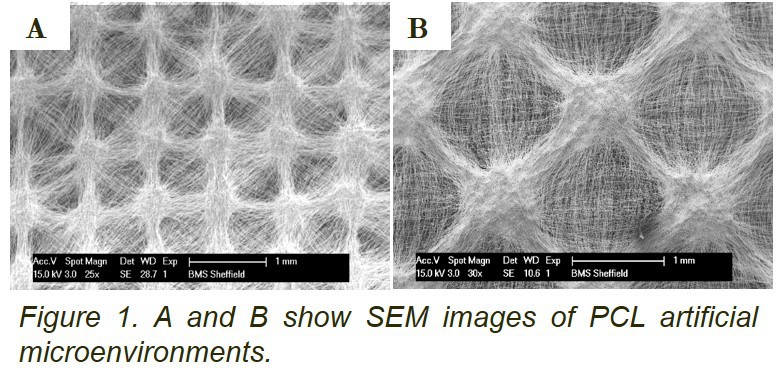
Results: We have optimised the design and fabrication of a broad range of biodegradable constructs equipped with artificial niches (Fig.1) and we have used these constructs for the study of embryonic stem cell behaviour. Initial studies have shown that the shape and morphology of the underlying 3D patterns seem to affect cell responses.
Conclusions: The development of this platform technology sets the basis for the creation of artificial 3D microfabricated membranes for controlling stem cell fate which could be ultimately translated to a biomaterial device with potential use in the regeneration of musculoskeletal tissue.
Methods: The microfabricated membranes were computer-designed and manufactured via a combination of novel 3D-printing techniques and conventional electrospinning. The additive manufacturing part of the fabrication allows the creation of intricate structures which will simulate to a certain extent the stem cell niche; on the other hand, the use of electrospinning techniques allows the creation of biodegradable membranes and the use of FDA approved polymers (polycaprolactone has been used in this work). In terms of cell culture work, a range of differentiation factors for directing hESCs towards a musculoskeletal pathway will be used, these factors including sonic hedgehog, Wnt1 and MyoD; furthermore, aspects such as cell morphology and cell differentiation will be studied using markers such as SSEA3, Oct4 and nanog.
Results: We have optimised the design and fabrication of a broad range of biodegradable constructs equipped with artificial niches (Fig.1) and we have used these constructs for the study of embryonic stem cell behaviour. Initial studies have shown that the shape and morphology of the underlying 3D patterns seem to affect cell responses.
Conclusions: The development of this platform technology sets the basis for the creation of artificial 3D microfabricated membranes for controlling stem cell fate which could be ultimately translated to a biomaterial device with potential use in the regeneration of musculoskeletal tissue.
IMAGES
2314081_File000003.jpg
2314081_File000003.jpg