IADR Abstract Archives
Comparative Evaluation of Tricalcium Silicate, Mineral Trioxide Aggregate and Calcium Hydroxide as Dental Pulp Capping Materials: An In-Vivo Study
Objectives: ● Clinical and radiographic assessment of reparative dentin formation using Tricalcium Silicate (Biodentine), MTA and Ca(OH)2 as Pulp Capping Agents.
Methods: 114 teeth with deep dentinal caries involving inner third of the dentine with no symptoms of irreversible pulpitis were treated randomly with one of the pulp capping agents and intermediate restorative material Fuji IX GIC. They were assessed in 2nd and 6th month, if successfully treated underwent final restoration with composite/amalgam.
Radiographic success criteria:
(1) The contours width and structure of the periodontal margin within normal limits;
(2) No signs of pathological tooth resorption.
Clinical success criteria :
No history of spontaneous, persistent pain or sensitivity to palpation/percussion and/or presence of clinical signs (abscess, sinus tract, and abnormal mobility).
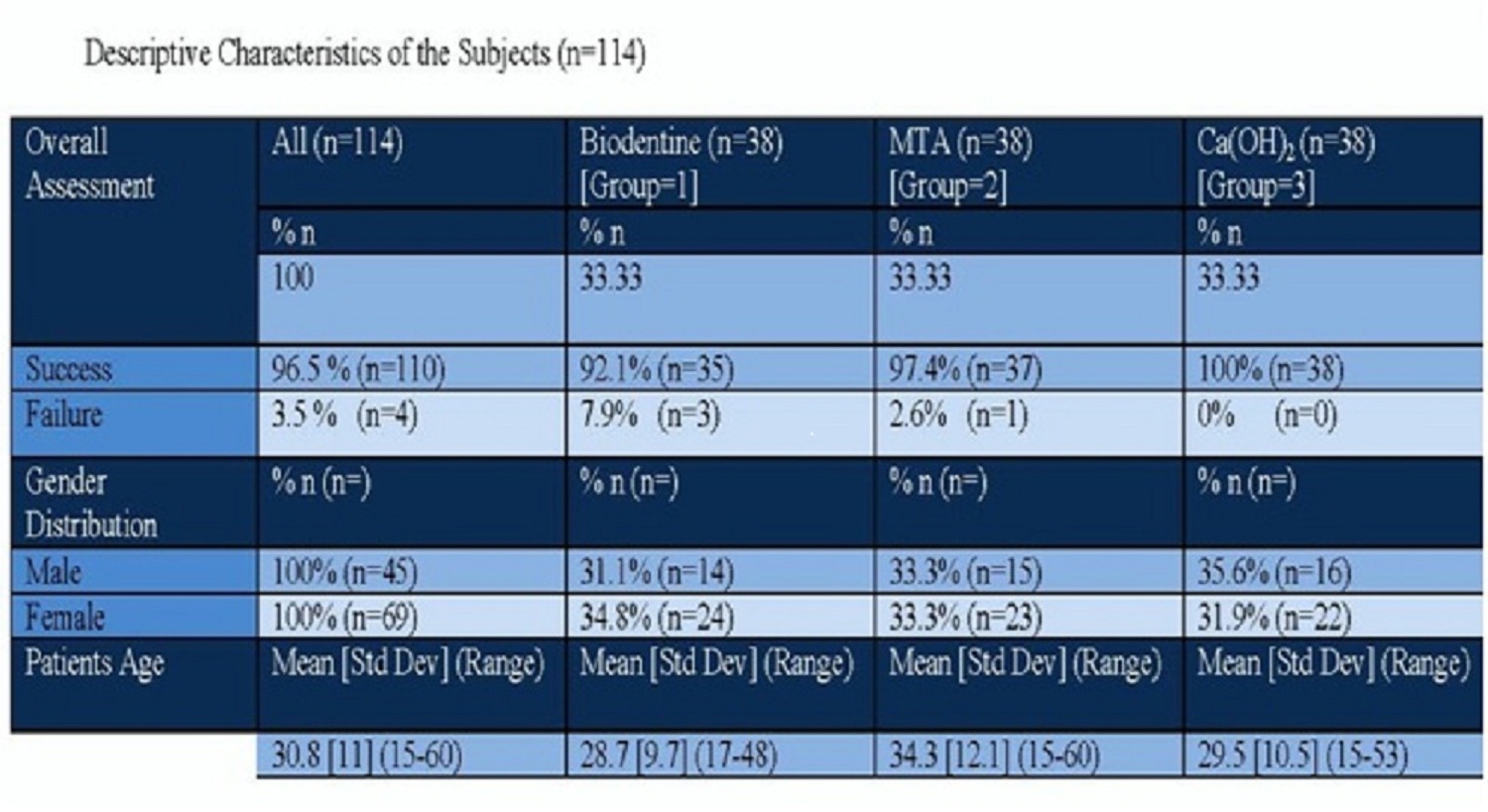
Results: Three Biodentine pulp-capped teeth and 1 MTA pulp-capped teeth were recommended for either extraction or root canal therapy; Ca(OH)2 pulp-capped teeth showed no failure. The overall analysis indicated few failure in the Biodentine group (7.9%; n=3) and MTA group (2.6%; n=1) than in the Ca(OH)2 group (0%; n=0). The failure was seen in the 1st week itself due to the poor choice of cases and an inch forward taken to treat cases with features of irreversible pulpitis. The results were unfavourable for cases with feature of irreversible pulpitis. The 4 failed cases underwent root canal treatment and were included in the analysis as failure. However, on comparison between Biodentine and MTA using Chi Square Fisher’s Exact Test (=0.615), it revealed no significant difference between the group proving either of the material can be safely used for indirect pulp-capping procedure.
Conclusions: This study conducted for up to 6 months provided confirmatory evidence for a performance with Biodentine as an indirect pulp-capping agent as compared with MTA and Ca(OH)2. However, long term study is needed in future.
Methods: 114 teeth with deep dentinal caries involving inner third of the dentine with no symptoms of irreversible pulpitis were treated randomly with one of the pulp capping agents and intermediate restorative material Fuji IX GIC. They were assessed in 2nd and 6th month, if successfully treated underwent final restoration with composite/amalgam.
Radiographic success criteria:
(1) The contours width and structure of the periodontal margin within normal limits;
(2) No signs of pathological tooth resorption.
Clinical success criteria :
No history of spontaneous, persistent pain or sensitivity to palpation/percussion and/or presence of clinical signs (abscess, sinus tract, and abnormal mobility).
Results: Three Biodentine pulp-capped teeth and 1 MTA pulp-capped teeth were recommended for either extraction or root canal therapy; Ca(OH)2 pulp-capped teeth showed no failure. The overall analysis indicated few failure in the Biodentine group (7.9%; n=3) and MTA group (2.6%; n=1) than in the Ca(OH)2 group (0%; n=0). The failure was seen in the 1st week itself due to the poor choice of cases and an inch forward taken to treat cases with features of irreversible pulpitis. The results were unfavourable for cases with feature of irreversible pulpitis. The 4 failed cases underwent root canal treatment and were included in the analysis as failure. However, on comparison between Biodentine and MTA using Chi Square Fisher’s Exact Test (=0.615), it revealed no significant difference between the group proving either of the material can be safely used for indirect pulp-capping procedure.
Conclusions: This study conducted for up to 6 months provided confirmatory evidence for a performance with Biodentine as an indirect pulp-capping agent as compared with MTA and Ca(OH)2. However, long term study is needed in future.
IMAGES
2312093_File000000.jpg
2312093_File000000.jpg