IADR Abstract Archives
Dentifrice Delivery into Dental Plaque Biofilms by High-velocity Microsprays
Objectives: Dental plaque biofilms can act as a barrier to the transport of dentifrices inside the biofilm, thus antimicrobial agents are limited in their effectiveness. We assessed the ability of high-velocity microsprays generated by the Philips Sonicare AirFloss to enhance the delivery of dentifrices into Streptococcus mutans biofilms, the primary etiologic agent of caries.
Methods: Microscope slides colonized with 3-days old S. mutans biofilm grown in a 1% mucin-containing medium supplemented with 2% sucrose were exposed to microsprays delivered at a 90° or 30° impact angle using an AirFloss containing 1-µm carboxylate-modified polystyrene fluorescent tracer beads. In addition a 0.2% Chlorexidine (CHX) solution microspray was delivered at 90° impact. For comparison, static diffusive transport (30 sec) and a simulated shaking mouth-washing (30 sec at 200 rpm) were performed. Confocal microscopy was used to determine the number and relative bead penetration depth (PD) into the biofilm. For CHX, the killing depth was found from the resultant zone of killing by live (green)/ dead (red) viability staining.
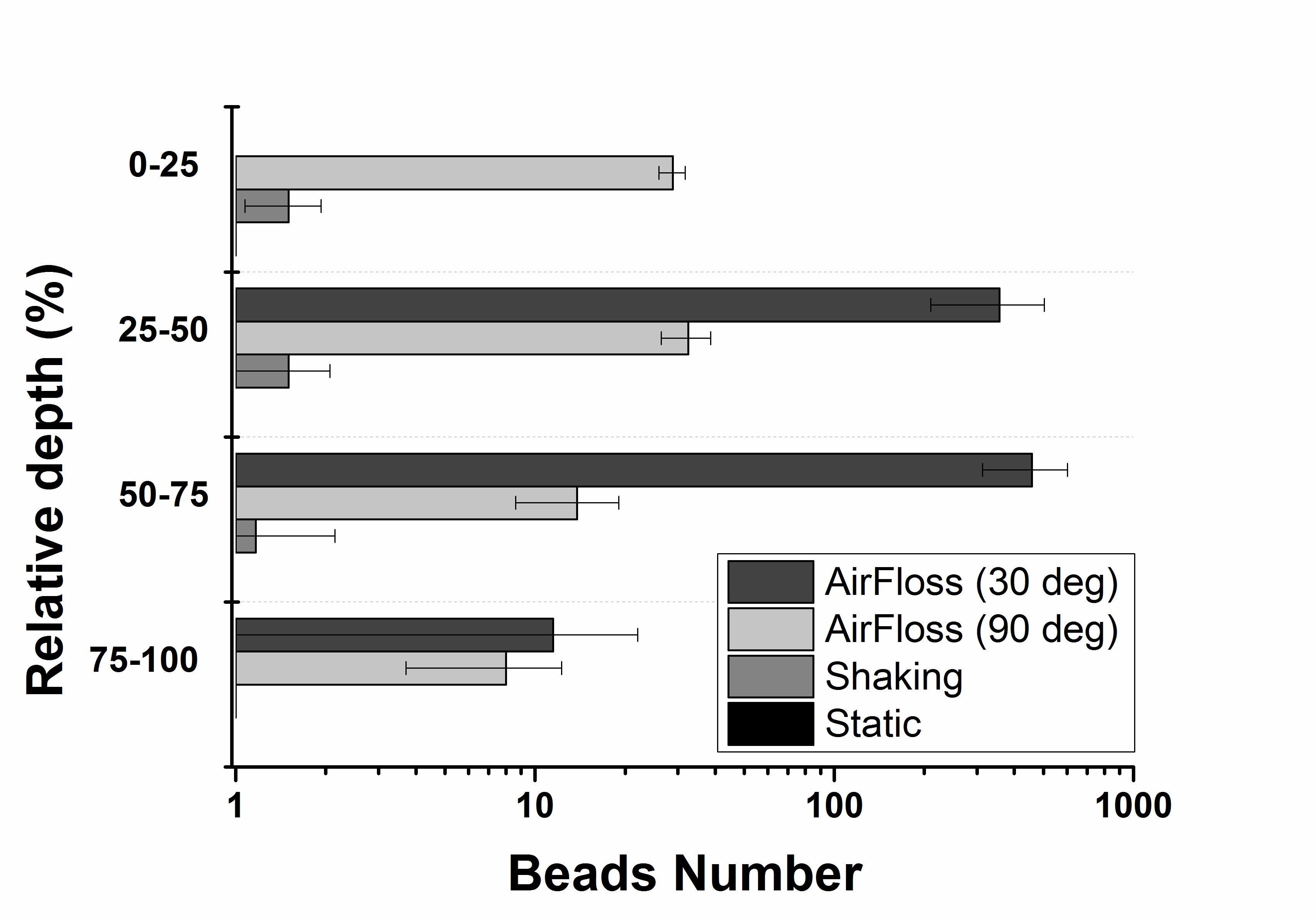
Results: The 30° impact delivered approximately 10 times more microbeads than the 90o impact (Fig. 1). However, both microsprays delivered significantly more beads deeper (P<0.05, n=2) into the biofilm than static or shaking conditions (Fig. 1). The 90° microspray impact resulted in significantly greater killing depth (28.3% of the total biofilm thickness) compared to shaking (1.2%) and static (3.4%) experiments (P<0.05, n=2).
Conclusions: These data suggest that high-velocity water microsprays can be used as an effective mechanism to deliver microparticles and dentifrices inside S. mutans dental biofilms. Further, the impact angle has potential to be optimized both for biofilm removal and dentifrice delivery inside biofilm in those protected areas where some biofilm might remain.
Methods: Microscope slides colonized with 3-days old S. mutans biofilm grown in a 1% mucin-containing medium supplemented with 2% sucrose were exposed to microsprays delivered at a 90° or 30° impact angle using an AirFloss containing 1-µm carboxylate-modified polystyrene fluorescent tracer beads. In addition a 0.2% Chlorexidine (CHX) solution microspray was delivered at 90° impact. For comparison, static diffusive transport (30 sec) and a simulated shaking mouth-washing (30 sec at 200 rpm) were performed. Confocal microscopy was used to determine the number and relative bead penetration depth (PD) into the biofilm. For CHX, the killing depth was found from the resultant zone of killing by live (green)/ dead (red) viability staining.
Results: The 30° impact delivered approximately 10 times more microbeads than the 90o impact (Fig. 1). However, both microsprays delivered significantly more beads deeper (P<0.05, n=2) into the biofilm than static or shaking conditions (Fig. 1). The 90° microspray impact resulted in significantly greater killing depth (28.3% of the total biofilm thickness) compared to shaking (1.2%) and static (3.4%) experiments (P<0.05, n=2).
Conclusions: These data suggest that high-velocity water microsprays can be used as an effective mechanism to deliver microparticles and dentifrices inside S. mutans dental biofilms. Further, the impact angle has potential to be optimized both for biofilm removal and dentifrice delivery inside biofilm in those protected areas where some biofilm might remain.
IMAGES
2307434_File000000.jpg
2307434_File000000.jpg