IADR Abstract Archives
Microfluidic Production of Stem-Cell Microcapsules for Spinal Cord Regeneration
Objectives: Cell transplantation is a promising technique to replace damaged tissue however, it is still difficult to guide cell fate during this process. Cell encapsulation permits a better control of cell responses and also protects the cells from any adverse environmental conditions post grafting. Microfluidics is a technique for generating monodisperse microcapsules in which the size of the capsules can be easily controlled.
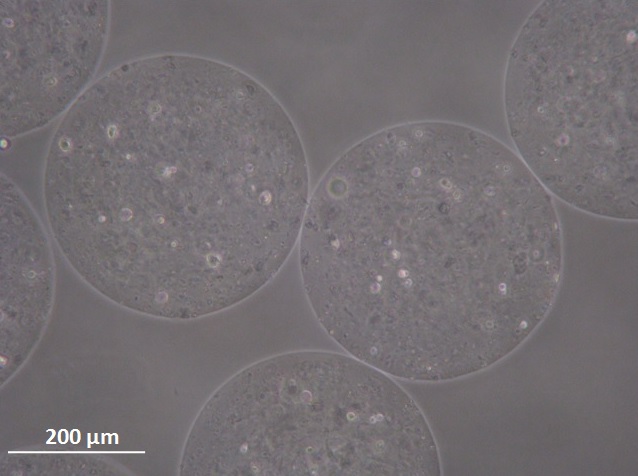
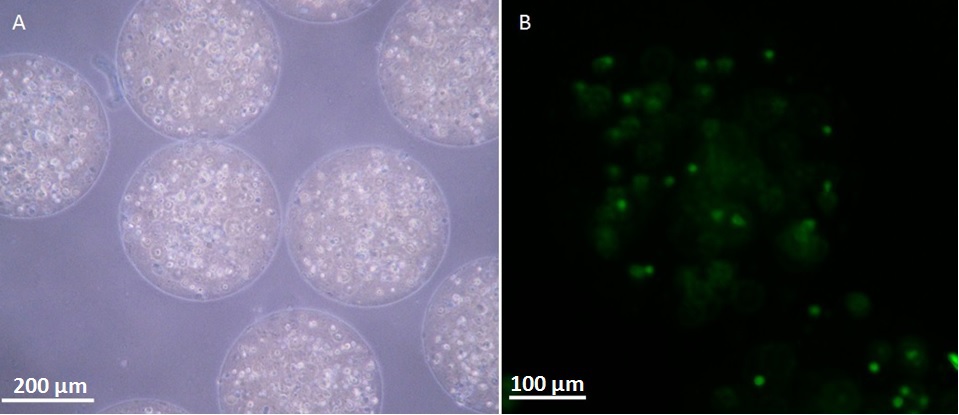
Methods: Alginate microcapsules were formed on a customised Polytetrafluoroethylene microfluidic chip. Actin-driven GFP expressing Dental Pulp Stem Cells (DPSCs) were encapsulated (figure 1,2) and incubated in a humidified 37°C, 5% CO2 environment. Medium was change every 2-3 days. Cell viability was measured using a Trypan Blue exclusion assay and a Live/Dead Viability Kit at different time points. In addition, the capacity of DPSCs to differentiate into neuronal-like cells in 2D culture was studied as a pre-requisite for 3D studies. Neural marker expression was analysed using q-PCR.
Results: Flow rate alteration produced alginate beads of between 270-380µm diameter with a consistent shape. An increase in the flow rate of the continuous phase gave rise to smaller beads with the result that the distance between droplets was increased (thereby preventing bead fusion). Experiments with varying cell numbers demonstrated that DPSCs encapsulated at a density of 1x10⁶ cells/mL (in 350µm microcapsules) produced the best cell-laden beads (increased viability, notable GFP-actin expression). With respect to DPSC differentiation, the cells demonstrated a good, but somewhat variable, tendency to differentiate into neuronal-like stem cells.
Conclusions: Alginate microcapsules containing viable stem cells were obtained using a microfluidics-based approach. Droplet diameter was controlled by flow rate modification. The next stage of this project is to investigate the potential for controlled neuronal differentiation of the stem cells within the microcapsules as part of the long-term aim to develop a stem cell-based therapy for neuronal regeneration in oral tissues.
Methods: Alginate microcapsules were formed on a customised Polytetrafluoroethylene microfluidic chip. Actin-driven GFP expressing Dental Pulp Stem Cells (DPSCs) were encapsulated (figure 1,2) and incubated in a humidified 37°C, 5% CO2 environment. Medium was change every 2-3 days. Cell viability was measured using a Trypan Blue exclusion assay and a Live/Dead Viability Kit at different time points. In addition, the capacity of DPSCs to differentiate into neuronal-like cells in 2D culture was studied as a pre-requisite for 3D studies. Neural marker expression was analysed using q-PCR.
Results: Flow rate alteration produced alginate beads of between 270-380µm diameter with a consistent shape. An increase in the flow rate of the continuous phase gave rise to smaller beads with the result that the distance between droplets was increased (thereby preventing bead fusion). Experiments with varying cell numbers demonstrated that DPSCs encapsulated at a density of 1x10⁶ cells/mL (in 350µm microcapsules) produced the best cell-laden beads (increased viability, notable GFP-actin expression). With respect to DPSC differentiation, the cells demonstrated a good, but somewhat variable, tendency to differentiate into neuronal-like stem cells.
Conclusions: Alginate microcapsules containing viable stem cells were obtained using a microfluidics-based approach. Droplet diameter was controlled by flow rate modification. The next stage of this project is to investigate the potential for controlled neuronal differentiation of the stem cells within the microcapsules as part of the long-term aim to develop a stem cell-based therapy for neuronal regeneration in oral tissues.
IMAGES
2304968_File000000.jpg
2304968_File000001.jpg
2304968_File000000.jpg
2304968_File000001.jpg