IADR Abstract Archives
Optical Assessment of Cortical Bone for Photobiomodulation and Photodynamic Therapies
Objectives: Photobiomodulation (PBM) and Photodynamic Therapy (PDT) utilize red and near-infrared wavelengths (600-1,000nm). PBM is utilized to improve soft tissue wound healing, reduce inflammation, and provide analgesia, while PDT activates photosensitizing agents for non-ionizing cancer treatment. Current light dosing protocols rely on defined human tissue optical properties such as absorption coefficient and reduced scattering coefficients. These properties fail to account for variability across boundaries of bone tissue at different regions of the head and neck. This research seeks to develop a pre-clinical modeling system to guide clinical dosing and optimize irradiation parameters for bone tissue, thereby ensuring uniform light delivery and predictable treatment outcomes in light-based therapies.
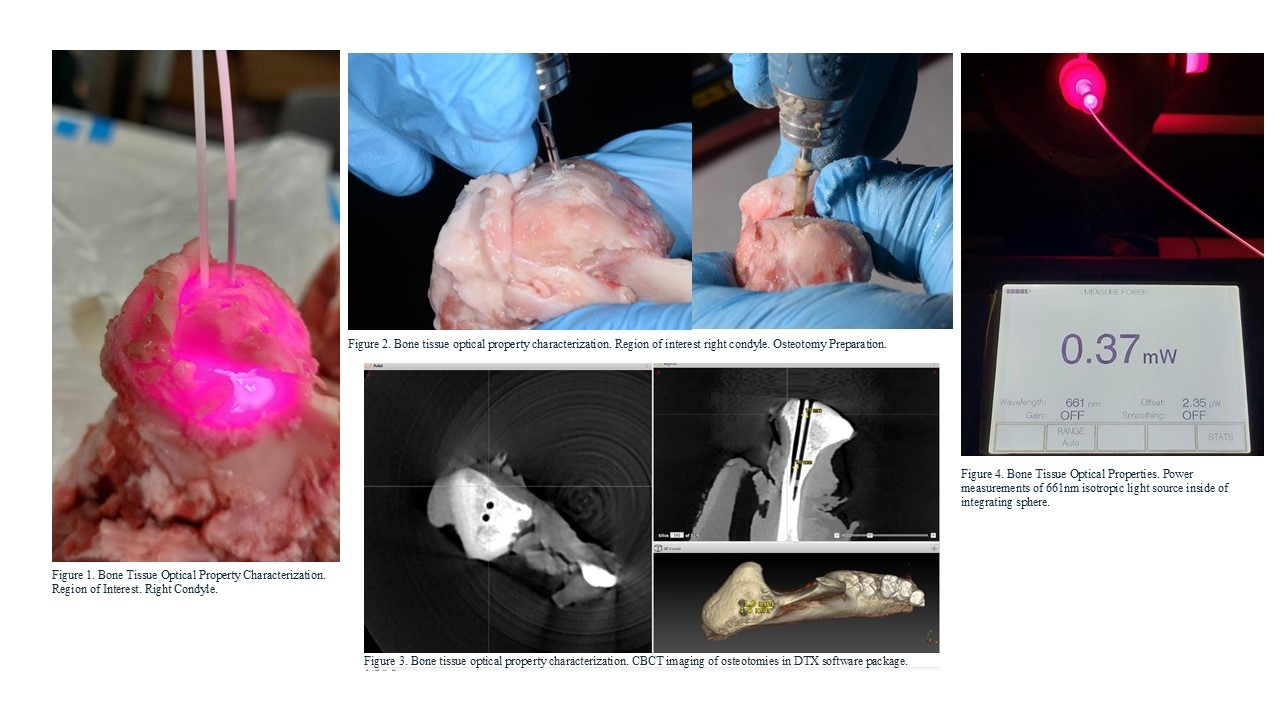
Methods: Mandibles from five Yorkshire pigs were studied to investigate the optical properties of bone tissue. Using two fixed parallel catheters with an isotropic detector and a 661 nm light source, data were collected and analyzed with algorithms in MATLAB, yielding absorption and reduced scattering measurements. The histogram was standardized to a "fit range" of -0.1 to 0.9. Data distribution was assessed using the Kolmogorov-Smirnov and Shapiro-Wilk tests in IBM SPSS Statistics.
Results: Over 800 measurements were acquired between the detector and the light source for each model, resulting in a detailed dataset that includes sixty absorption measurements and sixty reduced scattering measurements. The properties were analyzed using the Kolmogorov-Smirnov and Shapiro-Wilk tests, which confirmed significant differences in tissue properties. Both the K-S and S-W tests reported significant values for absorption and scattering, particularly for specimens 2, 3, and 5.
Conclusions: A novel approach was developed to assess tissue optical properties at wavelengths utilized in PBM/PDT, validated through statistical analysis across five specimens. This methodology can advance future research on optical properties in the head and neck areas, improving the efficacy and safety of PBM/PDT applications in clinical settings.
Methods: Mandibles from five Yorkshire pigs were studied to investigate the optical properties of bone tissue. Using two fixed parallel catheters with an isotropic detector and a 661 nm light source, data were collected and analyzed with algorithms in MATLAB, yielding absorption and reduced scattering measurements. The histogram was standardized to a "fit range" of -0.1 to 0.9. Data distribution was assessed using the Kolmogorov-Smirnov and Shapiro-Wilk tests in IBM SPSS Statistics.
Results: Over 800 measurements were acquired between the detector and the light source for each model, resulting in a detailed dataset that includes sixty absorption measurements and sixty reduced scattering measurements. The properties were analyzed using the Kolmogorov-Smirnov and Shapiro-Wilk tests, which confirmed significant differences in tissue properties. Both the K-S and S-W tests reported significant values for absorption and scattering, particularly for specimens 2, 3, and 5.
Conclusions: A novel approach was developed to assess tissue optical properties at wavelengths utilized in PBM/PDT, validated through statistical analysis across five specimens. This methodology can advance future research on optical properties in the head and neck areas, improving the efficacy and safety of PBM/PDT applications in clinical settings.
IMAGES
4216166_File000000.jpg
4216166_File000000.jpg