IADR Abstract Archives
U.S. Geographic Opioid Prescribing Practice Following Toothache
Objectives: It has been suggested that prescription opioid analgesics for dental-related pain, particularly for conditions such as toothache, have contributed to the ongoing opioid epidemic in the U.S. This study explored differences in opioid prescribing following toothache diagnoses between: 1) state’s compared to the U.S. national average and 2) urban and rural areas.
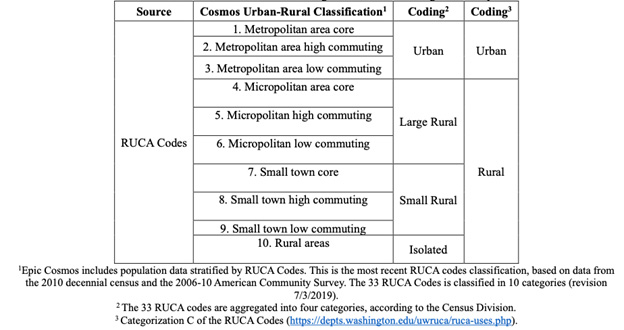
Methods: Epic Cosmos was searched for those with opioid prescriptions within 2 days of a toothache diagnoses between August 2020 and July 2024 across 50 U.S. states. Prescriptions were categorized based on the Rural-Urban Commuting Area (RUCA) codes, which were further grouped into two broad categories of rural vs. urban areas (Figure 1). State prevalence of opioid prescription after toothache diagnoses was assessed using prevalence ratios (PR) and 95% confidence intervales (CI) relative to the general U.S. trend for the corresponding timeframe. PR>1 and PR<1 identified overrepresentation and underrepresentation, respectively, of that state compared to national average.
Results: 49,190 opioid prescriptions were issued for 1,382,711 toothache diagnoses. Toothache-related opioid prescribing was overrepresented in 15 states relative to the national average, with the highest being Virginia (PR=2.31, 95%CI 2.24, 2.39), Georgia (PR=1.51, 95%CI 1.44, 1.57), and Maryland (PR=1.37, 95%CI 1.38, 1.56). Opioid prescribing following toothache diagnoses relative to the national average was underrepresented among 27 states, with South Dakota (PR=0.20, 95%CI 0.12, 0.34), Hawaii (PR=0.35, 95%CI 0.26, 0.39) and California (PR=.038, 95%CI 0.36, 0.40) being the lowest.
Overall, urban areas were responsible for most opioid prescriptions (88.8%) and were overrepresented relative to rural areas (PR=1.47, 95%CI 1.46, 1.49) compared to rural areas (11.2%). These trends remained consistent throughout the selected timeframe .
Conclusions: Opioid prescribing after toothache diagnoses in the U.S. was differentially distributed by state and rurality. Context-specific analyses of possible contributing factors are needed to guide future interventions.
Methods: Epic Cosmos was searched for those with opioid prescriptions within 2 days of a toothache diagnoses between August 2020 and July 2024 across 50 U.S. states. Prescriptions were categorized based on the Rural-Urban Commuting Area (RUCA) codes, which were further grouped into two broad categories of rural vs. urban areas (Figure 1). State prevalence of opioid prescription after toothache diagnoses was assessed using prevalence ratios (PR) and 95% confidence intervales (CI) relative to the general U.S. trend for the corresponding timeframe. PR>1 and PR<1 identified overrepresentation and underrepresentation, respectively, of that state compared to national average.
Results: 49,190 opioid prescriptions were issued for 1,382,711 toothache diagnoses. Toothache-related opioid prescribing was overrepresented in 15 states relative to the national average, with the highest being Virginia (PR=2.31, 95%CI 2.24, 2.39), Georgia (PR=1.51, 95%CI 1.44, 1.57), and Maryland (PR=1.37, 95%CI 1.38, 1.56). Opioid prescribing following toothache diagnoses relative to the national average was underrepresented among 27 states, with South Dakota (PR=0.20, 95%CI 0.12, 0.34), Hawaii (PR=0.35, 95%CI 0.26, 0.39) and California (PR=.038, 95%CI 0.36, 0.40) being the lowest.
Overall, urban areas were responsible for most opioid prescriptions (88.8%) and were overrepresented relative to rural areas (PR=1.47, 95%CI 1.46, 1.49) compared to rural areas (11.2%). These trends remained consistent throughout the selected timeframe .
Conclusions: Opioid prescribing after toothache diagnoses in the U.S. was differentially distributed by state and rurality. Context-specific analyses of possible contributing factors are needed to guide future interventions.
IMAGES
4215150_File000000.jpg
4215150_File000000.jpg