IADR Abstract Archives
Dental Composite Photopolymerization Using a Polywave Curing Light Incorporating Near-Infrared Energy
Objectives: The objective of this presentation is to evaluate the effectiveness of a new polywave curing light (PinkWave) incorporating near-infrared (NIR) energy at curing dental composite.
Methods: Nine composite samples (4 x 3mm; diameter x height; Filtek Supreme, 3M St. Paul, MN) were cured for 20 seconds using three different curing lights, PinkWave (Vista Apex, Racine, WI), Valo Grand (Ultradent, South Jordan, UT), and SmartLite (Dentsply, Charlotte, NC). The top of each puck was marked using a Sharpie to ensure orientation and samples were kept blinded in labeled bags. Microhardness of the puck was obtained using an HMV-G Micro Hardness Tester (Shimadzu, Japan). Cured puck degree of conversion (DoC) was measured by micro-attenuated total reflectance Fourier transform infrared spectroscopy (micro-ATR FTIR) using a Nicolet iS5 Spectrometer (ThermoFisher Scientific, MA). Statistical analysis of results was undertaken using a Student’s t-test with a confidence interval of 95%.
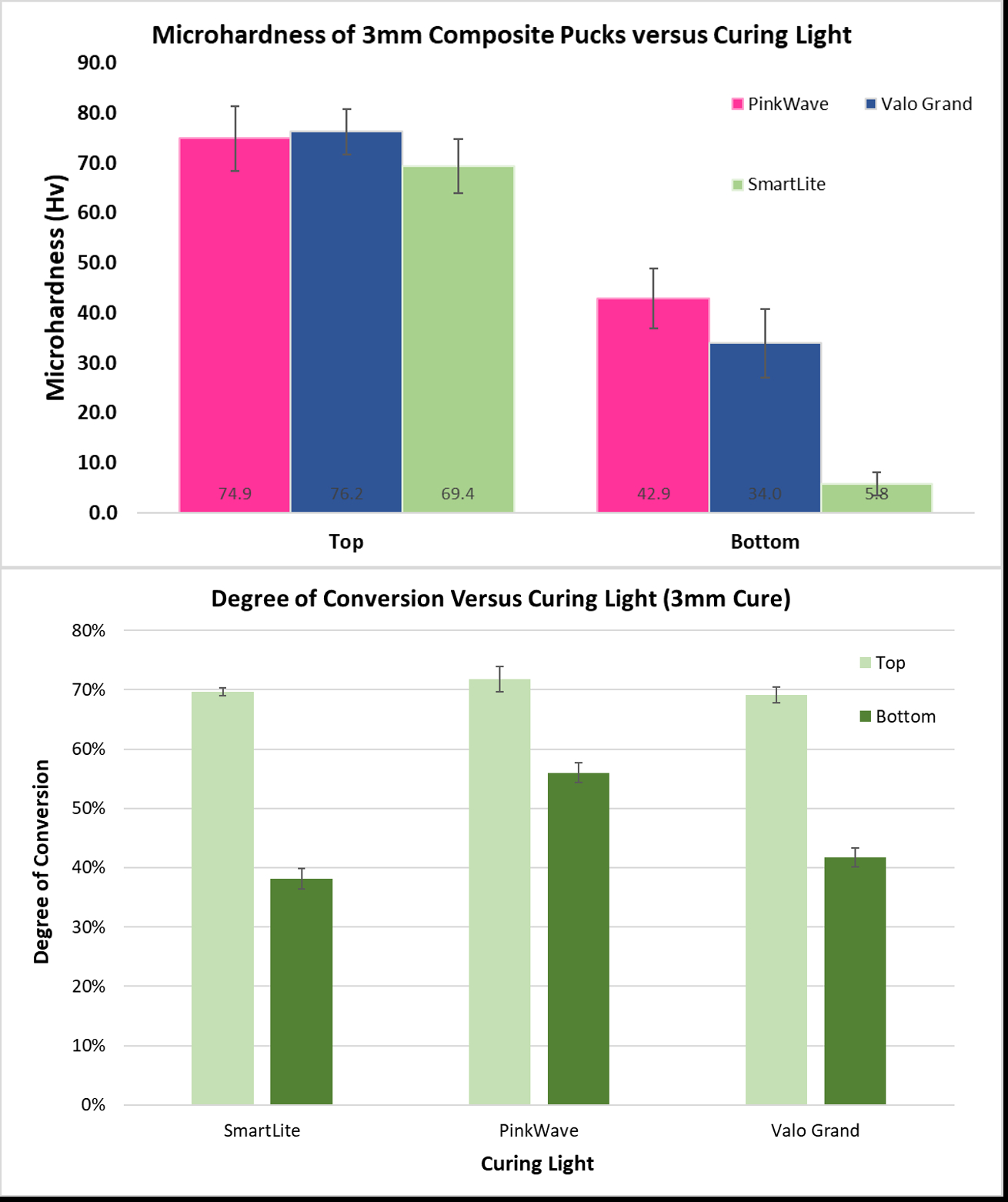
Results: Figure 1 presents microhardness and DoC results. Valo Grand produced statistically significantly harder results on the top of the puck compared to SmartLite (p=0.01), with no other significant intergroup differences (p>0.06). PinkWave yielded statistically significantly harder results on the bottom compared to SmartLite (p=5e-11) and Valo Grand (p=0.01), while Valo Grand outperformed SmartLite on the bottom (p=1.4e-8). DoC results followed the microhardness trend, but no significant differences were found between groups on the top (p>0.41) or between Valo Grand and SmartLite on the bottom (p=0.56).
Conclusions: Within the limitations of this study, PinkWave resulted in greater microhardness and degree of conversion on the bottom side of a cured 3mm puck. This is anticipated to be due to the incorporation of NIR energy that elevates the temperature of the composite during the polymerization process; however, further testing is warranted to identify the exact mechanics behind the results.
Methods: Nine composite samples (4 x 3mm; diameter x height; Filtek Supreme, 3M St. Paul, MN) were cured for 20 seconds using three different curing lights, PinkWave (Vista Apex, Racine, WI), Valo Grand (Ultradent, South Jordan, UT), and SmartLite (Dentsply, Charlotte, NC). The top of each puck was marked using a Sharpie to ensure orientation and samples were kept blinded in labeled bags. Microhardness of the puck was obtained using an HMV-G Micro Hardness Tester (Shimadzu, Japan). Cured puck degree of conversion (DoC) was measured by micro-attenuated total reflectance Fourier transform infrared spectroscopy (micro-ATR FTIR) using a Nicolet iS5 Spectrometer (ThermoFisher Scientific, MA). Statistical analysis of results was undertaken using a Student’s t-test with a confidence interval of 95%.
Results: Figure 1 presents microhardness and DoC results. Valo Grand produced statistically significantly harder results on the top of the puck compared to SmartLite (p=0.01), with no other significant intergroup differences (p>0.06). PinkWave yielded statistically significantly harder results on the bottom compared to SmartLite (p=5e-11) and Valo Grand (p=0.01), while Valo Grand outperformed SmartLite on the bottom (p=1.4e-8). DoC results followed the microhardness trend, but no significant differences were found between groups on the top (p>0.41) or between Valo Grand and SmartLite on the bottom (p=0.56).
Conclusions: Within the limitations of this study, PinkWave resulted in greater microhardness and degree of conversion on the bottom side of a cured 3mm puck. This is anticipated to be due to the incorporation of NIR energy that elevates the temperature of the composite during the polymerization process; however, further testing is warranted to identify the exact mechanics behind the results.
IMAGES
4213481_File000000.jpg
4213481_File000000.jpg