IADR Abstract Archives
Fracture Resistance of Zirconia Mandibular Molar Crowns With Different Endodontic Access Designs
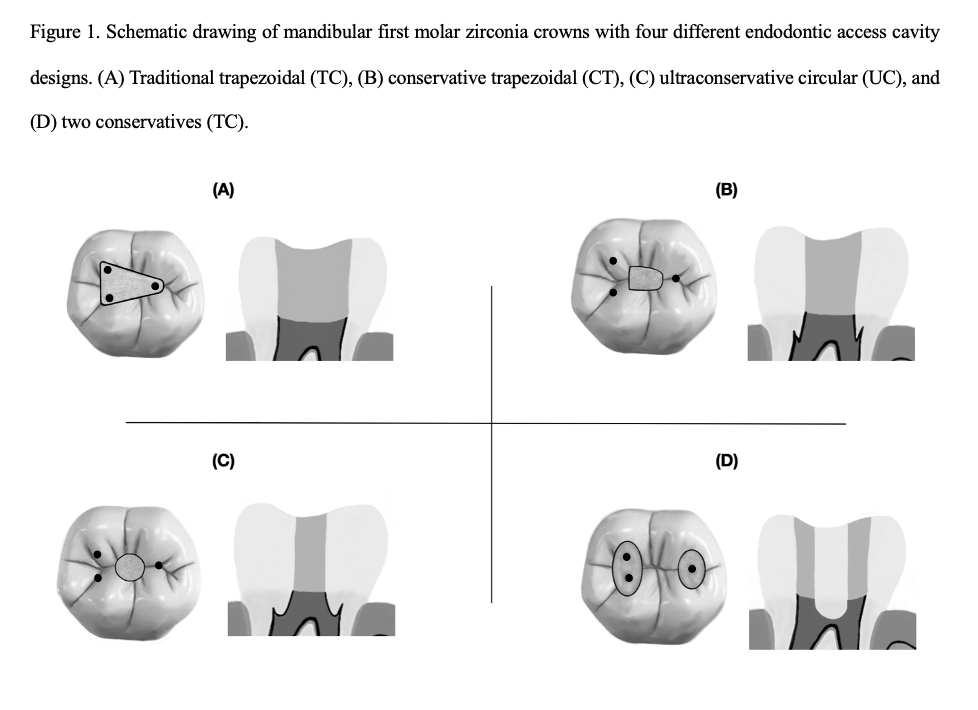
Objectives: This in vitro study aimed to evaluate and compare the fracture resistance of zirconia mandibular molar crowns with the traditional trapezoidal shaped access and three novel conservative access. The designs tested were the traditional trapezoidal (TT), conservative trapezoidal (CT), ultraconservative circular (UC), and two conservative single accesses (TC).
Methods: A mandibular right first molar typodont tooth was prepared for full coverage zirconia crown. The preparation was scanned and a total of 56 monolithic zirconia crowns were milled. A printed resin dies was printed for each restoration. Crowns were cemented using to the 3D printed testing dies with dual curing resin cement. The specimens were artificially aged with 10,000 thermal cycles between 5 and 55 C with a dwell time of 30 seconds and were loaded to failure using a universal testing machine. Furthermore, scanning electron microscope images were taken to evaluate fracture patterns of the specimens. The fracture load was analyzed using the Shapiro-Wilks normality test, followed by a one-way ANOVA with a post hoc Tukey test.
Results: The fracture resistance of mandibular molar zirconia crowns significantly varied according to the endodontic access cavity design. The highest resistance was displayed with crowns with ultraconservative circular access (2722±113.2 N, p<0.001), followed by the conservative trapezoidal (2469±126.1 N) and the traditional trapezoidal access (1915 ±71.2 N). The lowest value was for the two conservative single access (1064+129.6 N).
Conclusions: All endodontic access designs for mandibular molar zirconia crowns appear to resist the average occlusal forces. Crowns with ultraconservative circular access appears to offer the highest fracture resistance among different endodontic access designs. Two single conservative single access in the same crowns significantly diminished the crown’s fracture resistance.
Methods: A mandibular right first molar typodont tooth was prepared for full coverage zirconia crown. The preparation was scanned and a total of 56 monolithic zirconia crowns were milled. A printed resin dies was printed for each restoration. Crowns were cemented using to the 3D printed testing dies with dual curing resin cement. The specimens were artificially aged with 10,000 thermal cycles between 5 and 55 C with a dwell time of 30 seconds and were loaded to failure using a universal testing machine. Furthermore, scanning electron microscope images were taken to evaluate fracture patterns of the specimens. The fracture load was analyzed using the Shapiro-Wilks normality test, followed by a one-way ANOVA with a post hoc Tukey test.
Results: The fracture resistance of mandibular molar zirconia crowns significantly varied according to the endodontic access cavity design. The highest resistance was displayed with crowns with ultraconservative circular access (2722±113.2 N, p<0.001), followed by the conservative trapezoidal (2469±126.1 N) and the traditional trapezoidal access (1915 ±71.2 N). The lowest value was for the two conservative single access (1064+129.6 N).
Conclusions: All endodontic access designs for mandibular molar zirconia crowns appear to resist the average occlusal forces. Crowns with ultraconservative circular access appears to offer the highest fracture resistance among different endodontic access designs. Two single conservative single access in the same crowns significantly diminished the crown’s fracture resistance.
IMAGES
4211482_File000000.jpg
4211482_File000000.jpg