IADR Abstract Archives
Autocatalytic vs. Phenomenological Methods to Determine Polymerization Kinetics of Dental RBCs
Objectives: To investigate the methods used for analysing the real-time degree of conversion (DC) of 6 resin-based composites (RBCs) and the effect of sampling rate on the values obtained.
Methods: The DC of 6 brands of RBCs was calculated from data recorded before, during, and after light-curing using a Bluephase PowerCure (Ivoclar). The changes in DC were monitored using attenuated total reflectance Fourier-transform infrared spectroscopy at data collection rates of 0.2, 1, 2 and 13 Hz. The reaction process was described using both the autocatalytic equation commonly used in chemistry and the phenomenological exponential fitting commonly used in dentistry. The effect of the method used to determine the polymerization kinetics and role of sampling rate on the results were examined
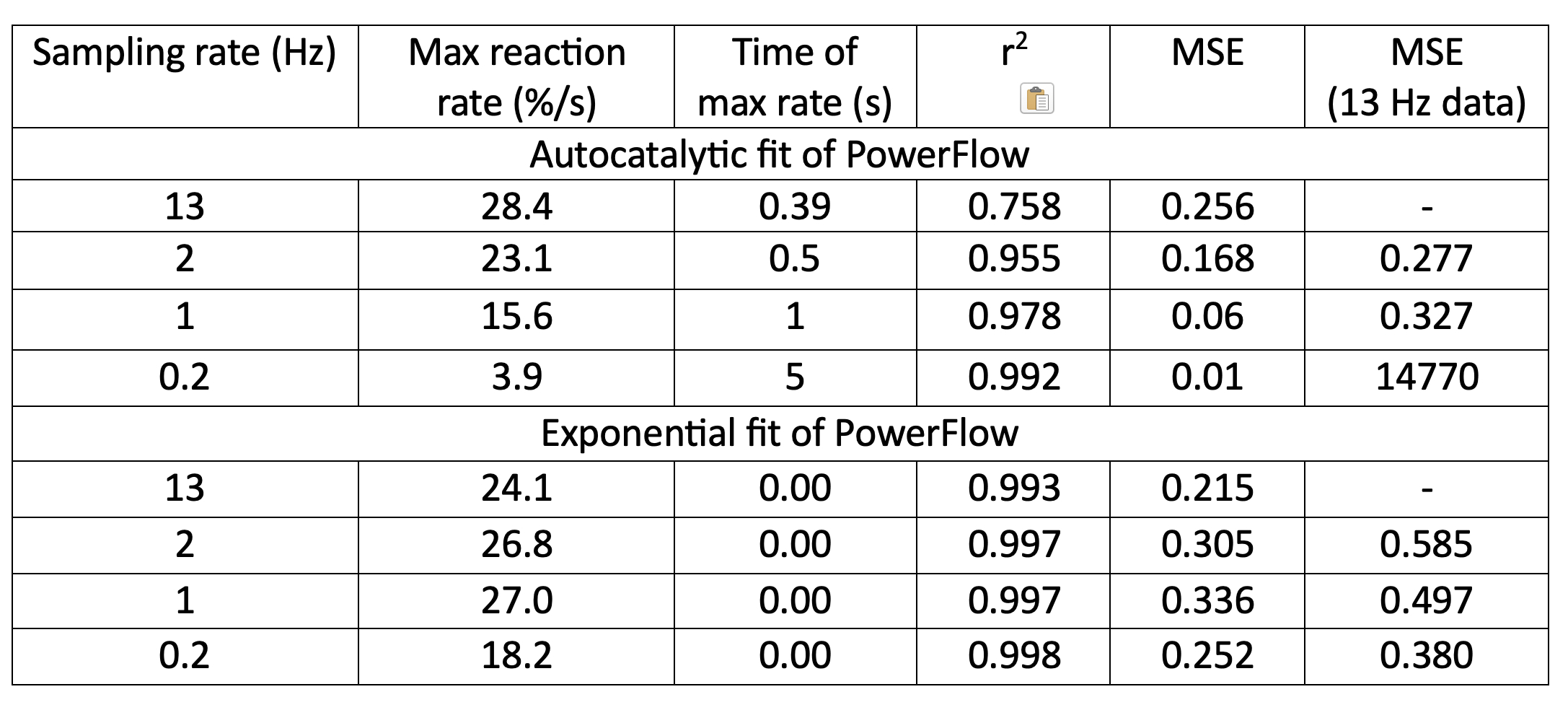
Results: For all 6 resins, fitting the DC rate using the autocatalytic model was the more robust method for analyzing the DC reaction kinetics. Using the lower sampling rates failed to describe adequately the highly temporally-resolved data. Figure 1 shows the results from the autocatalytic and exponential models on one RBC (PowerFlow, Ivoclar). In the autocatalytic model, the time of maximum DC rate was falsely the same as the sampling time for sampling rates ≤ 2 Hz. For data collected at 0.2 Hz in the autocatalytic model, the maximum reaction rate was 3.9 %/s at 5s after ‘light turned on’ (r2 = 0.99), but the MSE was 14770. In contrast, for data collected at 13 Hz, using the autocatalytic model, the maximum reaction rate was 28.4 %/s, but this occurred at 0.39s after the light was tirned on. When the same data were analyzed using the exponential model the maximum reaction rate was 24.1 %/s at 0s. The mean squared error (MSE) was found to be a better figure of trueness than r2 for both fitting methods. Similar results were obtained for the other 5 resins.
Conclusions: For all 6 resins, the autocatalytic equation best described the reaction kinetics of real-time resin photopolymerization. To provide sufficient data resolution for curve fitting, the collection rate should be at least 10 Hz and the interval ideally no more than one-fifth of the time of maximum DC rate.
Methods: The DC of 6 brands of RBCs was calculated from data recorded before, during, and after light-curing using a Bluephase PowerCure (Ivoclar). The changes in DC were monitored using attenuated total reflectance Fourier-transform infrared spectroscopy at data collection rates of 0.2, 1, 2 and 13 Hz. The reaction process was described using both the autocatalytic equation commonly used in chemistry and the phenomenological exponential fitting commonly used in dentistry. The effect of the method used to determine the polymerization kinetics and role of sampling rate on the results were examined
Results: For all 6 resins, fitting the DC rate using the autocatalytic model was the more robust method for analyzing the DC reaction kinetics. Using the lower sampling rates failed to describe adequately the highly temporally-resolved data. Figure 1 shows the results from the autocatalytic and exponential models on one RBC (PowerFlow, Ivoclar). In the autocatalytic model, the time of maximum DC rate was falsely the same as the sampling time for sampling rates ≤ 2 Hz. For data collected at 0.2 Hz in the autocatalytic model, the maximum reaction rate was 3.9 %/s at 5s after ‘light turned on’ (r2 = 0.99), but the MSE was 14770. In contrast, for data collected at 13 Hz, using the autocatalytic model, the maximum reaction rate was 28.4 %/s, but this occurred at 0.39s after the light was tirned on. When the same data were analyzed using the exponential model the maximum reaction rate was 24.1 %/s at 0s. The mean squared error (MSE) was found to be a better figure of trueness than r2 for both fitting methods. Similar results were obtained for the other 5 resins.
Conclusions: For all 6 resins, the autocatalytic equation best described the reaction kinetics of real-time resin photopolymerization. To provide sufficient data resolution for curve fitting, the collection rate should be at least 10 Hz and the interval ideally no more than one-fifth of the time of maximum DC rate.
IMAGES
4211142_File000004.jpg
4211142_File000004.jpg