IADR Abstract Archives
Anti-Biofilm Efficacy and Remineralization Potential of CPP-ACP/SnF2 Dentrifice
Objectives: This in-vitro study was designed to evaluate the anti-biofilm activity and remineralization potential of a novel dentifrice using casein phosphopeptide-amorphous calcium phosphate (CPP-ACP) and stannous fluoride (SnF2) combination technology.
Methods: Five dentifrices were selected for evaluation: MI Paste ONE Perio (MPP), Colgate Total (COL), Crest Gum Detoxify (CRE), Sensodyne Complete Protection (SEN), and Enamelon Fluoride Toothpaste (ENA). All products contained 0.454% W/W SnF2 (1,100 ppm F). MPP contained CPP-ACP. COL contained pentasodium triphosphate. SEN contained tetrasodium pyrophosphate. ENA contained ACP. Ten-fold water-diluted slurry was centrifuged (10,000G, 10 min) and the supernatant was sterilized by filtration. To evaluate anti-biofilm efficacy, saliva-based biofilms were cultured for 24 hours in microtiter plates and exposed to supernatants for 5 min. Fluorometric resazurin assay was conducted to investigate bacterial metabolic activity immediately after exposure (0 hours) and after 4, 8, and 12 hours (N=3). Metabolic activities of five dentifrices were compared to that of deionized water.
To evaluate remineralization potential, ten-fold water-diluted slurry was centrifuged (10,000G, 10min) and supernatant was used for bioavailable calcium and phosphate detection (colorimetric method, N=3).
All the results were statistically analyzed (ANOVA, Tukey’s test, p<0.05).
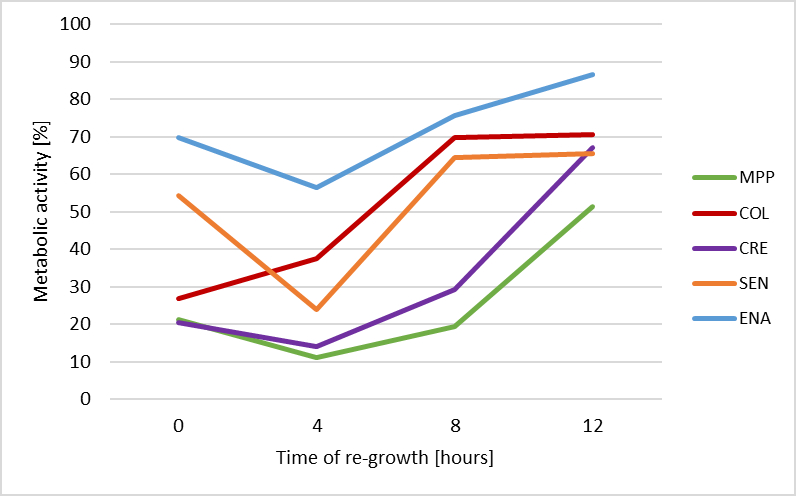
Results: Mean (SD) values of metabolic activities are presented in table. The time-dependent changes of metabolic activities are shown in figure. MPP exhibited lower metabolic activity level than other dentifrices at 4, 8 and 12 hour intervals as well as maintaining higher anti-biofilm activity for 12 hours compared to other dentifrices.
Bioavailable calcium ion and phosphate ion concentrations are shown in table. MPP contained higher bioavailable calcium and phosphate ion compared to all other dentifrices tested.
Conclusions: Results suggest that MPP can be a clinically effective material for prolonged prevention of biofilm-induced caries and gingivitis. In addition, MPP has remineralization potential.
Methods: Five dentifrices were selected for evaluation: MI Paste ONE Perio (MPP), Colgate Total (COL), Crest Gum Detoxify (CRE), Sensodyne Complete Protection (SEN), and Enamelon Fluoride Toothpaste (ENA). All products contained 0.454% W/W SnF2 (1,100 ppm F). MPP contained CPP-ACP. COL contained pentasodium triphosphate. SEN contained tetrasodium pyrophosphate. ENA contained ACP. Ten-fold water-diluted slurry was centrifuged (10,000G, 10 min) and the supernatant was sterilized by filtration. To evaluate anti-biofilm efficacy, saliva-based biofilms were cultured for 24 hours in microtiter plates and exposed to supernatants for 5 min. Fluorometric resazurin assay was conducted to investigate bacterial metabolic activity immediately after exposure (0 hours) and after 4, 8, and 12 hours (N=3). Metabolic activities of five dentifrices were compared to that of deionized water.
To evaluate remineralization potential, ten-fold water-diluted slurry was centrifuged (10,000G, 10min) and supernatant was used for bioavailable calcium and phosphate detection (colorimetric method, N=3).
All the results were statistically analyzed (ANOVA, Tukey’s test, p<0.05).
Results: Mean (SD) values of metabolic activities are presented in table. The time-dependent changes of metabolic activities are shown in figure. MPP exhibited lower metabolic activity level than other dentifrices at 4, 8 and 12 hour intervals as well as maintaining higher anti-biofilm activity for 12 hours compared to other dentifrices.
Bioavailable calcium ion and phosphate ion concentrations are shown in table. MPP contained higher bioavailable calcium and phosphate ion compared to all other dentifrices tested.
Conclusions: Results suggest that MPP can be a clinically effective material for prolonged prevention of biofilm-induced caries and gingivitis. In addition, MPP has remineralization potential.
IMAGES
4197425_File000000.jpg
4197425_File000000.jpg