IADR Abstract Archives
Lifestyle Modifications Significantly Attenuate Obesity-Induced Bone Loss
Objectives: To compare the efficacy of long-term lifestyle modification versus short-term modification followed by weight maintenance in mitigating obesity-induced bone dyshomeostasis and bone loss in obese rats.
Methods: Male Wistar rats, aged seven weeks, were assigned to either a normal diet (ND; n=6) or a high-fat diet (HFD; n=30) for 12 weeks to induce obesity. Afterward, ND-fed rats continued on the ND for an additional 16 weeks. HFD-fed rats were divided into five groups (n=6/group): (1) HFD without intervention for 16 weeks (HFNI), (2) HFD plus six weeks of exercise followed by ND without exercise for 10 weeks (HFEX-S), (3) HFD plus 16 weeks of exercise (HFEX-L), (4) 40% caloric restriction for six weeks followed by ad libitum ND for 10 weeks (HFCR-S), and (5) 40% caloric restriction for 16 weeks (HFCR-L). Metabolic parameters were re-evaluated at the end of the interventions, and serum and tibia samples were collected for analysis.
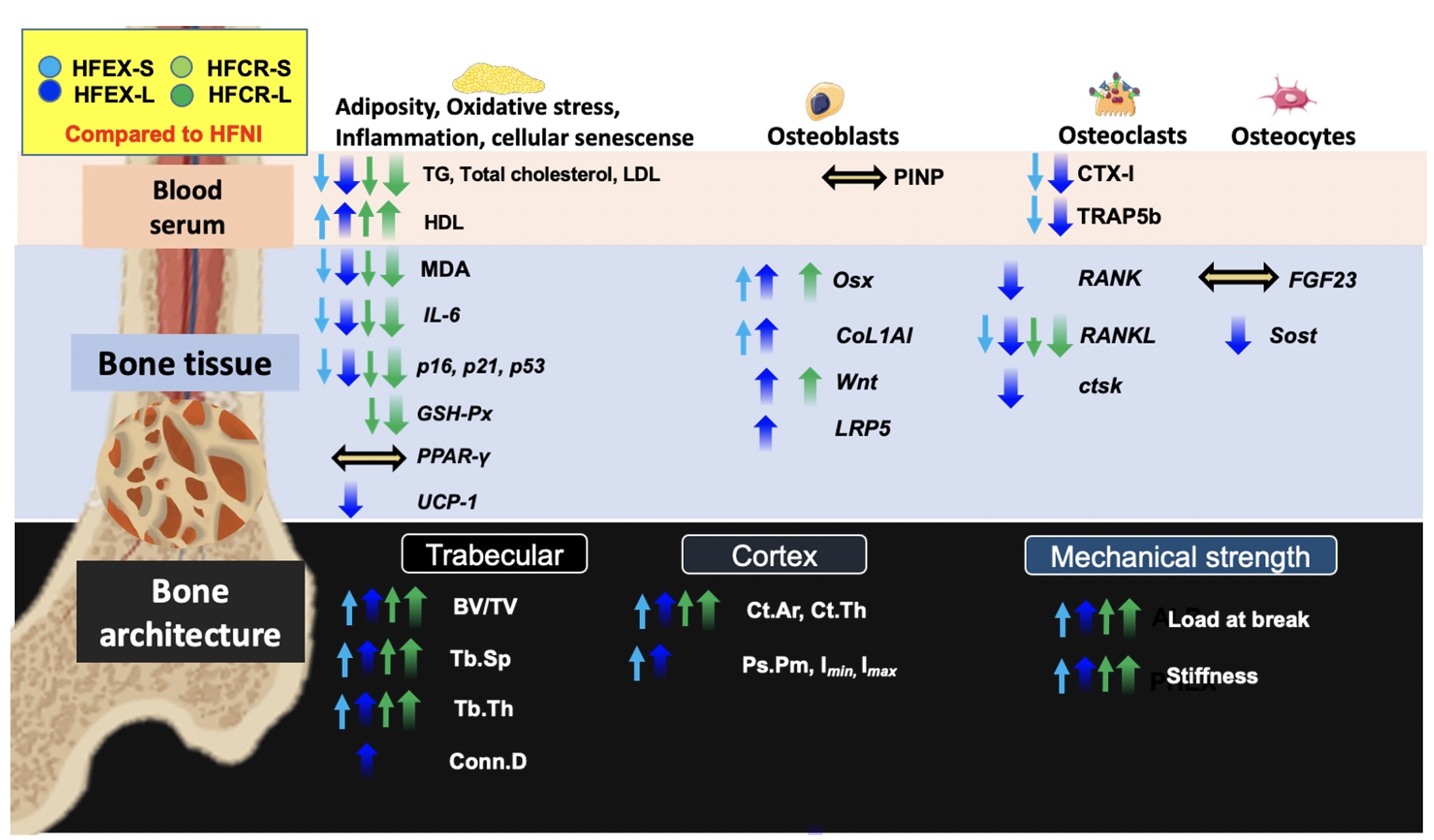
Results: Serum C-terminal cross-linked telopeptide of type I collagen levels were significantly lower in HFEX-S, HFEX-L, and HFCR-L groups compared to HFNI group (P<0.05). Malondialdehyde levels and receptor activator of nuclear factor kappa-Β ligand (RANKL) mRNA expression in bone were significantly lower in all groups with interventions compared to HFNI group. The mRNA expression levels of cathepsin K (Ctsk) and sclerostin (Sost) were significantly lower in HFEX-L group compared to HFNI group. Furthermore, the average bone volume fraction (BV/TV) was significantly higher in rats subjected to exercise or caloric restriction compared to HFNI group (P<0.05). The HFEX-L group demonstrated the highest BV/TV and lowest trabecular separation among all groups with interventions, comparable to ND-fed rats.
Conclusions: Long-term exercise provided the most substantial benefits in attenuating obesity-induced bone dyshomeostasis and bone loss in rats. Emphasizing long-term lifestyle modification may offer the most effective approach to treating obesity-induced bone fragility.
Methods: Male Wistar rats, aged seven weeks, were assigned to either a normal diet (ND; n=6) or a high-fat diet (HFD; n=30) for 12 weeks to induce obesity. Afterward, ND-fed rats continued on the ND for an additional 16 weeks. HFD-fed rats were divided into five groups (n=6/group): (1) HFD without intervention for 16 weeks (HFNI), (2) HFD plus six weeks of exercise followed by ND without exercise for 10 weeks (HFEX-S), (3) HFD plus 16 weeks of exercise (HFEX-L), (4) 40% caloric restriction for six weeks followed by ad libitum ND for 10 weeks (HFCR-S), and (5) 40% caloric restriction for 16 weeks (HFCR-L). Metabolic parameters were re-evaluated at the end of the interventions, and serum and tibia samples were collected for analysis.
Results: Serum C-terminal cross-linked telopeptide of type I collagen levels were significantly lower in HFEX-S, HFEX-L, and HFCR-L groups compared to HFNI group (P<0.05). Malondialdehyde levels and receptor activator of nuclear factor kappa-Β ligand (RANKL) mRNA expression in bone were significantly lower in all groups with interventions compared to HFNI group. The mRNA expression levels of cathepsin K (Ctsk) and sclerostin (Sost) were significantly lower in HFEX-L group compared to HFNI group. Furthermore, the average bone volume fraction (BV/TV) was significantly higher in rats subjected to exercise or caloric restriction compared to HFNI group (P<0.05). The HFEX-L group demonstrated the highest BV/TV and lowest trabecular separation among all groups with interventions, comparable to ND-fed rats.
Conclusions: Long-term exercise provided the most substantial benefits in attenuating obesity-induced bone dyshomeostasis and bone loss in rats. Emphasizing long-term lifestyle modification may offer the most effective approach to treating obesity-induced bone fragility.
IMAGES
4158107_File000001.jpg
4158107_File000001.jpg