IADR Abstract Archives
Polishing Experimental Laser-Reversible Cement: a Qualitative Study
Objectives: A common drawback with orthodontic bracket removal is the time spent removing residual cement. We aim to investigate the efficacy of polishing a laser reversible experimental cement. With a fixed amount of time, the polished surfaces of the extracted teeth are compared among a lased vs a non-lased group with a traditional orthodontic resin as control. We explored the surface appearance in addition to SEM surface analysis for residual cement or enamel damage.
Methods: 150 mandibular premolar orthodontic brackets were debonded from 75 freshly extracted teeth. Brackets were bonded with an experimental laser-sensitive cement (CAO Group)(R) and was polymerized by either LED(Ascent) or Laser curing light(Monet). A traditional orthodontic cement 3M-Transbond(T) was used as control. The surfaces were randomly assigned to the following groups: (1)T/LED, (2)T/Monet, (3)R/LED, (4)R/LED+450nm diode laser (Da Vinci; CAO Group), (5)R/Monet and (6)R/Monet+450nm diode laser. Groups 4 and 6 were lased for 60 seconds with the 450nm laser before debonding. After the brackets have been debonded, we polished each surface for 30s. The surfaces were visually inspected and PVS impressions were taken for SEM surface analysis data.
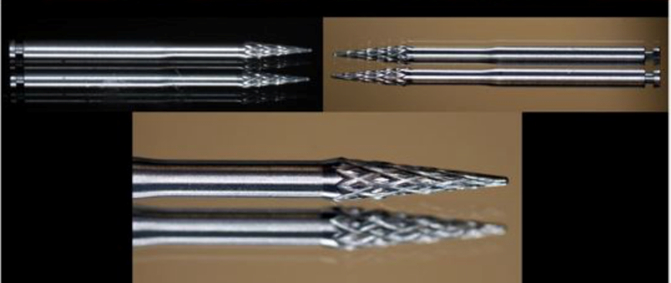
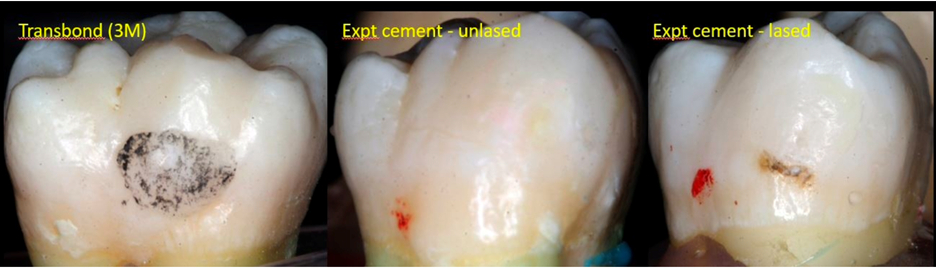
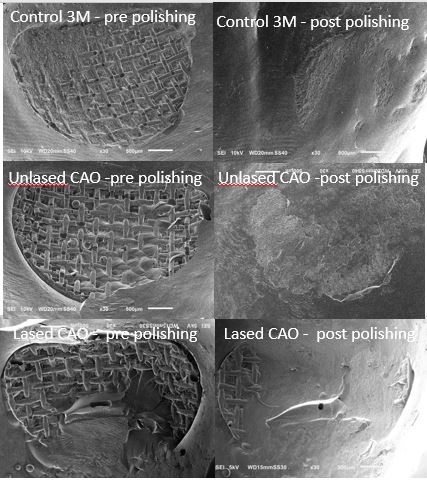
Results: The soft steel polishing bur (Figure 1) was most successful at removing both experimental cements (Figure 2). The soft straight bur rubbed off onto the harder control cement, which hindered its abrasiveness. The straight handpiece and soft steel bur was an unrealistic clinical polishing method due to its length and angle. Potential laser burn mark can be a problem. The SEM pictures did not show a distinct advantage of the experiemtal groups after polishing (Figure 4).
Conclusions: The soft steel polishing bur was equally successful at polishing the experimental cement lased and unlased. The reversible lasing of the cement caused irreversible burn marks on the tooth. Polishing the control cement (3M) was less successful. Adjustment to the polishing burs and technique as well as chemical formula of the experimetnal cement is underway.
Methods: 150 mandibular premolar orthodontic brackets were debonded from 75 freshly extracted teeth. Brackets were bonded with an experimental laser-sensitive cement (CAO Group)(R) and was polymerized by either LED(Ascent) or Laser curing light(Monet). A traditional orthodontic cement 3M-Transbond(T) was used as control. The surfaces were randomly assigned to the following groups: (1)T/LED, (2)T/Monet, (3)R/LED, (4)R/LED+450nm diode laser (Da Vinci; CAO Group), (5)R/Monet and (6)R/Monet+450nm diode laser. Groups 4 and 6 were lased for 60 seconds with the 450nm laser before debonding. After the brackets have been debonded, we polished each surface for 30s. The surfaces were visually inspected and PVS impressions were taken for SEM surface analysis data.
Results: The soft steel polishing bur (Figure 1) was most successful at removing both experimental cements (Figure 2). The soft straight bur rubbed off onto the harder control cement, which hindered its abrasiveness. The straight handpiece and soft steel bur was an unrealistic clinical polishing method due to its length and angle. Potential laser burn mark can be a problem. The SEM pictures did not show a distinct advantage of the experiemtal groups after polishing (Figure 4).
Conclusions: The soft steel polishing bur was equally successful at polishing the experimental cement lased and unlased. The reversible lasing of the cement caused irreversible burn marks on the tooth. Polishing the control cement (3M) was less successful. Adjustment to the polishing burs and technique as well as chemical formula of the experimetnal cement is underway.
IMAGES
3830476_File000000.jpg
3830476_File000001.jpg
3830476_File000003.JPG
3830476_File000000.jpg
3830476_File000001.jpg
3830476_File000003.JPG