IADR Abstract Archives
Lithium Disilicate Bond Strength Using Various Etching and Primer Condition
Objectives:
The conditions used to etch and prime lithium disilicate prior to bonding may affect its bond strength with a resin luting material. This study will examine the effects of varying the parameters of etchant and primer application.
Methods:
Lithium disilicate blocks (e.max CAD LT, Ivoclar Vivadent) were sectioned into 4mm thick specimens, crystallized, and embedded into acrylic. Their surfaces were wet ground to 320 grit SiC paper. For groups 1-3, specimens were etched with 5% hydrofluoric acid for 20, rinsed, and dried. Specimens were then either coated with 1 coat of silane (Calibra silane, Dentsply) for 60 seconds at room temperature (25C) or under a heat gun (80C) (Gr2) or 2 coats of silane at 25C (Gr3). Group 4 and 5 were etched with 5% hydrofluoric acid for 20sec, rinsed and dried. Group 4 was then cleaned with 37% phospohoric acid for 60sec and rinsed. Group 5 was re-etched with 5% hydrofluoric acid for 20sec. Group 6 was etched with 5% hydrofluoric acid for 60sec. Group 7 was etched with 10% hydrofluoric acid for 20sec. Group 8 and 9 were sandblasted with 50micron alumina for 10 seconds at 2 bar. Group 9 was then etched with 5% hydrofluoric acid for 20sec. Groups 4-9 were then coated with 1 coat of silane for 60sec at 25C. A button of flowable composite (Omnichroma Flow, Tokyama) was then bonded to the surface of the ceramic using the Ultradent shear bond strength method using an Elipar S10 curing light for 20sec. Specimens were stored in water at 37C for 24hrs and tested at 1mm/min in a universal testing machine
Results:
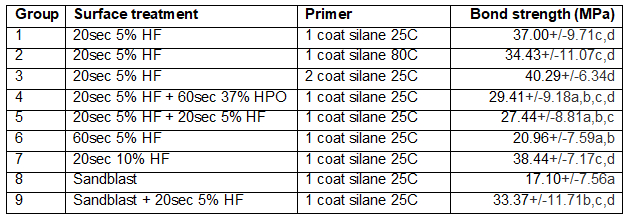
The mean+/-standard deviation of each group are listed in the chart. Groups in each column with different letters are statistically different.
attached in pictures is the results table.
Conclusions:
Surface treatments that produced a statically lower bond strength than the control (Group 1) was etching with 5% HF for 60sec and sandblasting alone.
The conditions used to etch and prime lithium disilicate prior to bonding may affect its bond strength with a resin luting material. This study will examine the effects of varying the parameters of etchant and primer application.
Methods:
Lithium disilicate blocks (e.max CAD LT, Ivoclar Vivadent) were sectioned into 4mm thick specimens, crystallized, and embedded into acrylic. Their surfaces were wet ground to 320 grit SiC paper. For groups 1-3, specimens were etched with 5% hydrofluoric acid for 20, rinsed, and dried. Specimens were then either coated with 1 coat of silane (Calibra silane, Dentsply) for 60 seconds at room temperature (25C) or under a heat gun (80C) (Gr2) or 2 coats of silane at 25C (Gr3). Group 4 and 5 were etched with 5% hydrofluoric acid for 20sec, rinsed and dried. Group 4 was then cleaned with 37% phospohoric acid for 60sec and rinsed. Group 5 was re-etched with 5% hydrofluoric acid for 20sec. Group 6 was etched with 5% hydrofluoric acid for 60sec. Group 7 was etched with 10% hydrofluoric acid for 20sec. Group 8 and 9 were sandblasted with 50micron alumina for 10 seconds at 2 bar. Group 9 was then etched with 5% hydrofluoric acid for 20sec. Groups 4-9 were then coated with 1 coat of silane for 60sec at 25C. A button of flowable composite (Omnichroma Flow, Tokyama) was then bonded to the surface of the ceramic using the Ultradent shear bond strength method using an Elipar S10 curing light for 20sec. Specimens were stored in water at 37C for 24hrs and tested at 1mm/min in a universal testing machine
Results:
The mean+/-standard deviation of each group are listed in the chart. Groups in each column with different letters are statistically different.
attached in pictures is the results table.
Conclusions:
Surface treatments that produced a statically lower bond strength than the control (Group 1) was etching with 5% HF for 60sec and sandblasting alone.
IMAGES
3826059_File000000.jpg
3826059_File000000.jpg