IADR Abstract Archives
Different Cementation Protocols Influence the Bonding to Lithium Disilicate Ceramics
Objectives: This study assessed the influence of bonding agents/cements in the bonding properties to a lithium disilicate ceramic/LD.
Methods: Eight bonding protocols were evaluated (RelyX Universal/RUL or Filtek Supreme Flowable/FSF bonded with Single Bond Universal/SBU, Single Bond plus + silane/SB+, or the adhesive bottle of Scotchbond Multipurpose + silane/SBMP; or RelyX Unicem 2 associated/RU2S or not with silane application/RU2). Twenty-four slices (12x12x2mm) were obtained from E-max CAD blocks, crystallized and polished flat using 320-, 600-, 800-, and 1200-grit silicon carbide papers. Following, LD surfaces were treated with 9% fluoric acid during 20s, silane application for 1 minute, and the respective bonding protocols.
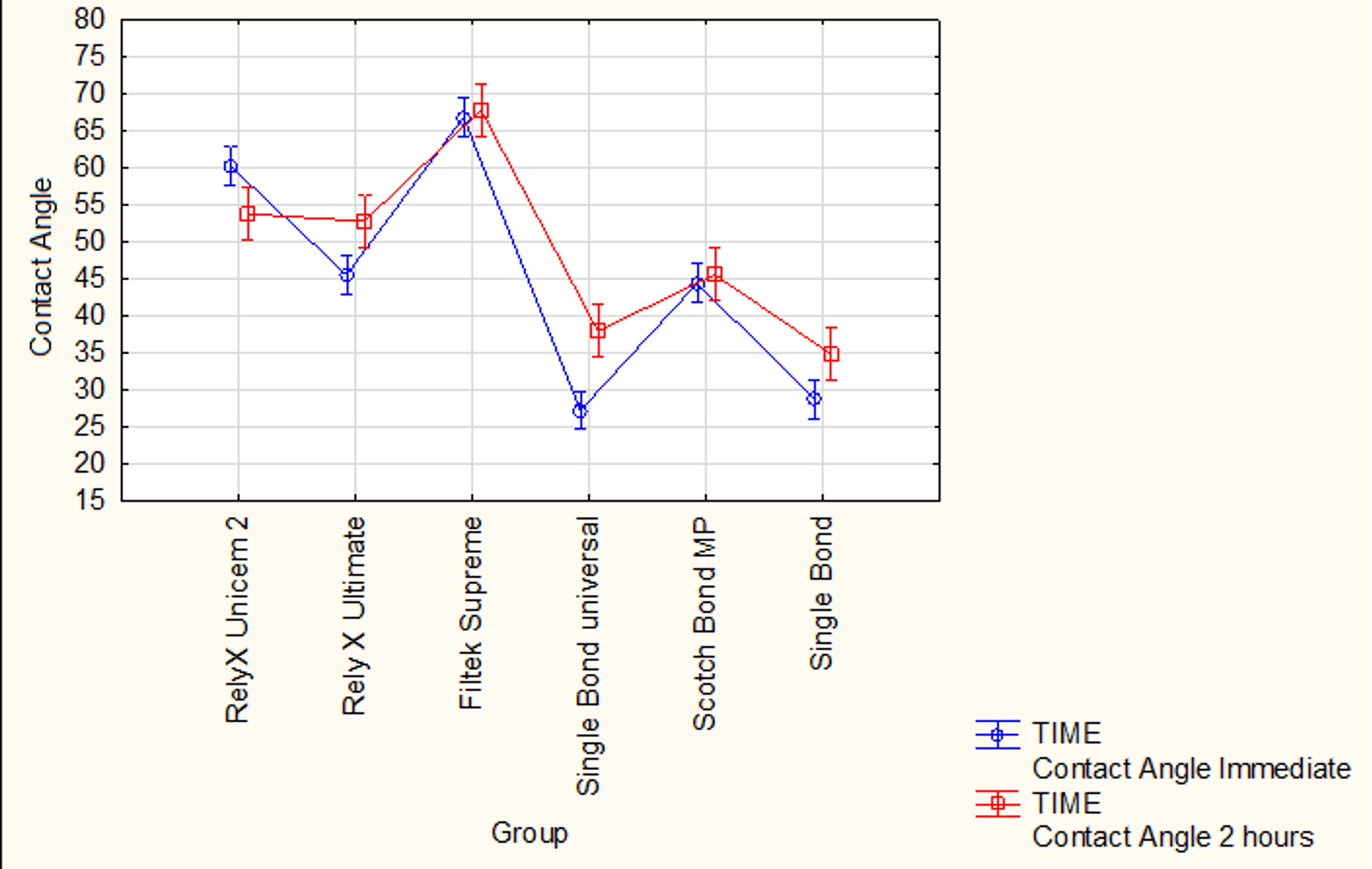
Six resins/resin cements cylinders (2.48mm diameter x 1mm height) were bonded to each LD slice and stored in deionized water at 37°C for 7 days and 6 months, in absence of light, before the shear bond test. Each group was represented by 2 ceramic slices (total of 12 resin cylinders per group). Three additional samples of the bonding agents and resins (4x4x1mm) were used for analysis of contact angle immediately and 2 hours after light curing.
Data was analyzed using 2-way ANOVA (shear bond strength) and 2-way repeated measurements ANOVA (contact angle); followed by Tukey test.
Results: Groups RUL and RU2 showed lower bond strength than other groups, especially after 6-months water storage. All groups showed similar or higher (SBMP+RU) bond strength after aging except groups cemented with SBU. Contact angle showed SBU and SB2+ are more hydrophilic than SBMP, although the difference tends to reduce after 2 hours. FSF and RUM2 are more hydrophobic than RUL both initially and after 2 hours.
Conclusions: Bonding protocols influence long-term bonding to LD. Resins cemented with universal bonding agent showed lower bond strength than the self-etch resin cement associated with silane or resins cemented with conventional 2- and 3-step bonding agents associated with silane.
Methods: Eight bonding protocols were evaluated (RelyX Universal/RUL or Filtek Supreme Flowable/FSF bonded with Single Bond Universal/SBU, Single Bond plus + silane/SB+, or the adhesive bottle of Scotchbond Multipurpose + silane/SBMP; or RelyX Unicem 2 associated/RU2S or not with silane application/RU2). Twenty-four slices (12x12x2mm) were obtained from E-max CAD blocks, crystallized and polished flat using 320-, 600-, 800-, and 1200-grit silicon carbide papers. Following, LD surfaces were treated with 9% fluoric acid during 20s, silane application for 1 minute, and the respective bonding protocols.
Six resins/resin cements cylinders (2.48mm diameter x 1mm height) were bonded to each LD slice and stored in deionized water at 37°C for 7 days and 6 months, in absence of light, before the shear bond test. Each group was represented by 2 ceramic slices (total of 12 resin cylinders per group). Three additional samples of the bonding agents and resins (4x4x1mm) were used for analysis of contact angle immediately and 2 hours after light curing.
Data was analyzed using 2-way ANOVA (shear bond strength) and 2-way repeated measurements ANOVA (contact angle); followed by Tukey test.
Results: Groups RUL and RU2 showed lower bond strength than other groups, especially after 6-months water storage. All groups showed similar or higher (SBMP+RU) bond strength after aging except groups cemented with SBU. Contact angle showed SBU and SB2+ are more hydrophilic than SBMP, although the difference tends to reduce after 2 hours. FSF and RUM2 are more hydrophobic than RUL both initially and after 2 hours.
Conclusions: Bonding protocols influence long-term bonding to LD. Resins cemented with universal bonding agent showed lower bond strength than the self-etch resin cement associated with silane or resins cemented with conventional 2- and 3-step bonding agents associated with silane.
IMAGES
3825080_File000000.jpg
3825080_File000000.jpg