IADR Abstract Archives
Photogrammetry, Intraoral Scanning, or Conventional Impressions: an Update on Accuracy
Objectives: The purpose of this in vitro study is to measure and compare the accuracy of the conventional impression, the intraoral scanner, and the photogrammetry techniques for full-arch implant-supported dental prostheses at the abutment level.
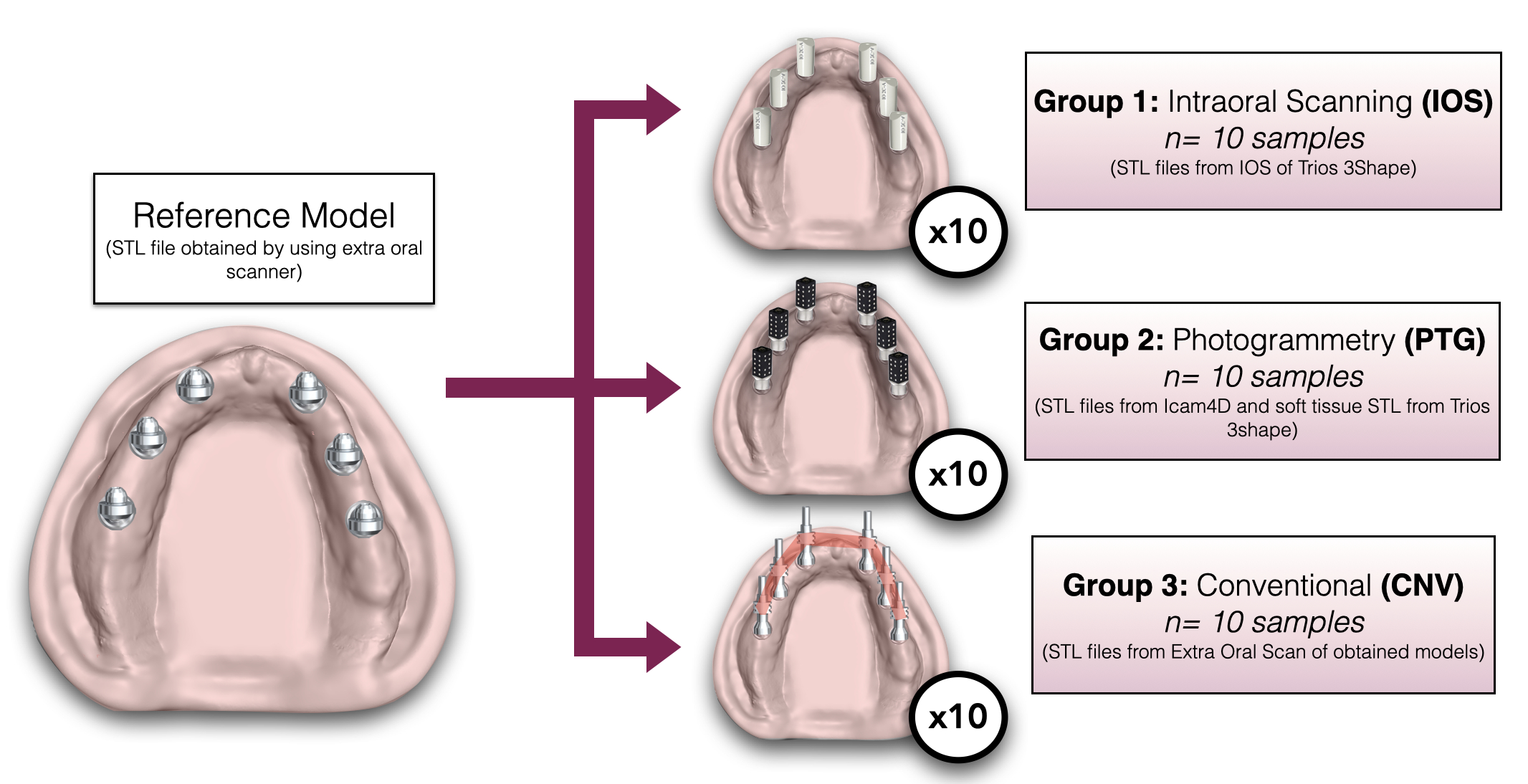
Methods: An edentulous maxillary master model containing 6 implant abutment replicas was fabricated. A reference STL of the master model was obtained using a laboratory scanner. Three impression techniques were performed: the intraoral scanning (IOS) group, the photogrammetry (PTG) group, and the conventional (CNV) group. Three tests were conducted to compare the different registration techniques: a 3D deviation test, an angular deviation test and a cross-arch distance deviation test through a “best fit” algorithm and a spatial similarity transformation platform. Trueness and precision were the two parameters used to define the accuracy of a system. The deviations were then calculated and were compared statistically (α = 0.05).
Results: The 3D deviation test showed statistically significant differences between PTG and CNV (p<.0001) and PTG and IOS (p<.0001). No statistically significant difference was found between CNV and IOS (p=0.8626) through the “best-fit” method, but were observed via the “spatial similarity” method (p=0.0041). PTG showed the best results for precision, followed by the IOS and least the CNV. The angular deviation test showed that IOS had the highest angular deviation, and that PTG and CNV had no statistically significant difference (p=0.7955) and were equivalent. Finally, in terms of cross-arch distances, the PTG showed optimal results followed by IOS and then CNV.
Conclusions: Within the scope of this study, the photogrammetry technique reported the best accuracy in terms of implant positions for complete-arch implant rehabilitation. Conventional impressions showed better accuracy results than intraoral scanning in the 3D deviations test and global angular deviation test, however the latter exhibited better results in cross-arch distances test.
Methods: An edentulous maxillary master model containing 6 implant abutment replicas was fabricated. A reference STL of the master model was obtained using a laboratory scanner. Three impression techniques were performed: the intraoral scanning (IOS) group, the photogrammetry (PTG) group, and the conventional (CNV) group. Three tests were conducted to compare the different registration techniques: a 3D deviation test, an angular deviation test and a cross-arch distance deviation test through a “best fit” algorithm and a spatial similarity transformation platform. Trueness and precision were the two parameters used to define the accuracy of a system. The deviations were then calculated and were compared statistically (α = 0.05).
Results: The 3D deviation test showed statistically significant differences between PTG and CNV (p<.0001) and PTG and IOS (p<.0001). No statistically significant difference was found between CNV and IOS (p=0.8626) through the “best-fit” method, but were observed via the “spatial similarity” method (p=0.0041). PTG showed the best results for precision, followed by the IOS and least the CNV. The angular deviation test showed that IOS had the highest angular deviation, and that PTG and CNV had no statistically significant difference (p=0.7955) and were equivalent. Finally, in terms of cross-arch distances, the PTG showed optimal results followed by IOS and then CNV.
Conclusions: Within the scope of this study, the photogrammetry technique reported the best accuracy in terms of implant positions for complete-arch implant rehabilitation. Conventional impressions showed better accuracy results than intraoral scanning in the 3D deviations test and global angular deviation test, however the latter exhibited better results in cross-arch distances test.
IMAGES
3823737_File000000.jpg
3823737_File000000.jpg