IADR Abstract Archives
Physical Properties of Experimental Antifungal Denture Base Materials
Objectives: To investigate the physical properties of experimental antifungal denture base materials containing fungicidal drug nystatin and synthesized antifungal monomer.
Methods: Experimental antifungal dimethacrylate monomer C16DC2DMA was synthesized as previously reported. Nystatin (Nys) was loaded onto MSN using saturated nystatin-ethanol (11mg/mL) solution under 45oC and reduced pressure (20-inch Hg) for 3 hours, centrifuged, and vacuum-dried overnight at 75oC. The loading process was repeated for 3 times. Disk specimens (25mm diameter, 2mm thick, n=5) for water sorption or (6mm diameter, 2mm thick, n=5) for degree of polymerization conversion (DC) of heat-cured denture base resins were prepared by adding 0% (Control), 2.5%, or 5% Nys@MSN, with or without 2.5%C16DC2DMA, to Ivocap High Impact denture base resin (Ivoclar Vivadent), and heat-cured under 90oC for 2 hours. Disk specimens of 3D-printed resin were prepared using Formlabs Denture Base Resin containing the same above compositions of Nys@MSN and C16DC2DMA, or 1% and 2%Nys (without MSN) and printed using Formlabs Form 2 printer, rinsed with isopropanol, and UV-cured under 60oC. The degree of conversion was measured using Thermo-Nicolet 670 FT-NIR around 6100cm-1. Water sorption and solubility were measured according to ISO Standard 20795-1.
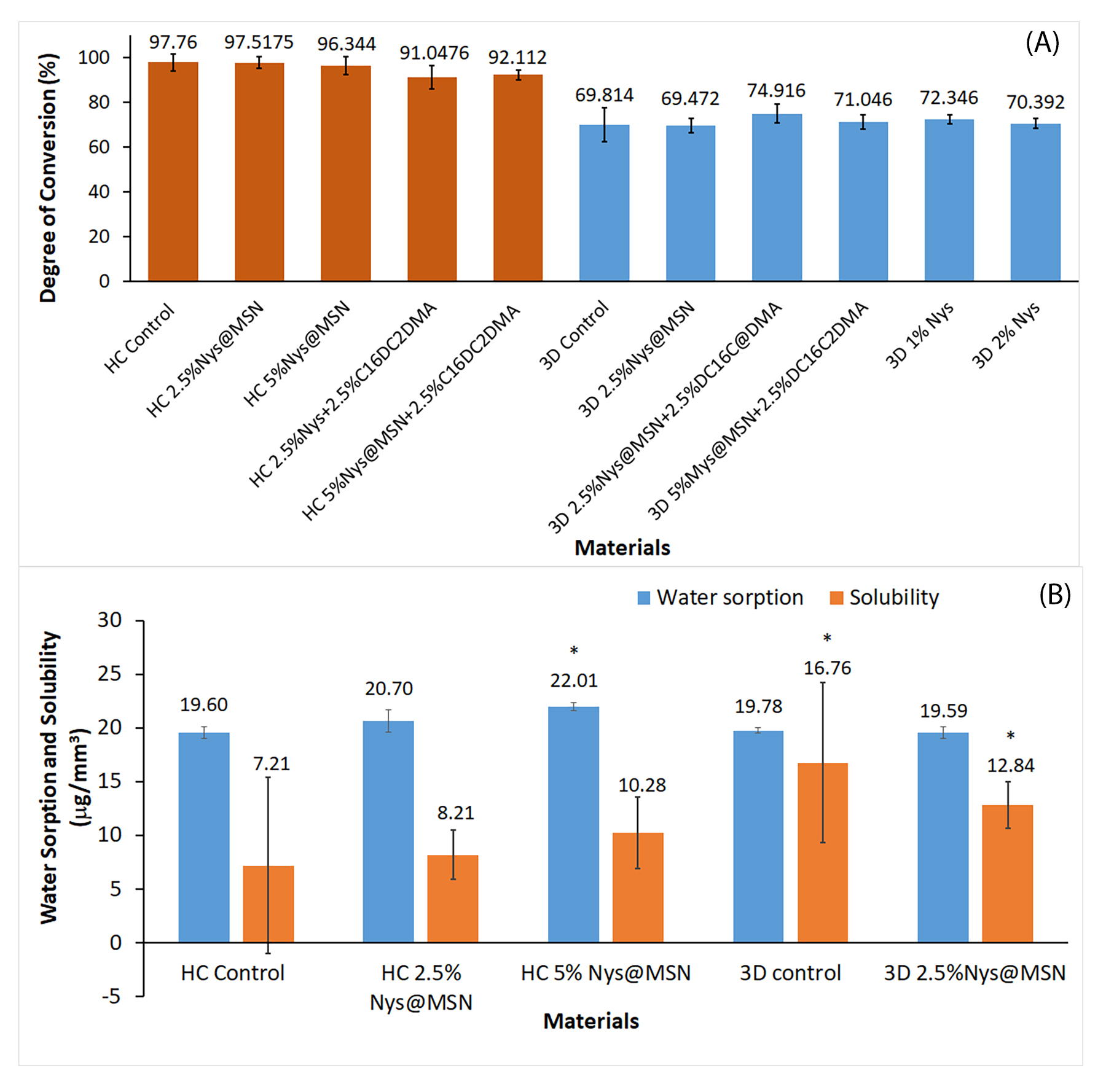
Results: The results are shown in Figure 1. Heat-cured resins have significantly higher DC (above 90%) than 3D-printed resins (around 70%). Adding small amount (2.5%) of Nys@MSN or C16DC2DMA has no significant effect on the DC. 3D-printed resins have similar water sorption but higher solubility than heat-cured resins. Adding 2.5-5%Nys@MSN only slightly increase the water sorption and solubility.
Conclusions: Antifungal denture bases can be fabricated by incorporating a small of antifungal drug or antifungal monomer without compromising the physical properties of the material.
Methods: Experimental antifungal dimethacrylate monomer C16DC2DMA was synthesized as previously reported. Nystatin (Nys) was loaded onto MSN using saturated nystatin-ethanol (11mg/mL) solution under 45oC and reduced pressure (20-inch Hg) for 3 hours, centrifuged, and vacuum-dried overnight at 75oC. The loading process was repeated for 3 times. Disk specimens (25mm diameter, 2mm thick, n=5) for water sorption or (6mm diameter, 2mm thick, n=5) for degree of polymerization conversion (DC) of heat-cured denture base resins were prepared by adding 0% (Control), 2.5%, or 5% Nys@MSN, with or without 2.5%C16DC2DMA, to Ivocap High Impact denture base resin (Ivoclar Vivadent), and heat-cured under 90oC for 2 hours. Disk specimens of 3D-printed resin were prepared using Formlabs Denture Base Resin containing the same above compositions of Nys@MSN and C16DC2DMA, or 1% and 2%Nys (without MSN) and printed using Formlabs Form 2 printer, rinsed with isopropanol, and UV-cured under 60oC. The degree of conversion was measured using Thermo-Nicolet 670 FT-NIR around 6100cm-1. Water sorption and solubility were measured according to ISO Standard 20795-1.
Results: The results are shown in Figure 1. Heat-cured resins have significantly higher DC (above 90%) than 3D-printed resins (around 70%). Adding small amount (2.5%) of Nys@MSN or C16DC2DMA has no significant effect on the DC. 3D-printed resins have similar water sorption but higher solubility than heat-cured resins. Adding 2.5-5%Nys@MSN only slightly increase the water sorption and solubility.
Conclusions: Antifungal denture bases can be fabricated by incorporating a small of antifungal drug or antifungal monomer without compromising the physical properties of the material.
IMAGES
3668090_File000000.jpg
3668090_File000000.jpg