IADR Abstract Archives
Characterization of Materials Used to Produce Orthodontic Sequential Aligners
Objectives: There are no ANSI/ADA or ISO standards that specifically address materials used to produce sequential aligners. This study reports on the suitability of different test methods to characterize the physical, thermal, and mechanical behavior of these materials along with results of performing these tests on 5 commercially available materials.
Methods: Five materials (Table1) were evaluated. Mechanical-behavior was determined using 3pt loading (support span=25.4mm, radii=3.6mm for loading-nose and supports) on an Instron5582 test system (strain rate-1%/min). Specimens (50.8mmx12.7mm) were cut from nominal 1mm-thick sheets after thermoforming (Biostar) over aluminum molds. Procedure A from ASTM-D790 was followed for materials less than 1.6mm-thick with correction factor applied for large support span-to-depth ratios. 12 specimens were tested directly after thermoforming, and 12 were conditioned in ISO-Grade2 water for 7days before testing. Additionally 24 A+ specimens were thermoformed over ABS molds to compare mold-effect. DSC was performed to determine thermal behavior (TB) for the materials after conditioning using two heating cycles from 20-180°C at 20°C/min. Light-transmission (LT) was also measured from 380-780nm using a spectrometer/integrating-sphere assembly after conditioning. Descriptive statistics were performed along with comparative (Student’s T-test) when appropriate.
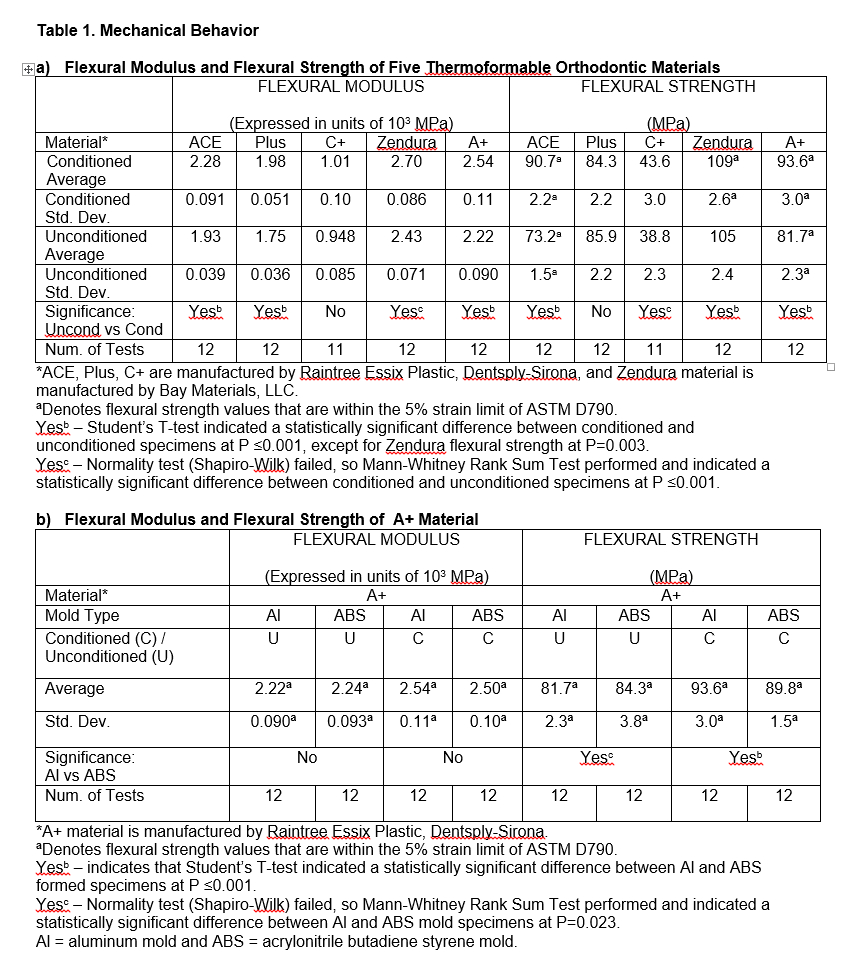
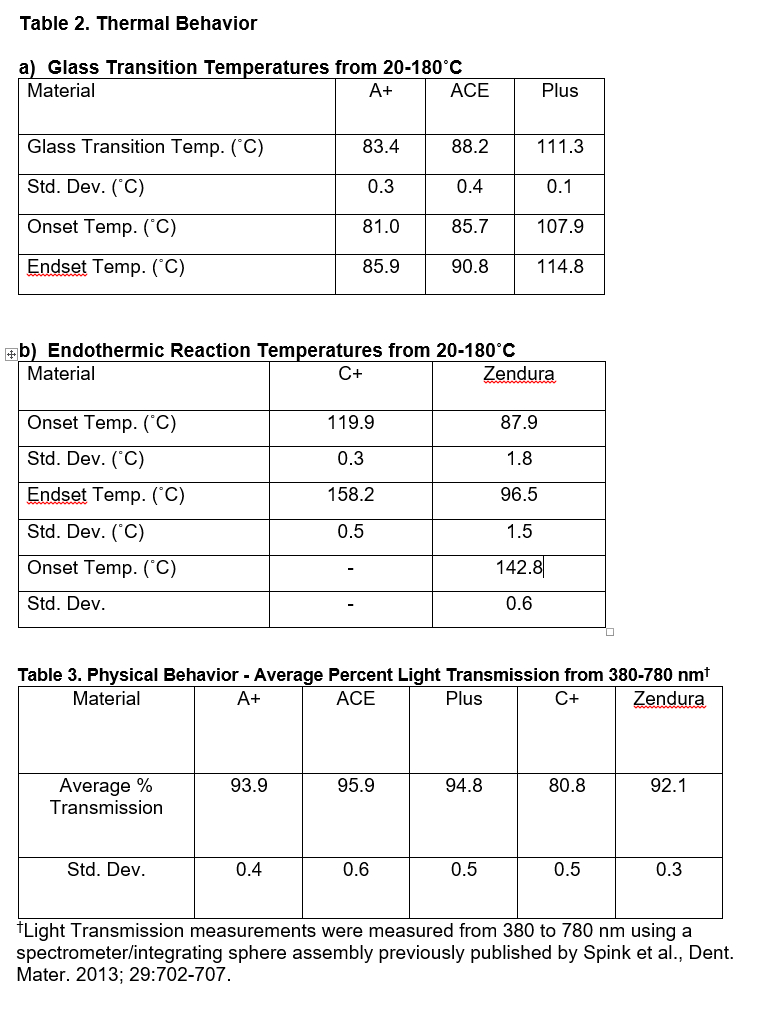
Results: Table1a shows a significant-difference between conditioned (greater) and unconditioned specimens for both strength and modulus (except for Plus-strength and C+-modulus), and mold material demonstrated a significant difference for strength, which warrants further investigation (Table1b). Many of the strength values slightly exceeded the 5%strain limit specified for ASTM-D790 indicating the method may not rigorously apply. Testing for TB showed glass-transitions from 83.4(A+) to 111.3°C(Plus) (Table2a), with endothermic-peaks at 87.9(C+) and 119.9°C(Zendura) (Table2b). Table3 shows average LT values ranged from 80.8-92.1%.
Conclusions: The 3pt loading configuration used to characterize mechanical behavior may not be suitable for high-strain materials used to produce sequential aligners and 4pt bend testing (ASTM-D6272) needs investigation. LT values need further comparison/correlation to ISO13468-1 for transparent plastics.
Methods: Five materials (Table1) were evaluated. Mechanical-behavior was determined using 3pt loading (support span=25.4mm, radii=3.6mm for loading-nose and supports) on an Instron5582 test system (strain rate-1%/min). Specimens (50.8mmx12.7mm) were cut from nominal 1mm-thick sheets after thermoforming (Biostar) over aluminum molds. Procedure A from ASTM-D790 was followed for materials less than 1.6mm-thick with correction factor applied for large support span-to-depth ratios. 12 specimens were tested directly after thermoforming, and 12 were conditioned in ISO-Grade2 water for 7days before testing. Additionally 24 A+ specimens were thermoformed over ABS molds to compare mold-effect. DSC was performed to determine thermal behavior (TB) for the materials after conditioning using two heating cycles from 20-180°C at 20°C/min. Light-transmission (LT) was also measured from 380-780nm using a spectrometer/integrating-sphere assembly after conditioning. Descriptive statistics were performed along with comparative (Student’s T-test) when appropriate.
Results: Table1a shows a significant-difference between conditioned (greater) and unconditioned specimens for both strength and modulus (except for Plus-strength and C+-modulus), and mold material demonstrated a significant difference for strength, which warrants further investigation (Table1b). Many of the strength values slightly exceeded the 5%strain limit specified for ASTM-D790 indicating the method may not rigorously apply. Testing for TB showed glass-transitions from 83.4(A+) to 111.3°C(Plus) (Table2a), with endothermic-peaks at 87.9(C+) and 119.9°C(Zendura) (Table2b). Table3 shows average LT values ranged from 80.8-92.1%.
Conclusions: The 3pt loading configuration used to characterize mechanical behavior may not be suitable for high-strain materials used to produce sequential aligners and 4pt bend testing (ASTM-D6272) needs investigation. LT values need further comparison/correlation to ISO13468-1 for transparent plastics.
IMAGES
3666425_File000000.jpg
3666425_File000003.jpg
3666425_File000000.jpg
3666425_File000003.jpg