IADR Abstract Archives
Periodontal Therapy Skews Macrophage Phenotypic Polarization Towards M2 Phenotype
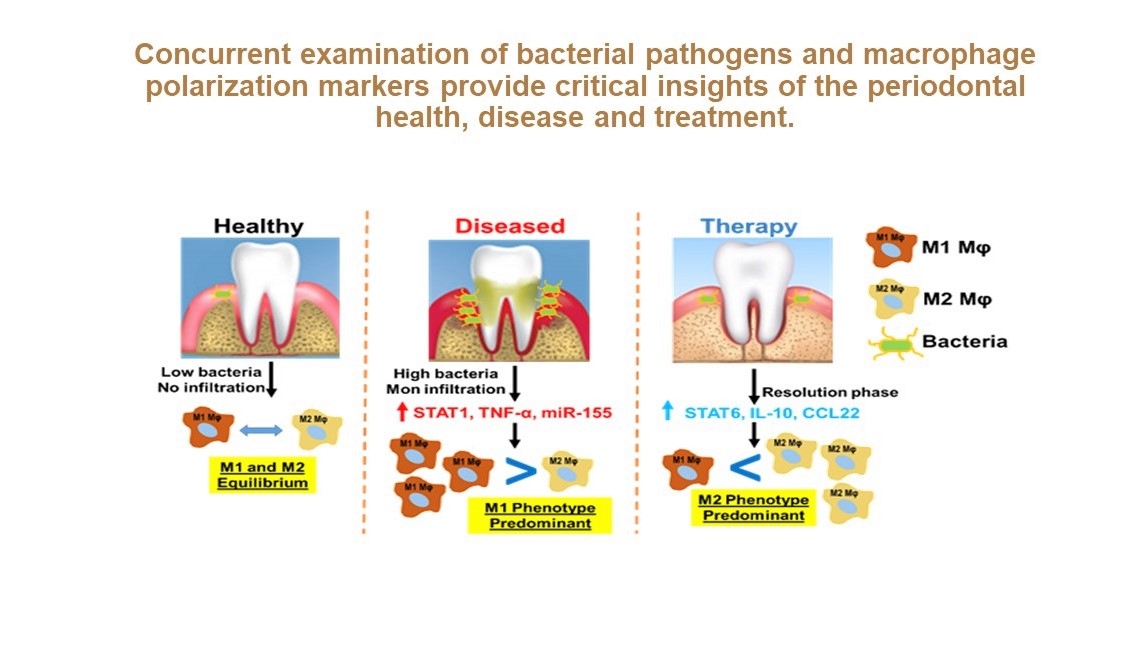
Objectives: Periodontal pathogens alter host immune response by perturbing expression of inflammatory mediators. Human macrophages (Mφ) respond to live periopathogens P. gingivalis or A. actinomycetemcomitans by polarizing towards pro-inflammatory M1 phenotype. To our knowledge there has been no longitudinal study evaluating influence of periodontal therapy on Mφ polarization. We hypothesize that periodontal therapy mediated reduction of bacterial load instigates pro-resolution environment favoring M2 Mφ polarization, contributing towards resolution of inflammation post-therapy.
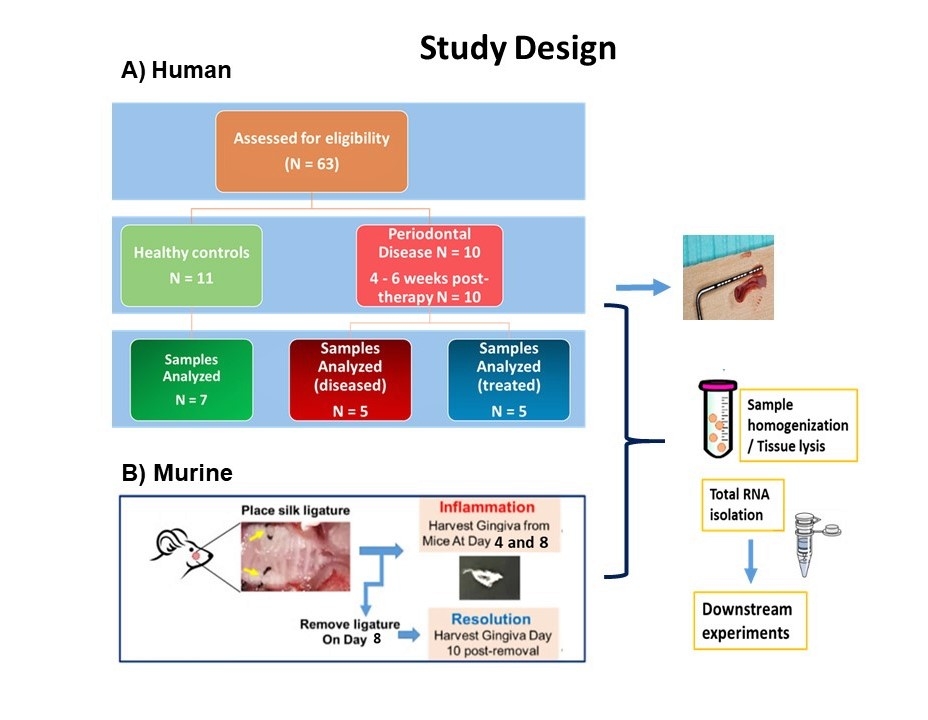
Methods: Gingival biopsies were excised from five subjects with generalized severe periodontitis. A second set of biopsies excised after 4-6 weeks to assess the impact of therapeutic resolution at molecular level. Gingival biopsies were also excised from seven periodontally healthy controls. Total RNA was isolated from gingival biopsies to evaluate pro- and anti- inflammatory markers associated with macrophage polarization by RT-qPCR, before and after non-surgical periodontal therapy.
Results: Compared to heathy and treated biopsies, higher load of Aa and Pg transcripts were observed in disease. Probing depths before (9 ± 1.52 mm) and after therapy (6.85 ± 0.89 mm), corroborated with reduced levels of periopathic bacterial transcripts after therapy. Lower expression of M1 Mφ markers (TNF-α, STAT1 & miR-155) were observed after therapy as compared to diseased samples. Correlating with clinical improvements, M2 Mφ markers (STAT6, IL-10 & CCL22) were highly expressed post-therapy. These findings corroborated with murine ligature-induced (challenged with Pg) periodontitis and resolution model, comparing the respective murine Mφ polarization markers (M1 Mφ: COX-2, iNOS and M2 Mφ: TGM2, CD206).
Conclusions: Polarization of Mφ in gingival tissues is a well-controlled axis and has considerable consequences for how Mφ detect, phagocytose and kill bacteria, and participate in tissue repair. Imbalance in Mφ polarization by assessment of their markers provides relevant clinical information on the successful response of periodontal therapy and can be used to target non-responders with exaggerated immune responses.
Methods: Gingival biopsies were excised from five subjects with generalized severe periodontitis. A second set of biopsies excised after 4-6 weeks to assess the impact of therapeutic resolution at molecular level. Gingival biopsies were also excised from seven periodontally healthy controls. Total RNA was isolated from gingival biopsies to evaluate pro- and anti- inflammatory markers associated with macrophage polarization by RT-qPCR, before and after non-surgical periodontal therapy.
Results: Compared to heathy and treated biopsies, higher load of Aa and Pg transcripts were observed in disease. Probing depths before (9 ± 1.52 mm) and after therapy (6.85 ± 0.89 mm), corroborated with reduced levels of periopathic bacterial transcripts after therapy. Lower expression of M1 Mφ markers (TNF-α, STAT1 & miR-155) were observed after therapy as compared to diseased samples. Correlating with clinical improvements, M2 Mφ markers (STAT6, IL-10 & CCL22) were highly expressed post-therapy. These findings corroborated with murine ligature-induced (challenged with Pg) periodontitis and resolution model, comparing the respective murine Mφ polarization markers (M1 Mφ: COX-2, iNOS and M2 Mφ: TGM2, CD206).
Conclusions: Polarization of Mφ in gingival tissues is a well-controlled axis and has considerable consequences for how Mφ detect, phagocytose and kill bacteria, and participate in tissue repair. Imbalance in Mφ polarization by assessment of their markers provides relevant clinical information on the successful response of periodontal therapy and can be used to target non-responders with exaggerated immune responses.
IMAGES
3665458_File000000.jpg
3665458_File000001.jpg
3665458_File000000.jpg
3665458_File000001.jpg