IADR Abstract Archives
Involvement of Neural Crest Derived Cells in Craniofacial Morphogenesis
Objectives: The objective of this work was to characterize the implication of homogenous gene Msx1 in the craniofacial morphogenesis. And to identify the determinant differences between oral stem cells and if they are related to their embryological origins and identify the impact of these factors on the potential for remodelling and bone regeneration.
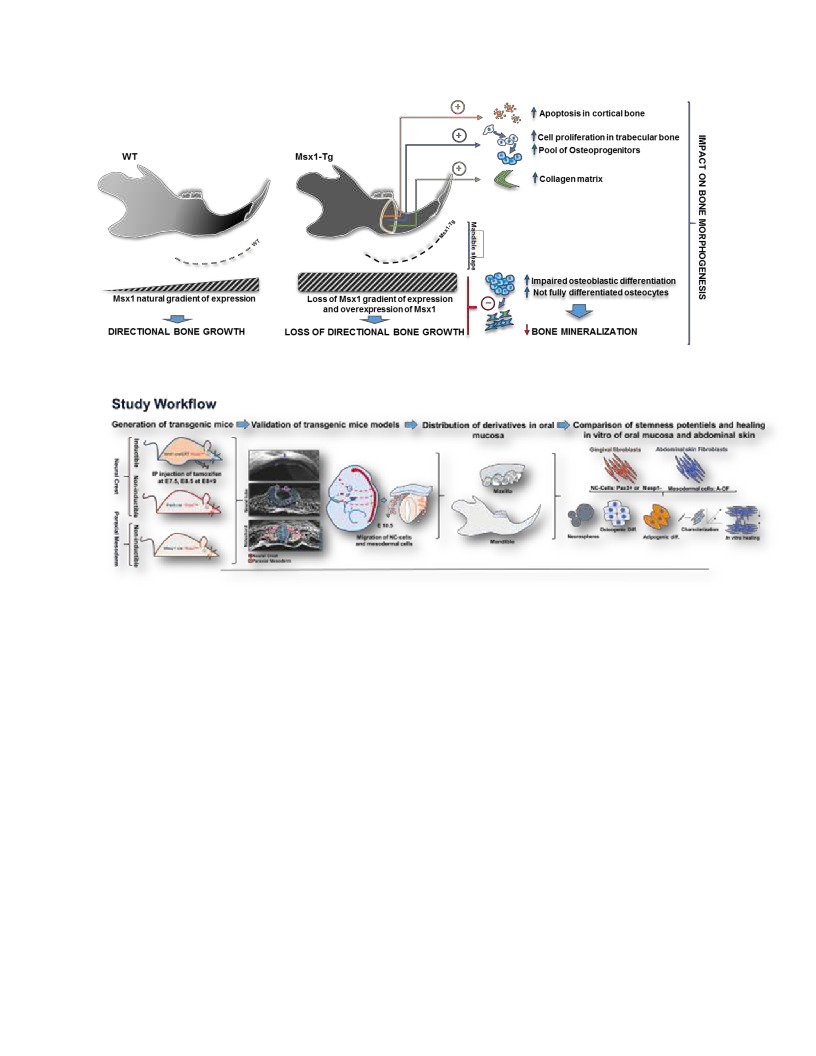
Methods: Firstly, to evaluate the role of homeobox gene Msx1, involved in the recruitment of progenitor cells and their differentiation in craniofacial morphogenesis. For this, we generated transgenic mice overexpressing Msx1 in osteoblasts and subsequently analysed their bone phenotype and then study the implication of Msx1 in alveolar bone healing that surrounds the teeth before and after bone loss (tooth extraction).
Secondly, to identify the embryonic origin of oral stem cells, including GSCs and determine if they are derived from the neural crest, mesodermal or a mosaic of both. We studied two mouse models to trace the CN waves of migration during embryonic life until adulthood.
Results: My PhD work has shown firstly the role of Msx1 gene in bone remodeling and craniofacial morphogenesis that regulates strictly the temporal-spatial level. on the other hand, and highlighted the embryological origin of oral stem cells which are derived from NC. We have shown that paraxial mesoderm is involved in angiogenesis of oral tissues during development and fully formed oral tissues.
Conclusions: The Neuroectodermal origin of GFs gives them their specific properties and their high regenerative potential and allows the use of such cells in cell therapy to regenerate the bones of oral sphere which have the same embryonic origin.
Methods: Firstly, to evaluate the role of homeobox gene Msx1, involved in the recruitment of progenitor cells and their differentiation in craniofacial morphogenesis. For this, we generated transgenic mice overexpressing Msx1 in osteoblasts and subsequently analysed their bone phenotype and then study the implication of Msx1 in alveolar bone healing that surrounds the teeth before and after bone loss (tooth extraction).
Secondly, to identify the embryonic origin of oral stem cells, including GSCs and determine if they are derived from the neural crest, mesodermal or a mosaic of both. We studied two mouse models to trace the CN waves of migration during embryonic life until adulthood.
Results: My PhD work has shown firstly the role of Msx1 gene in bone remodeling and craniofacial morphogenesis that regulates strictly the temporal-spatial level. on the other hand, and highlighted the embryological origin of oral stem cells which are derived from NC. We have shown that paraxial mesoderm is involved in angiogenesis of oral tissues during development and fully formed oral tissues.
Conclusions: The Neuroectodermal origin of GFs gives them their specific properties and their high regenerative potential and allows the use of such cells in cell therapy to regenerate the bones of oral sphere which have the same embryonic origin.
IMAGES
2941998_File000000.jpg
2941998_File000000.jpg