IADR Abstract Archives
Amalgam Shear Strength Under Submerged Condensation Conditions
Objectives: Dental amalgam has the reputation as a ‘forgiving’ restorative material regarding placement under less than ideal contamination conditions. This study designed a laboratory test to evaluate the null hypothesis that water- and saliva- contaminated samples will not significantly differ from the Control.
Methods: 45 Valiant PhD amalgam specimens were condensed in 3 groups (N=15): Group 1, Control (dry); Group 2, under Water; and Group 3, under Saliva. Specimens were condensed under continually flooded conditions with a minimum of 1 lb force using a 1.75 mm diameter condenser tip in a regular pattern of 11 strokes per layer of added amalgam. Each layer of amalgam was condensed into a 4 x 4 mm deep compartment flooded with the appropriate contaminating solution. The intermediate amalgam over-fill was removed with a flat-bladed instrument for a split-ring delrin disk with 3.5 x 3.5 mm diameter central hole to be immediately centered on top of the acrylic specimen cylinder. That hole was similarly flooded with contaminating fluid for the last increment of amalgam condensation per specimen. The control group was without fluid contamination. Shear strengths were tested with the Instron 3000 machine with cross-head speed of 0.5 mm/min. One-way ANOVA test was conducted to evaluate the difference among the groups. All tests were two-sided with alpha=0.05.
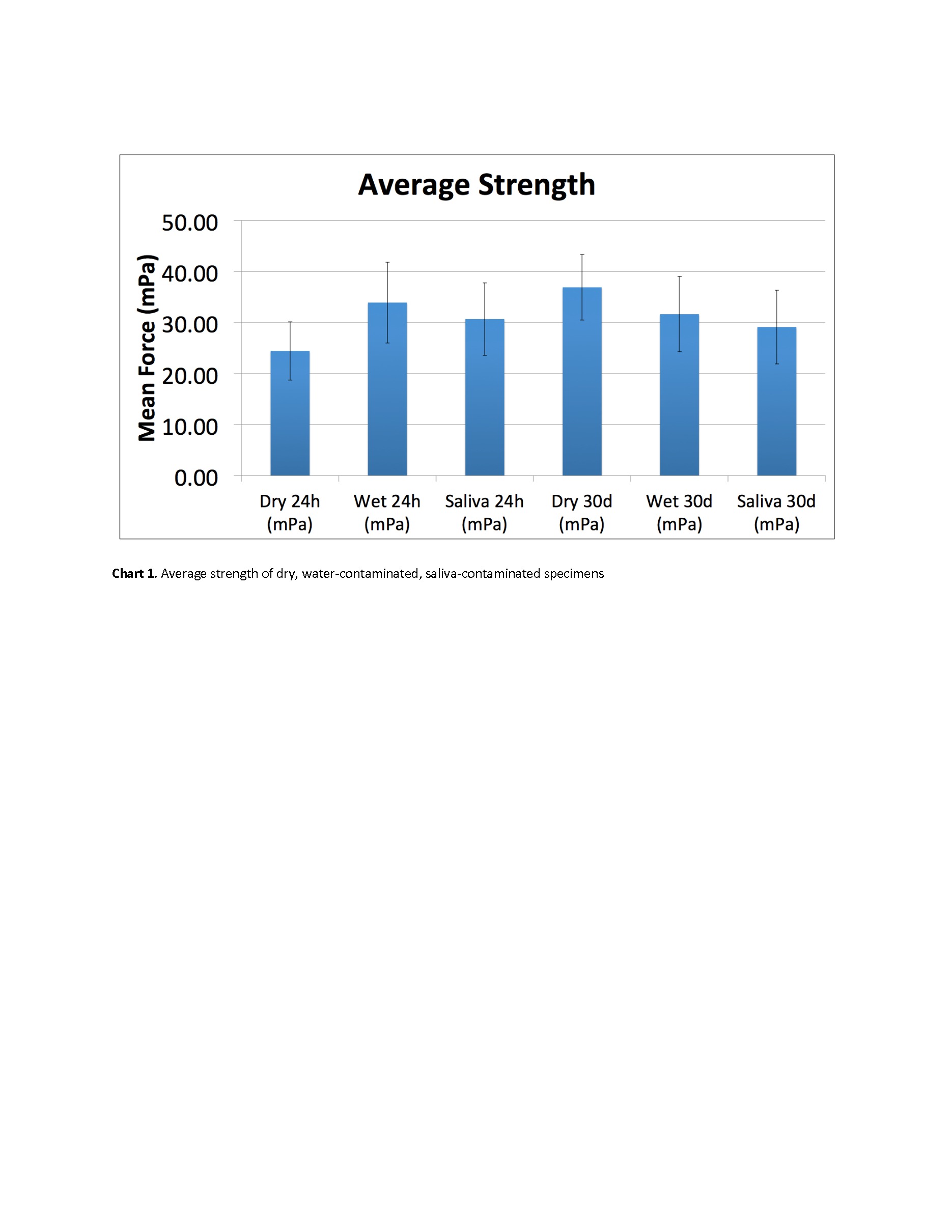
Results: Shear strength values (MPa) after 24 h at 37o C were as follows,
C = 24.42 (±5.72), W = 33.89 (±7.92), S = 30.67 (±7.12)
Shear strength values (MPa) after 30 d at 37o C were as follows,
C = 36.89 (±6.43), W = 31.63 (±7.35), S = 29.11 (±7.24)
Conclusions: Under the conditions of this study, shear strengths of amalgam condensed under extreme water and saliva contamination were significantly less relative to the control group after 30 days. Amalgam remains a very forgiving material in less than ideal situations.
Methods: 45 Valiant PhD amalgam specimens were condensed in 3 groups (N=15): Group 1, Control (dry); Group 2, under Water; and Group 3, under Saliva. Specimens were condensed under continually flooded conditions with a minimum of 1 lb force using a 1.75 mm diameter condenser tip in a regular pattern of 11 strokes per layer of added amalgam. Each layer of amalgam was condensed into a 4 x 4 mm deep compartment flooded with the appropriate contaminating solution. The intermediate amalgam over-fill was removed with a flat-bladed instrument for a split-ring delrin disk with 3.5 x 3.5 mm diameter central hole to be immediately centered on top of the acrylic specimen cylinder. That hole was similarly flooded with contaminating fluid for the last increment of amalgam condensation per specimen. The control group was without fluid contamination. Shear strengths were tested with the Instron 3000 machine with cross-head speed of 0.5 mm/min. One-way ANOVA test was conducted to evaluate the difference among the groups. All tests were two-sided with alpha=0.05.
Results: Shear strength values (MPa) after 24 h at 37o C were as follows,
C = 24.42 (±5.72), W = 33.89 (±7.92), S = 30.67 (±7.12)
Shear strength values (MPa) after 30 d at 37o C were as follows,
C = 36.89 (±6.43), W = 31.63 (±7.35), S = 29.11 (±7.24)
Conclusions: Under the conditions of this study, shear strengths of amalgam condensed under extreme water and saliva contamination were significantly less relative to the control group after 30 days. Amalgam remains a very forgiving material in less than ideal situations.
IMAGES
2869828_File000000.jpg
2869828_File000000.jpg