IADR Abstract Archives
The Pulp-dentin Complex-on-a-chip and 3D Bioprinting of Dentin-derived Hydrogels
Objectives: The pulp-dentin complex represents a unique microenvironment that is challenging to replicate. While the dentin matrix is increasingly seen as a dynamic tissue loaded with diffusible factors, the pulp represents a multi-typic tissue under constant fluid-flow, with well-defined 3D architectures, and spatiotemporal chemical gradients. Here we present two novel platforms that highlight these intricacies of the pulp-dentin complex: 1) a novel model of the pulp-dentin on-a-chip, and 2) 3D bioprinted tissue constructs using hydrogels constituted of dentin-derived molecules and growth factors.
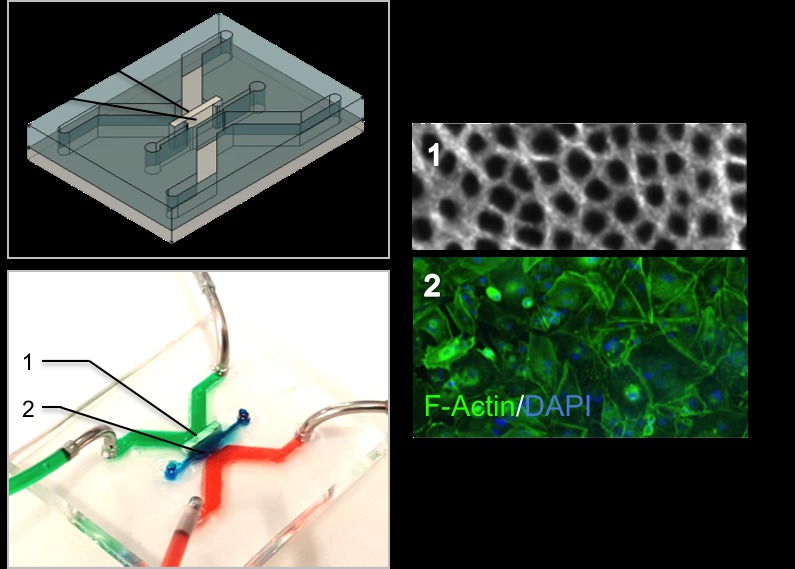
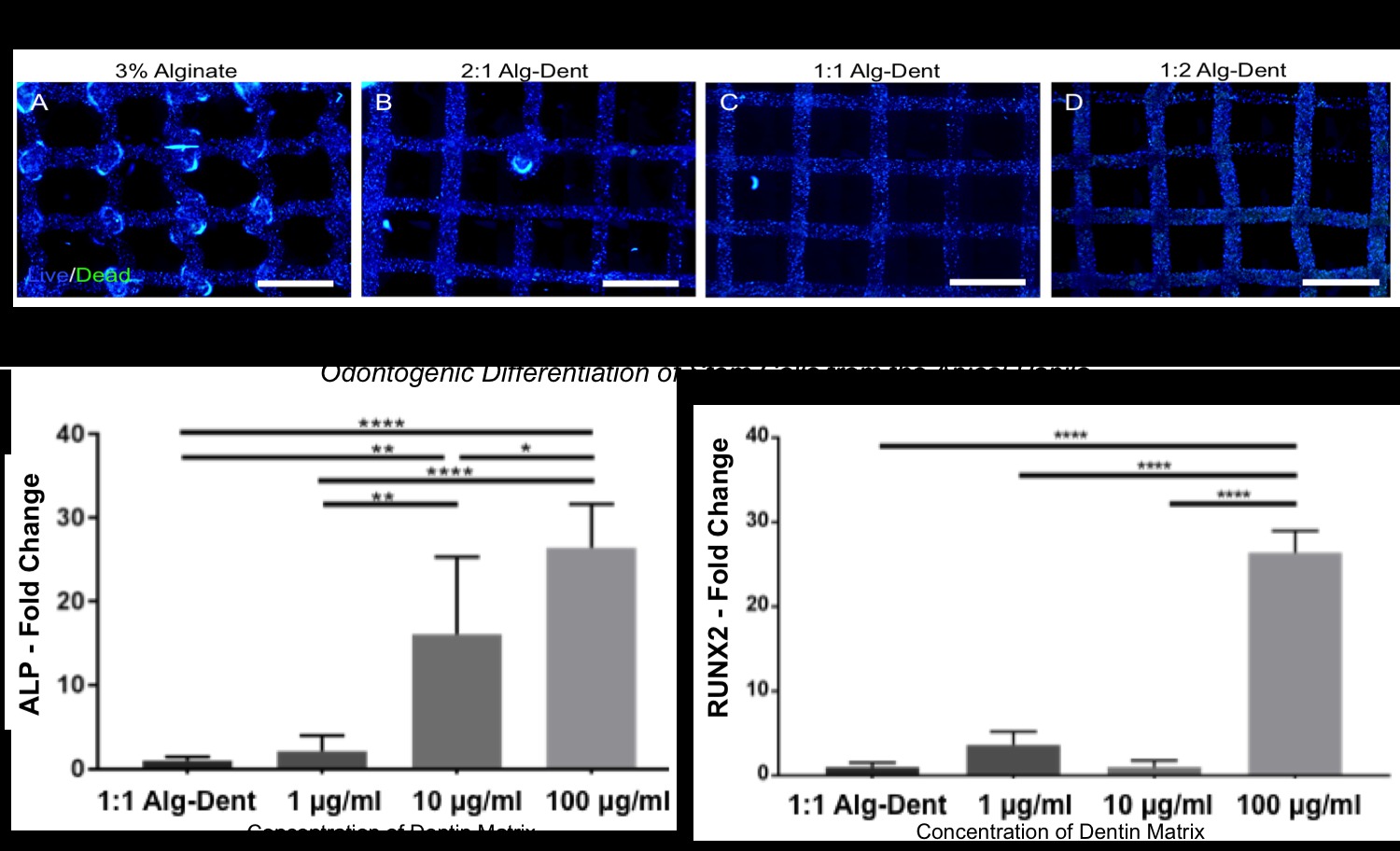
Methods: To develop the pulp-dentin on-a-chip we fabricated a poly dimethylsiloxane micro-fluidic device via a micromolding technique. In the microdevice a microchannel was fabricated directed at a chamber containing a precision-cut dentin fragment, which functions as permeable membrane. Across from the dentin fragment, a stem cell-laden photo-tunable hydrogel was loaded through a microfluidic inlet port, and the whole dentin-hydrogel interface perfused with medium through a separate microchannel. The process of fabrication and the resulting cell-viability in the device were characterized. Regarding the 3D bioprinting, a novel hydrogel bioink composed of dentin collagen and alginate hydrogel blends (2:1, 1:1 and 1:2) were mixed with soluble growth factors extracted from mineralized dentin, and bioprinted with SCAP cells. Cell-viability and differentiation were determined using a live/dead assay kit and RT-PCR. Data was analyzed using ANOVA and Tukey.
Results: The pulp-dentin complex on-a-chip was successfully fabricated and maintained under fluid-flow for at least 5d. Sustained cell-viability was observed across the pulp-dentin interface. The 3D bioprinted constructs showed that the alginate-dentin hydrogels with a 1:2 ratio had higher cell-viability, whereas increasing concentrations of dentin-derived growth factors increased the odontogenic differentiation of SCAP in a dose dependent manner.
Conclusions: The pulp-dentin complex on-a-chip and the 3D bioprinted dentin-derived hydrogels can be useful tools for future pulp regeneration studies and translational applications.
Methods: To develop the pulp-dentin on-a-chip we fabricated a poly dimethylsiloxane micro-fluidic device via a micromolding technique. In the microdevice a microchannel was fabricated directed at a chamber containing a precision-cut dentin fragment, which functions as permeable membrane. Across from the dentin fragment, a stem cell-laden photo-tunable hydrogel was loaded through a microfluidic inlet port, and the whole dentin-hydrogel interface perfused with medium through a separate microchannel. The process of fabrication and the resulting cell-viability in the device were characterized. Regarding the 3D bioprinting, a novel hydrogel bioink composed of dentin collagen and alginate hydrogel blends (2:1, 1:1 and 1:2) were mixed with soluble growth factors extracted from mineralized dentin, and bioprinted with SCAP cells. Cell-viability and differentiation were determined using a live/dead assay kit and RT-PCR. Data was analyzed using ANOVA and Tukey.
Results: The pulp-dentin complex on-a-chip was successfully fabricated and maintained under fluid-flow for at least 5d. Sustained cell-viability was observed across the pulp-dentin interface. The 3D bioprinted constructs showed that the alginate-dentin hydrogels with a 1:2 ratio had higher cell-viability, whereas increasing concentrations of dentin-derived growth factors increased the odontogenic differentiation of SCAP in a dose dependent manner.
Conclusions: The pulp-dentin complex on-a-chip and the 3D bioprinted dentin-derived hydrogels can be useful tools for future pulp regeneration studies and translational applications.
IMAGES
2865893_File000000.jpg
2865893_File000001.jpg
2865893_File000000.jpg
2865893_File000001.jpg