IADR Abstract Archives
Water Absorption and Solubility of Four Dental Composite Materials
Objectives: To determine the water absorption and solubility of four dental composite materials according to ISO 4049: 2009.
Methods: Four dental composite materials (n=11): Group 1: Filtek™ Supreme Ultra (3M), Group 2: Fuji II LC® (GC America), Group 3: Fuji IX GP® (GC America), Group 4: Ketac™ Nano (3M) were used to create 44 sample disks approximately 15mm in diameter and 1mm in depth. The disks were made according to each manufacturer’s specifications. A Demi™ (Kerr) dental curing light was used for light cured samples. Samples were desiccated at 37°C for 22 hours and ambient temperature overnight. Weight, thickness at 4 points, and diameter were measured at the start and again after 7 days in DI water at 37 °C. The samples were then measured over a three-week period until they achieved a constant mass. Water Absorption Percentage (WAP), Water Absorption (WA) per mg/mm3, Water Solubility Percentage (WSP), and Water Solubility (WS) per mg/mm3 were calculated and analysis was conducted using the one-way ANOVA test and post-hoc pairwise comparison using the Bonferroni method (Stata version 15). Results were considered significant if p<0.05.
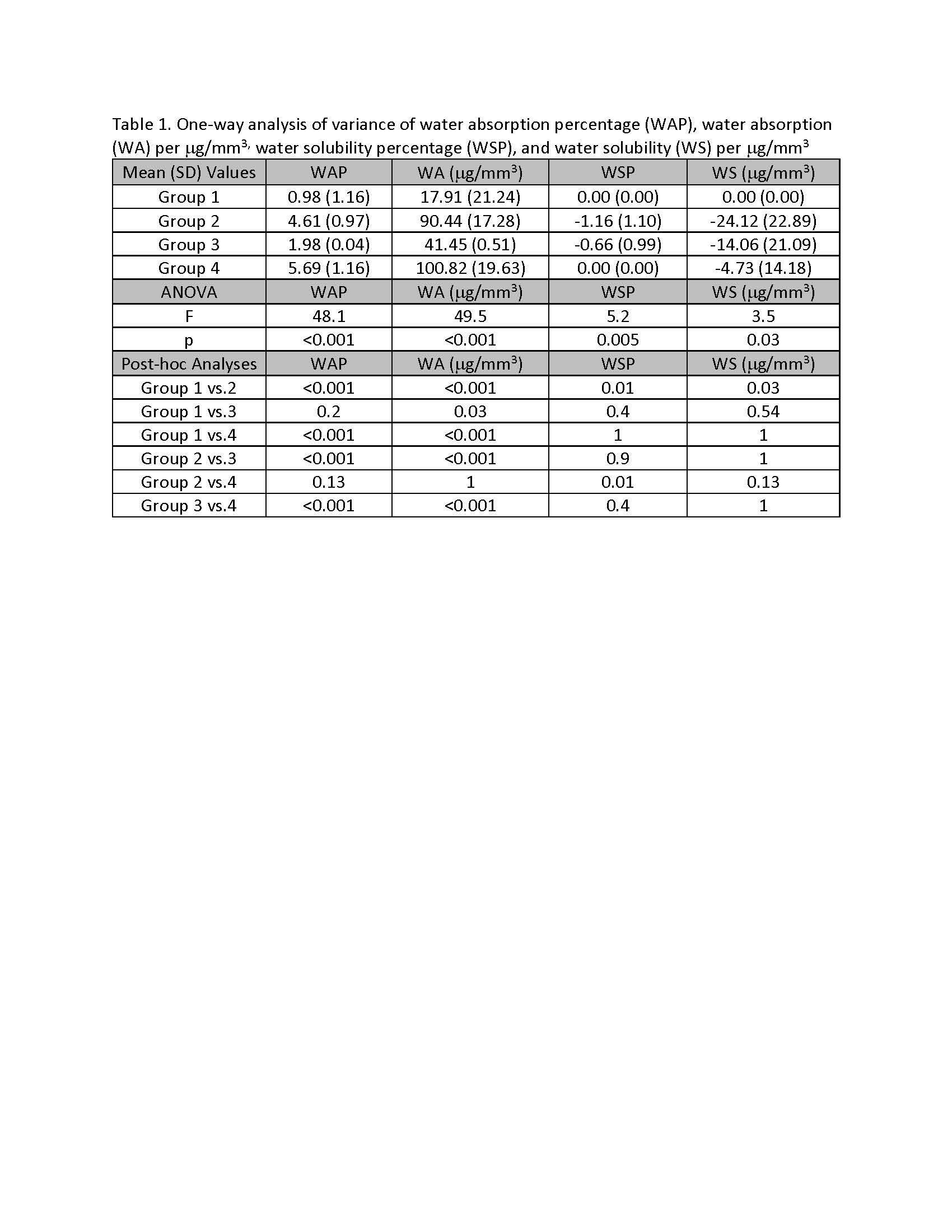
Results: There was a statistically significant difference in the WAP, WA, WSP, and WS between the four materials. In WAP and WA, Groups 1 and 3 each showed a significant difference when compared to Groups 2 and 4 (p<0.001). For WSP and WS, Group 1 showed a significant difference when compared to Group 2 (p<0.03).
Conclusions: Material resin and filler composition likely plays a role in water absorption and solubility. Groups 2 and 4 are both classic resin-modified glass ionomers (RGMIs). RMGIs typically absorb more water, as in the case with this study. Further testing is needed.
Methods: Four dental composite materials (n=11): Group 1: Filtek™ Supreme Ultra (3M), Group 2: Fuji II LC® (GC America), Group 3: Fuji IX GP® (GC America), Group 4: Ketac™ Nano (3M) were used to create 44 sample disks approximately 15mm in diameter and 1mm in depth. The disks were made according to each manufacturer’s specifications. A Demi™ (Kerr) dental curing light was used for light cured samples. Samples were desiccated at 37°C for 22 hours and ambient temperature overnight. Weight, thickness at 4 points, and diameter were measured at the start and again after 7 days in DI water at 37 °C. The samples were then measured over a three-week period until they achieved a constant mass. Water Absorption Percentage (WAP), Water Absorption (WA) per mg/mm3, Water Solubility Percentage (WSP), and Water Solubility (WS) per mg/mm3 were calculated and analysis was conducted using the one-way ANOVA test and post-hoc pairwise comparison using the Bonferroni method (Stata version 15). Results were considered significant if p<0.05.
Results: There was a statistically significant difference in the WAP, WA, WSP, and WS between the four materials. In WAP and WA, Groups 1 and 3 each showed a significant difference when compared to Groups 2 and 4 (p<0.001). For WSP and WS, Group 1 showed a significant difference when compared to Group 2 (p<0.03).
Conclusions: Material resin and filler composition likely plays a role in water absorption and solubility. Groups 2 and 4 are both classic resin-modified glass ionomers (RGMIs). RMGIs typically absorb more water, as in the case with this study. Further testing is needed.
IMAGES
2864502_File000000.jpg
2864502_File000000.jpg