IADR Abstract Archives
Biomimetic Intrafibrillar Mineralization of Collagen Membranes With Strontium-substituted Hydroxyapatite
Objectives: The polymer-induced liquid precursor (PILP) process is a biomimetic method to mineralize collagen with hydroxyapatite (HAp). Ionic substitution in HAp using PILP has been scarcely explored. Strontium is beneficial for bone formation and prevention of bone resorption. Sr-substituted HAp by direct synthesis in aqueous media has already been obtained where strontium replaced calcium in HAp in the whole range of composition. We aimed to obtain intrafibrillar mineralization of collagen membranes with Sr-substituted HAp by systematically modifying the biomimetic PILP process.
Methods: Crosslinked, reconstituted type-I collagen films were mineralized in seven modified PILP solutions (2.1mM K2HPO4 and 50mg/L PAA [Mw 450kDa]) with varying SrCl2:(CaCl2+SrCl2) ratios; from 1:100 to 1:2. Control solutions with 100% 4.5mM SrCl2 or CaCl2 were also tested. After 4 days of mineralization of the collagen membranes in the different mineralizing PILP solutions, samples were characterized via scanning electron microscopy (SEM), energy dispersive X-ray spectroscopy (EDS), Fourier-transformed infrared spectroscopy (FT-IR), and X-ray diffractometry (XRD).
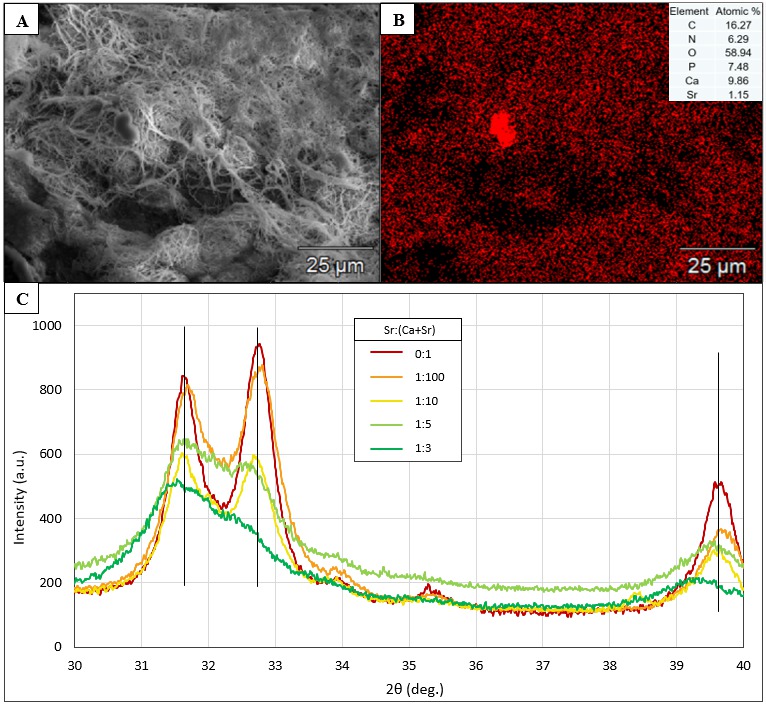
Results: Sr in modified PILP solutions delayed collagen mineralization compared to traditional PILP. SEM showed intrafibrillar mineralization in solutions with up to a 1:3 SrCl2:CaCl2 ratio. Higher Sr contents inhibited mineralization. Elemental mapping showed homogeneously distributed Sr, Ca, and P throughout the mineralized collagen. Collagen was mineralized with HAp crystals (Figure 1). (211) and (310) XRD peaks shifted to smaller 2θ-angles and broadened in solutions with increasing Sr, indicating changes in the crystal lattice due to the presence of larger Sr-substituting than Ca-substituted ions and a decrease in crystallinity, respectively. Thus, Sr substituted for Ca in HAp and increasingly stabilized the amorphous phase. The latter limited the Sr content that can be used in this system.
Conclusions: Intrafibrillar mineralization of collagen membranes with Sr-substituted HAp was obtained via a modified PILP process. The Sr-substituted HAp-mineralized collagen membranes can be further explored as candidates for bone regeneration applications.
Methods: Crosslinked, reconstituted type-I collagen films were mineralized in seven modified PILP solutions (2.1mM K2HPO4 and 50mg/L PAA [Mw 450kDa]) with varying SrCl2:(CaCl2+SrCl2) ratios; from 1:100 to 1:2. Control solutions with 100% 4.5mM SrCl2 or CaCl2 were also tested. After 4 days of mineralization of the collagen membranes in the different mineralizing PILP solutions, samples were characterized via scanning electron microscopy (SEM), energy dispersive X-ray spectroscopy (EDS), Fourier-transformed infrared spectroscopy (FT-IR), and X-ray diffractometry (XRD).
Results: Sr in modified PILP solutions delayed collagen mineralization compared to traditional PILP. SEM showed intrafibrillar mineralization in solutions with up to a 1:3 SrCl2:CaCl2 ratio. Higher Sr contents inhibited mineralization. Elemental mapping showed homogeneously distributed Sr, Ca, and P throughout the mineralized collagen. Collagen was mineralized with HAp crystals (Figure 1). (211) and (310) XRD peaks shifted to smaller 2θ-angles and broadened in solutions with increasing Sr, indicating changes in the crystal lattice due to the presence of larger Sr-substituting than Ca-substituted ions and a decrease in crystallinity, respectively. Thus, Sr substituted for Ca in HAp and increasingly stabilized the amorphous phase. The latter limited the Sr content that can be used in this system.
Conclusions: Intrafibrillar mineralization of collagen membranes with Sr-substituted HAp was obtained via a modified PILP process. The Sr-substituted HAp-mineralized collagen membranes can be further explored as candidates for bone regeneration applications.
IMAGES
2861040_File000000.jpg
2861040_File000000.jpg