IADR Abstract Archives
Endogenous Progenitor Cell-based Temporomandibular Joint Cartilage Repair
Objectives: Degeneration of cartilage surfaces in temporomandibular joint (TMJ) disorders cause pain and disability and seldom resolve spontaneously; thus, there is a need to develop regenerative therapies. In previous studies, we showed that endogenous progenitor cells have a promising potential for the regeneration of TMJ cartilage. The objective of this study was to determine the optimal conditions of WBC lysates and hydrogel for migration of progenitor cells, and to develop sustained delivery of N-[N-(3,5-Difluorophenacetyl)-L-alanyl]-S-phenylglycine t-butyl ester (DAPT) from polylactic-co-glycolic acid (PLGA) microspheres.
Methods: Progenitor cells from bovine TMJ cartilage were isolated and processed for cell migration assay using 8 µm-pore Transwell® plates with various concentrations of WBC lysates (0, 0.8, 2.5, 8.3 and 16.7 million cells/ml). The lysates were obtained by freeze/thaw method and measured for high mobility group box1 (HMGB1), a chemotactic agent. Full-thickness cartilage defects (4 mm-diameter) were implanted with different concentrations of fibrinogen (12.5, 15 and 20 mg/ml) and thrombin (5 and 10 U/ml) of fibrin/hyaluronic acid (HA) hydrogel. After 2-week of culture, wet weight and DNA content were measured from the hydrogel. Additionally, releasing kinetics of DAPT-encapsulated PLGA microspheres were tested.
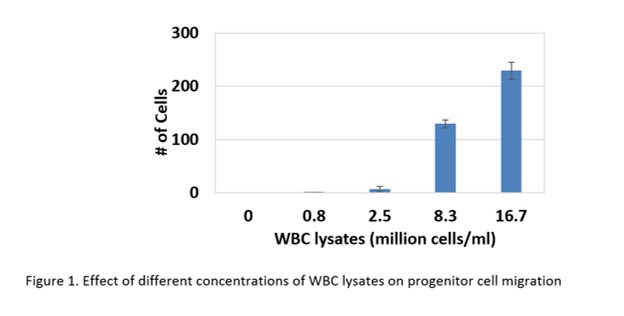
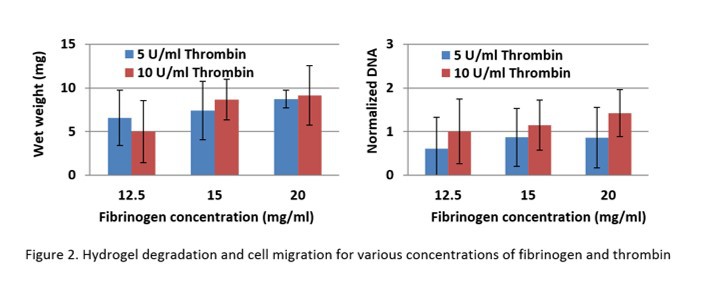
Results: HMGB1 was detected in WBC lysates and the migration of progenitor cells was dramatically enhanced at higher than 8.3 million cells/ml (Fig. 1). Hydrogel stability and cell migration were more effective in 20 mg/ml fibrinogen and 10 U/ml thrombin hydrogel but there were no significant differences (Fig. 2). DAPT release profile of PLGA microspheres demonstrated an initial burst release (40%) in first 24 hours, followed by a sustained release until 2 months.
Conclusions: Progenitor cell migration can be enhanced by optimizing WBC lysates concentration and composition of fibrin/HA gels. In future work, for optimal chondrogenic differentiation of migrating cells, we will modify PLGA microspheres to reduce the initial burst of DAPT.
Methods: Progenitor cells from bovine TMJ cartilage were isolated and processed for cell migration assay using 8 µm-pore Transwell® plates with various concentrations of WBC lysates (0, 0.8, 2.5, 8.3 and 16.7 million cells/ml). The lysates were obtained by freeze/thaw method and measured for high mobility group box1 (HMGB1), a chemotactic agent. Full-thickness cartilage defects (4 mm-diameter) were implanted with different concentrations of fibrinogen (12.5, 15 and 20 mg/ml) and thrombin (5 and 10 U/ml) of fibrin/hyaluronic acid (HA) hydrogel. After 2-week of culture, wet weight and DNA content were measured from the hydrogel. Additionally, releasing kinetics of DAPT-encapsulated PLGA microspheres were tested.
Results: HMGB1 was detected in WBC lysates and the migration of progenitor cells was dramatically enhanced at higher than 8.3 million cells/ml (Fig. 1). Hydrogel stability and cell migration were more effective in 20 mg/ml fibrinogen and 10 U/ml thrombin hydrogel but there were no significant differences (Fig. 2). DAPT release profile of PLGA microspheres demonstrated an initial burst release (40%) in first 24 hours, followed by a sustained release until 2 months.
Conclusions: Progenitor cell migration can be enhanced by optimizing WBC lysates concentration and composition of fibrin/HA gels. In future work, for optimal chondrogenic differentiation of migrating cells, we will modify PLGA microspheres to reduce the initial burst of DAPT.
IMAGES
2860672_File000000.jpg
2860672_File000001.jpg
2860672_File000000.jpg
2860672_File000001.jpg