IADR Abstract Archives
Biofilm Promotes Degradation of Composite Restoration Marginal Integrity
Objectives: Our objective was to investigate the effect of bacterial exposure on the margin integrity of dentin-resin interfaces for composites with and without bioactive glass.
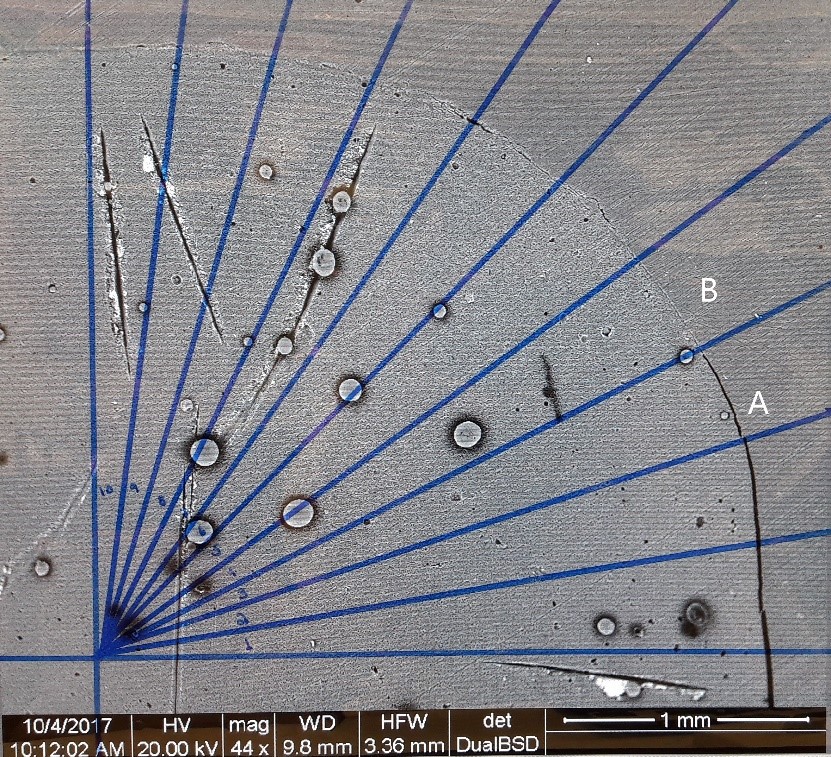
Methods: Cavity preparations (5mm diameterx1.5mm deep) were machined into human dentin disks (3mm thick) with a CNC milling system. After applying and light-curing (10s at 900 mW/cm2) the bonding agent (Clearfil SE Bond), preps (n=3) were restored by incremental technique with experimental resin composites (50:50 BisGMA/TEGDMA: 72wt% filler) containing different filler composition: (57wt% silanated strontium glass/15wt% bioactive glass (BAG-65wt% silica) or 67wt% silanated strontium glass/5% OX50). Each increment was light-cured for 20s. Samples of both groups were co-incubated with a constitutive luciferase reporter strain of Streptococcus mutans (UA159), in 5% CO2, under constant shaking at 40 rpm (37°C). Media (TH) was changed daily for 2 weeks. Biofilm presence and viability at 2 weeks was confirmed by means of a luciferase assay. Surfaces were replicated (PVS impression/epoxy resin) and examined in the SEM before and after the bacterial exposure. Percentage of discontinuous margins (%DM) was quantitatively assessed along the marginal interface (divided into 40 equal arcs), identifying the presence (A) or absence (B) of discontinuity in each segment (Figure 1). Analysis was done by a single calibrated examiner (intra-observer kappa > 0.70) and analyzed by Repeated measures ANOVA (α=0.05).
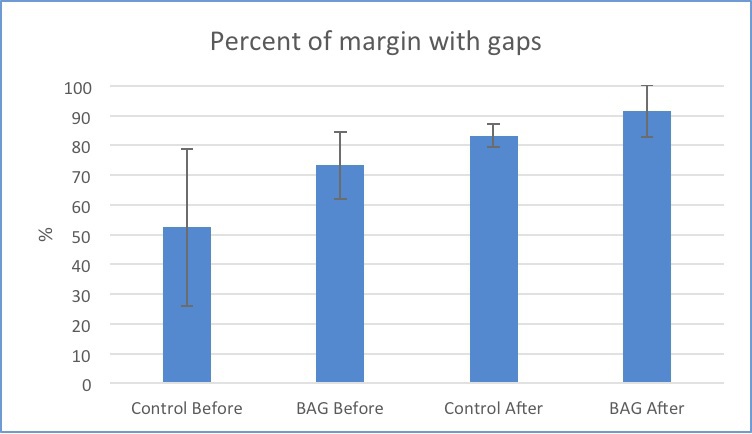
Results: Gap size ranged between 7-23µm (before and after samples). The bacterial exposure significantly increased the %DM in both groups (Figure 2), predominantly due to the formation of new gap regions. Most samples assessed after the biodegradation also showed dentin cracks near the dentin-composite interface (not present in the before replicas) and dentin demineralization; all corresponding with the increase in gaps. There was no difference between control and BAG composites.
Conclusions: Bacterial exposure promoted further degradation of composite restoration marginal integrity, with no difference between composites with and without bioactive glass.
Methods: Cavity preparations (5mm diameterx1.5mm deep) were machined into human dentin disks (3mm thick) with a CNC milling system. After applying and light-curing (10s at 900 mW/cm2) the bonding agent (Clearfil SE Bond), preps (n=3) were restored by incremental technique with experimental resin composites (50:50 BisGMA/TEGDMA: 72wt% filler) containing different filler composition: (57wt% silanated strontium glass/15wt% bioactive glass (BAG-65wt% silica) or 67wt% silanated strontium glass/5% OX50). Each increment was light-cured for 20s. Samples of both groups were co-incubated with a constitutive luciferase reporter strain of Streptococcus mutans (UA159), in 5% CO2, under constant shaking at 40 rpm (37°C). Media (TH) was changed daily for 2 weeks. Biofilm presence and viability at 2 weeks was confirmed by means of a luciferase assay. Surfaces were replicated (PVS impression/epoxy resin) and examined in the SEM before and after the bacterial exposure. Percentage of discontinuous margins (%DM) was quantitatively assessed along the marginal interface (divided into 40 equal arcs), identifying the presence (A) or absence (B) of discontinuity in each segment (Figure 1). Analysis was done by a single calibrated examiner (intra-observer kappa > 0.70) and analyzed by Repeated measures ANOVA (α=0.05).
Results: Gap size ranged between 7-23µm (before and after samples). The bacterial exposure significantly increased the %DM in both groups (Figure 2), predominantly due to the formation of new gap regions. Most samples assessed after the biodegradation also showed dentin cracks near the dentin-composite interface (not present in the before replicas) and dentin demineralization; all corresponding with the increase in gaps. There was no difference between control and BAG composites.
Conclusions: Bacterial exposure promoted further degradation of composite restoration marginal integrity, with no difference between composites with and without bioactive glass.
IMAGES
2860340_File000000.jpg
2860340_File000001.jpg
2860340_File000000.jpg
2860340_File000001.jpg