IADR Abstract Archives
Clinical Performance of Three Composite Resins Incrementally or Bulk Placed
Objectives: Traditionally resin restorations have been placed in 2 mm increments, recently a flowable resin composite has developed to be placed and cured in 4mm increments. This 1 year report of a 3 year study compares the clinical success of 3 composites (2 incrementally cured and 1 bulk cured) in posterior restorations.
Methods: 40 subjects were recruited needing 3 Class I and or II restoration following IRB approval. Prepared teeth had Isthmus widths no greater than 1/3 the intercuspal distance and opposed natural or prosthetic teeth. Teeth were prepared without bevels using electric handpieces with water spray. A liner was placed for deep cavity preparations. Scotchbond Universal bonding agent (3M ESPE), was used in the total-etch mode for all restorations. The adhesive and composite were polymerized (Elipar Deep Cure-S Curing Light 3M ESPE) with an output >1000 mW/cm2. Filtek Supreme Ultra Universal and Flowable Restorative were placed using a 2 mm incremental fill technique. The Bulk Fill Flowable Restorative was placed and cured in 4 mm increments. Restorations were finished with carbide finishing burs, finishing strips and disks (Sof-Lex, 3M, St Paul, MN), and the Sof-Lex Diamond Polishing System (15-18,000 rpm) with water spray). After rubber dam removal and polishing the restoration; digital images and a conventional impression (Imprint 4, 3M ESPE) of the restoration was made. Restorations evaluated with modified FDI criteria, data compared with Kruskal Wallis test.
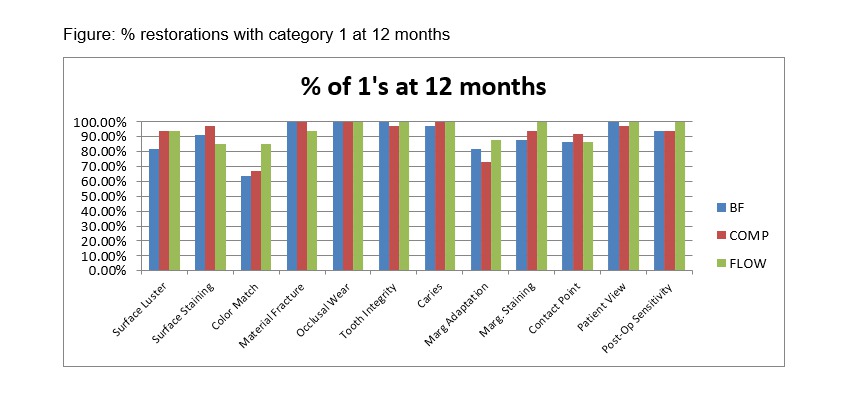
Results: See Figure. There were no significant differences between materials for any FDI criteria (p>.05).
Conclusions: At 12 months, the flowable bulk cured restorations functioned as well as the highly filled incrementally placed material. A nonsignificant (p>.05) and decrease in marginal adaptation occurred at 12 months for all materials. At 12 months, the esthetics and function of the restorations was excellent.
Methods: 40 subjects were recruited needing 3 Class I and or II restoration following IRB approval. Prepared teeth had Isthmus widths no greater than 1/3 the intercuspal distance and opposed natural or prosthetic teeth. Teeth were prepared without bevels using electric handpieces with water spray. A liner was placed for deep cavity preparations. Scotchbond Universal bonding agent (3M ESPE), was used in the total-etch mode for all restorations. The adhesive and composite were polymerized (Elipar Deep Cure-S Curing Light 3M ESPE) with an output >1000 mW/cm2. Filtek Supreme Ultra Universal and Flowable Restorative were placed using a 2 mm incremental fill technique. The Bulk Fill Flowable Restorative was placed and cured in 4 mm increments. Restorations were finished with carbide finishing burs, finishing strips and disks (Sof-Lex, 3M, St Paul, MN), and the Sof-Lex Diamond Polishing System (15-18,000 rpm) with water spray). After rubber dam removal and polishing the restoration; digital images and a conventional impression (Imprint 4, 3M ESPE) of the restoration was made. Restorations evaluated with modified FDI criteria, data compared with Kruskal Wallis test.
Results: See Figure. There were no significant differences between materials for any FDI criteria (p>.05).
Conclusions: At 12 months, the flowable bulk cured restorations functioned as well as the highly filled incrementally placed material. A nonsignificant (p>.05) and decrease in marginal adaptation occurred at 12 months for all materials. At 12 months, the esthetics and function of the restorations was excellent.
IMAGES
2857283_File000000.jpg
2857283_File000000.jpg