IADR Abstract Archives
Comparison of Open-Sandwich, Bulk-fill and Preheated-Composite Techniques on Microleakage of Subgingival Class-II-Restorations
Objectives: It is a challenge to achieve successful marginal seal in deep,subgingival Class-II restorations. The aim of this in-vitro study was to evaluate the microleakage in gingival(cementum) and occlusal(enamel) cavosurface-margins of resin restorations using Open-Sandwich(OST), Bulk-fill and Preheated-composite techniques. Additionally, the interphase between resin and the initial layer as glass-inomer(GI), resin-modified-glass-ionomer(RMGI) and flowable-composite(FC) was evaluated
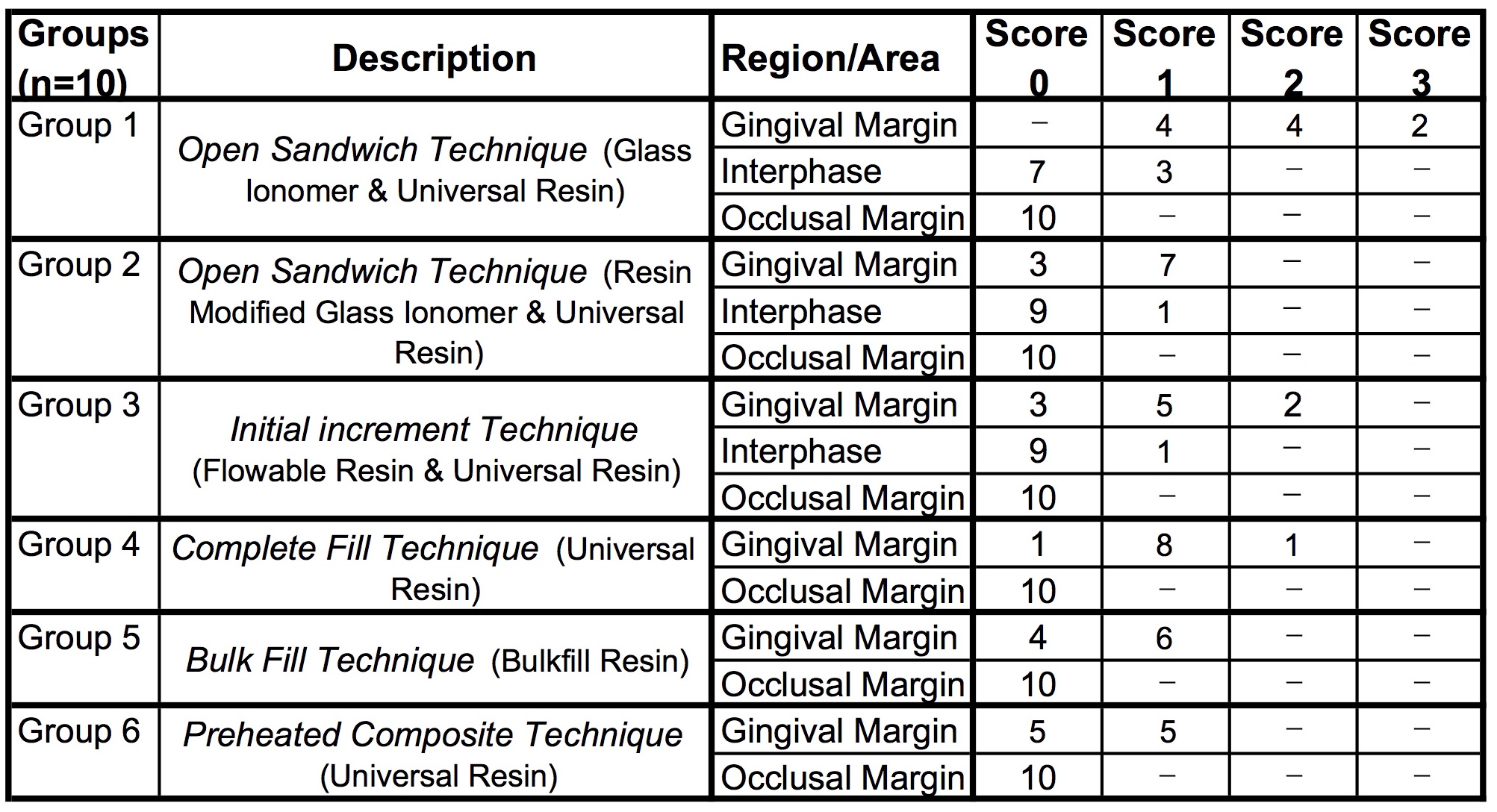
Methods: A total of 60 extracted sound-human-molars were used to prepare Class-II slot preparations(flat occlusal, 3x2mm box, 1mm gingival-floor,1mm below CEJ). Six study groups(n=10) included OST using universal-resin(Filtek-Supreme-Ultra) with GI(Fuji-IX)(Gr 1), OST with RMGI(Fuji-II)(Gr2), universal-resin with initial FC layering(Filtek-Supreme-Ultra-Flow)(Gr3), complete-fill(incrementally-cured) universal-resin(Gr4), Bulk-fill composite(Filtek Bulk-Fill)(Gr5) and preheated-composite(Calset-Tritray/heater)(Gr6). After the restorations, all samples were stored in 37°C water for 24hrs(Isotemp/Incubator) and thermocycled for 1500 cycles(5-55°C, 1min dwell-time). Teeth were sealed at the apices, coated with two-applications of nail varnish(1mm from the margins) and immersed in a freshly prepared 1%methylene blue solution(pH 7.0)(Icca) for 4hrs(37°C), then washed with water. Samples were fully embedded in clear-acrylic(Orthojet) using 10x10mm moulds to prevent sample-loss during sectioning. Teeth inside the acrylic blocks were sectioned vertically(1mm intervals) using a slow diamond saw(Isomet). All samples were evaluated under a digital light microscope(Olympus SZX7,40x) and were scored for microleakage(0=No dye penetration;1=up to 1/3 wall;2= up to 2/3 of wall;3= more than 2/3 wall). Results were statistically evaluated using Fisher’s Exact Test.
Results: OST using conventional-GI showed the most amount of microleakage in the subgingival-margins and the interphase(p<0.001). Bulk -fill and preheated-composite techniques showed better results compared to other groups but data was not statistically different between groups 2-6. All techniques performed well on enamel(occlusal).
Conclusions: OST technique using conventional-GI caused more microleakage in subgingival Class-II restorations. All other techniques performed similarly.
Methods: A total of 60 extracted sound-human-molars were used to prepare Class-II slot preparations(flat occlusal, 3x2mm box, 1mm gingival-floor,1mm below CEJ). Six study groups(n=10) included OST using universal-resin(Filtek-Supreme-Ultra) with GI(Fuji-IX)(Gr 1), OST with RMGI(Fuji-II)(Gr2), universal-resin with initial FC layering(Filtek-Supreme-Ultra-Flow)(Gr3), complete-fill(incrementally-cured) universal-resin(Gr4), Bulk-fill composite(Filtek Bulk-Fill)(Gr5) and preheated-composite(Calset-Tritray/heater)(Gr6). After the restorations, all samples were stored in 37°C water for 24hrs(Isotemp/Incubator) and thermocycled for 1500 cycles(5-55°C, 1min dwell-time). Teeth were sealed at the apices, coated with two-applications of nail varnish(1mm from the margins) and immersed in a freshly prepared 1%methylene blue solution(pH 7.0)(Icca) for 4hrs(37°C), then washed with water. Samples were fully embedded in clear-acrylic(Orthojet) using 10x10mm moulds to prevent sample-loss during sectioning. Teeth inside the acrylic blocks were sectioned vertically(1mm intervals) using a slow diamond saw(Isomet). All samples were evaluated under a digital light microscope(Olympus SZX7,40x) and were scored for microleakage(0=No dye penetration;1=up to 1/3 wall;2= up to 2/3 of wall;3= more than 2/3 wall). Results were statistically evaluated using Fisher’s Exact Test.
Results: OST using conventional-GI showed the most amount of microleakage in the subgingival-margins and the interphase(p<0.001). Bulk -fill and preheated-composite techniques showed better results compared to other groups but data was not statistically different between groups 2-6. All techniques performed well on enamel(occlusal).
Conclusions: OST technique using conventional-GI caused more microleakage in subgingival Class-II restorations. All other techniques performed similarly.
IMAGES
2855501_File000000.jpg
2855501_File000000.jpg