IADR Abstract Archives
Hydrogen Peroxide Temporarily Increases the Jun-D Expression in Dental Pulp
Objectives: This study evaluated the effects of the hydrogen peroxide (H2O2) from bleaching gel in the expression Jun-D, a differentiation marker of odontoblasts-like cells.
Methods: Randomly, the maxillary molars from 60 Wistar rats were treated with 35% H2O2 (Bleached group), or placebo gel (Control). At 0 hours, 2, 3, 7, 15 and 30 days (n=10), the rats were killed and their jaws removed for histological and immunohistochemical analysis of Jun-D. Statistical tests were performed (P<.05).
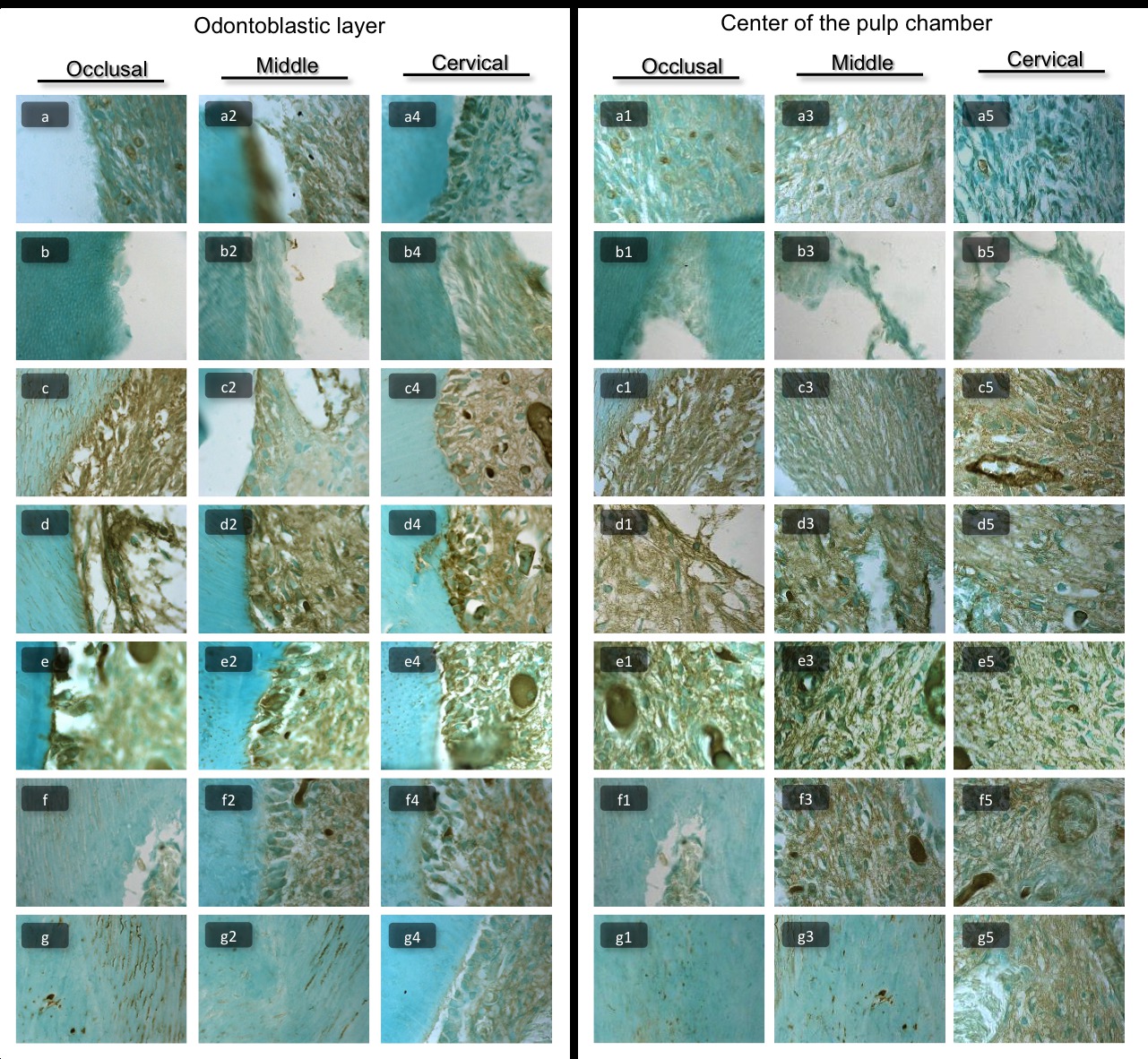
Results: Immediately after the bleaching, and at 2 and 3 days, there was necrosis in the in the occlusal third of the coronary pulp; in other periods there was no inflammation, as in the control group (P>.05). Tertiary dentin was present at 7 days, increasing over time (P<.05). In odontoblastic layer, the control group had higher immunolabeling of Jun-D compared to bleached group in the occlusal and middle thirds at 0 hours, 2 and 30 days, and in occlusal third at 3 days (P<.05), as well as compared to occlusal third at 15 days (P<.05); and only occlusal third at 3 and 30 days (P<.05). Higher immunolabeling was observed at 7 days in occlusal and middle thirds of bleached group compared to most periods, and in cervical third compared to 30 days (P<.05). In the center of the pulp chamber, higher immunolabeling was observed at 7 and 15 days in the middle and cervical thirds of the bleached group compared to the control (P<.05); all thirds at 7 days, and in middle and cervical thirds at 15 days, had higher immunolabeling compared to 0 h and 30 days after bleaching (P<.05).
Conclusions: The H2O2 temporarily increases Jun-D immunolabeling in pulp tissue, while inflammation is reduced and begins the formation of tertiary dentin; after, the Jun-D immunolabeling returns to normal level.
Methods: Randomly, the maxillary molars from 60 Wistar rats were treated with 35% H2O2 (Bleached group), or placebo gel (Control). At 0 hours, 2, 3, 7, 15 and 30 days (n=10), the rats were killed and their jaws removed for histological and immunohistochemical analysis of Jun-D. Statistical tests were performed (P<.05).
Results: Immediately after the bleaching, and at 2 and 3 days, there was necrosis in the in the occlusal third of the coronary pulp; in other periods there was no inflammation, as in the control group (P>.05). Tertiary dentin was present at 7 days, increasing over time (P<.05). In odontoblastic layer, the control group had higher immunolabeling of Jun-D compared to bleached group in the occlusal and middle thirds at 0 hours, 2 and 30 days, and in occlusal third at 3 days (P<.05), as well as compared to occlusal third at 15 days (P<.05); and only occlusal third at 3 and 30 days (P<.05). Higher immunolabeling was observed at 7 days in occlusal and middle thirds of bleached group compared to most periods, and in cervical third compared to 30 days (P<.05). In the center of the pulp chamber, higher immunolabeling was observed at 7 and 15 days in the middle and cervical thirds of the bleached group compared to the control (P<.05); all thirds at 7 days, and in middle and cervical thirds at 15 days, had higher immunolabeling compared to 0 h and 30 days after bleaching (P<.05).
Conclusions: The H2O2 temporarily increases Jun-D immunolabeling in pulp tissue, while inflammation is reduced and begins the formation of tertiary dentin; after, the Jun-D immunolabeling returns to normal level.
IMAGES
![Figure 1. Panoramic microscopic aspect of control group showing normal pulp tissue and (A,a) cervical third of the coronary pulp with organised pulp tissue; 0 h: bleached group immediately after dental bleaching, showing an extensive area of necrosis and (B,b) absence of cellularity; 2 and 3 days : bleached group at 2 and 3 days with regions of necrosis in the disorganized pulp tissue and (C,c; D,d) evident tissue disorganisation; 7 days: bleached group at 7 days showing organised pulp tissue and areas of tertiary dentine, and (E,e) cervical third of the coronary pulp with the formation of odontoblastic-like cells; 15 days: bleached group at 15 days with intact pulp tissue and presence of tertiary dentine, and (F,f) higher magnification showing pulp organisation; 30 days: bleached group at 30 days with tissue organisation and (G,g) absence of inflammation and deposition of tertiary dentine. (100×, 400×, 1000×: haematoxylin–eosin [H.E.])](https://iadr.abstractarchives.com/efs/47am/all_submission_types/all_abstract_statuses/images/2855386.jpg)
2855386_File000000.jpg
2855386_File000001.jpg
2855386_File000000.jpg
2855386_File000001.jpg