IADR Abstract Archives
Effects of pH on Shear Bond Strength of Bioactive Cement
Objectives: To test the effects of pH levels on shear bond strength (SBS) of bioactive cement and a resin cement to dentin.
Methods: Extracted human teeth were used for dentin samples, and divided into two storage time periods, 24 hours and 1 week (n=30 per group). Within each time period the samples were divided into three storage solutions: artificial saliva pH 7, artificial saliva pH 3, and deionized water (n=15 per group). Before storage a button of cement bonded to the dentin samples. Cements used were RelyXTM Unicem 2 Self-Adhesive Resin Cement (R- resin)) and Ceramir® Crown & Bridge (BA - bioactive). Product was applied following manufacturer’s guidelines. After the designated storage time, teeth were dried and tested. SBS was tested using a universal testing machine (Instron® 5566A, Norwood, MA); crosshead speed moved at 5mm/min until failure. A two-way ANOVA with check for normalization was done for analysis.
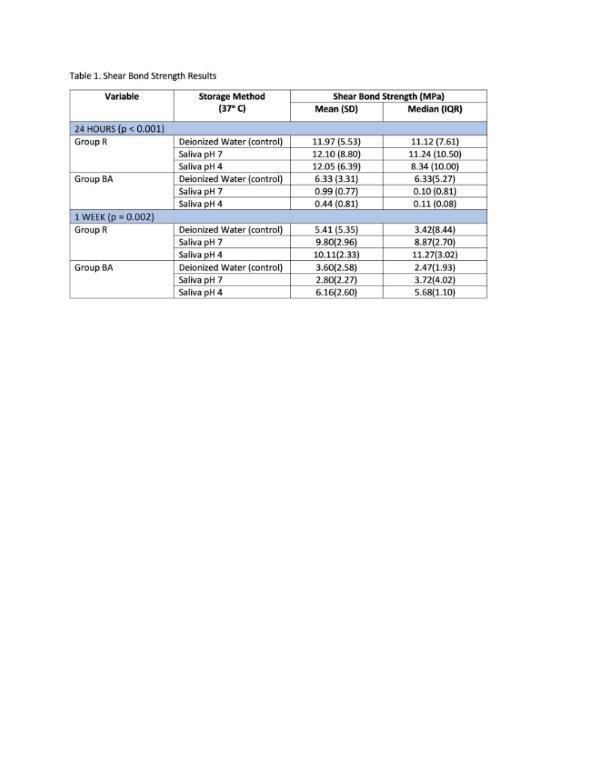
Results: Means, medians, standard deviations (SD), and interquartile ranges (IQRs) for compressive stress at maximum compressive load were calculated (Table 1). For the 24 hour group, there was a statistically significant difference in mean compressive stress at maximum compressive load between Group R and BA (p < 0.001). There was not a statistically significant difference in compressive stress at maximum compressive load between any of the conditions (p = 0.33). For the 1 week storage group there was a statistically significant difference in mean compressive stress at maximum compressive load between Group R and BA (p = 0.002). There was not a statistically significant difference in compressive stress at maximum compressive load between any of the conditions (p = 0.06).
Conclusions: Across all conditions Group R showed a stronger bonding to dentin in the testing conditions than Group BA.
Methods: Extracted human teeth were used for dentin samples, and divided into two storage time periods, 24 hours and 1 week (n=30 per group). Within each time period the samples were divided into three storage solutions: artificial saliva pH 7, artificial saliva pH 3, and deionized water (n=15 per group). Before storage a button of cement bonded to the dentin samples. Cements used were RelyXTM Unicem 2 Self-Adhesive Resin Cement (R- resin)) and Ceramir® Crown & Bridge (BA - bioactive). Product was applied following manufacturer’s guidelines. After the designated storage time, teeth were dried and tested. SBS was tested using a universal testing machine (Instron® 5566A, Norwood, MA); crosshead speed moved at 5mm/min until failure. A two-way ANOVA with check for normalization was done for analysis.
Results: Means, medians, standard deviations (SD), and interquartile ranges (IQRs) for compressive stress at maximum compressive load were calculated (Table 1). For the 24 hour group, there was a statistically significant difference in mean compressive stress at maximum compressive load between Group R and BA (p < 0.001). There was not a statistically significant difference in compressive stress at maximum compressive load between any of the conditions (p = 0.33). For the 1 week storage group there was a statistically significant difference in mean compressive stress at maximum compressive load between Group R and BA (p = 0.002). There was not a statistically significant difference in compressive stress at maximum compressive load between any of the conditions (p = 0.06).
Conclusions: Across all conditions Group R showed a stronger bonding to dentin in the testing conditions than Group BA.
IMAGES
2855115_File000001.jpg
2855115_File000001.jpg