IADR Abstract Archives
Effect of 30° Taper on Molar CAD/CAM Crown Retention
Objectives: To evaluate molar axial wall height effect on retention of adhesively bonded lithium disilicate CAD/CAM crowns with a 30° total occlusal convergence.
Methods: Sixty recently-extracted molars were divided into 5 groups (n=12). Each group received standardized 30° taper all-ceramic crown preparations accomplished using a high speed handpiece inserted into a milling device. Groups consisted of preparations with axial wall heights of zero, one, two, three, or four millimeters. The surface area of the completed preparations was determined using a digital measuring microscope (Hirox). Preparations were digitally captured (CEREC OmniCam) and crowns were designed using “Biogeneric Copy” of a standard waxing. Lithium disilicate crowns were milled (CEREC MC XL), crystallized, intaglio surfaces etched and coupling agent applied (e.max CAD, IPS Ceramic Etching Gel, Clearfil Ceramic Primer; Ivoclar Vivadent). Crowns were cemented with a self-adhesive resin cement (RelyX Unicem2, 3M ESPE). All manufacturer recommendations were followed. Specimens were stored for 24 hours and then tested to failure at a 45-degree angle on a universal testing machine. Failure load was converted in MPa using the available bonding surface area with mean data analyzed using Kruskal-Wallis/Dunn’s post hoc test (p=0.05).
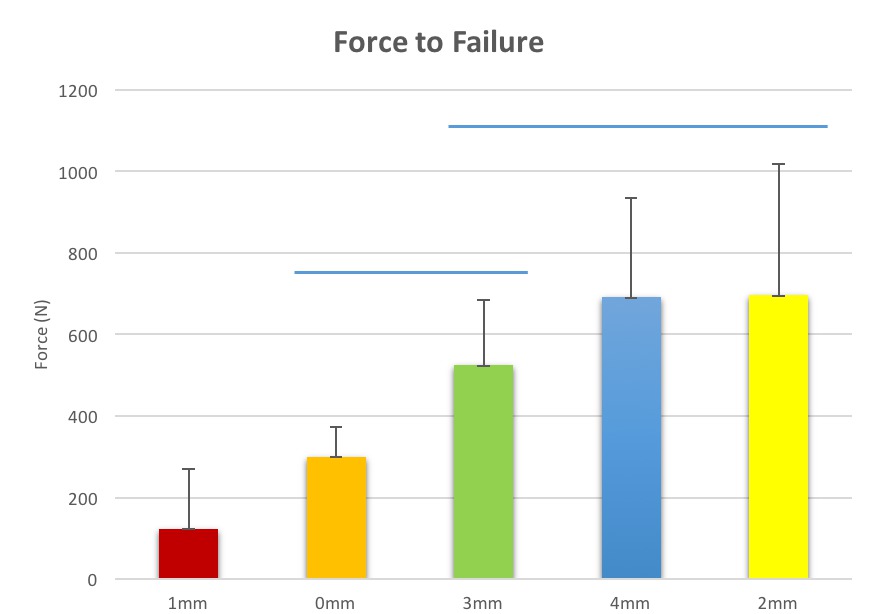
Results: Results show a significant difference within the groups. The 2 and 4 mm axial wall height preparations displayed significantly higher failure strength than 0 and 1 mm groups.
Conclusions: Under the conditions of this study, our findings suggest adhesion may compensate for a less than optimal 30° total occlusal convergence at axial wall heights between 2-4 mm in all-ceramic molar preparations.
Methods: Sixty recently-extracted molars were divided into 5 groups (n=12). Each group received standardized 30° taper all-ceramic crown preparations accomplished using a high speed handpiece inserted into a milling device. Groups consisted of preparations with axial wall heights of zero, one, two, three, or four millimeters. The surface area of the completed preparations was determined using a digital measuring microscope (Hirox). Preparations were digitally captured (CEREC OmniCam) and crowns were designed using “Biogeneric Copy” of a standard waxing. Lithium disilicate crowns were milled (CEREC MC XL), crystallized, intaglio surfaces etched and coupling agent applied (e.max CAD, IPS Ceramic Etching Gel, Clearfil Ceramic Primer; Ivoclar Vivadent). Crowns were cemented with a self-adhesive resin cement (RelyX Unicem2, 3M ESPE). All manufacturer recommendations were followed. Specimens were stored for 24 hours and then tested to failure at a 45-degree angle on a universal testing machine. Failure load was converted in MPa using the available bonding surface area with mean data analyzed using Kruskal-Wallis/Dunn’s post hoc test (p=0.05).
Results: Results show a significant difference within the groups. The 2 and 4 mm axial wall height preparations displayed significantly higher failure strength than 0 and 1 mm groups.
Conclusions: Under the conditions of this study, our findings suggest adhesion may compensate for a less than optimal 30° total occlusal convergence at axial wall heights between 2-4 mm in all-ceramic molar preparations.
IMAGES
2855080_File000000.jpg
2855080_File000000.jpg