IADR Abstract Archives
Storage Temperature Effect on Fluoride Varnishes: Bioavailable Fluoride and Viscosity
Objectives: Dental materials may be affected by extreme climate conditions in resource-limited countries. The aim of this study was to assess the effect of temperature on viscosity and bioavailability of fluoride in fluoride varnish preparations.
Methods: To measure viscosity and fluoride concentrations, each test had twenty samples where 5 samples were from each brand of fluoride products (n=5). Group A: Acclean® 5% Sodium Fluoride Varnish (Young Dental Manufacturing™), Group B: Vanish™ 5% Sodium Fluoride (3M ESPE), Group C: VarnishAmerica™ (Medical Products Laboratories™), and Group D: Enamelast® 5% Sodium Fluoride Varnish (Ultradent). Samples were incubated at 21°C, 24°C, 40°C, and 52°C for 5 days. Viscosity was measured by allowing 0.3mL of varnish to flow on a 45-degree inclined plane. Velocity was calculated after 30 seconds by measuring the distance each material traveled. Fluoride concentrations were measured using Fluoride Ion Selective Electrode (ISE) by Thermo Scientific. Statistical analysis was performed using the Kruskal-Wallis Test and Dunn’s Test with Bonferroni correction to adjust p-values.
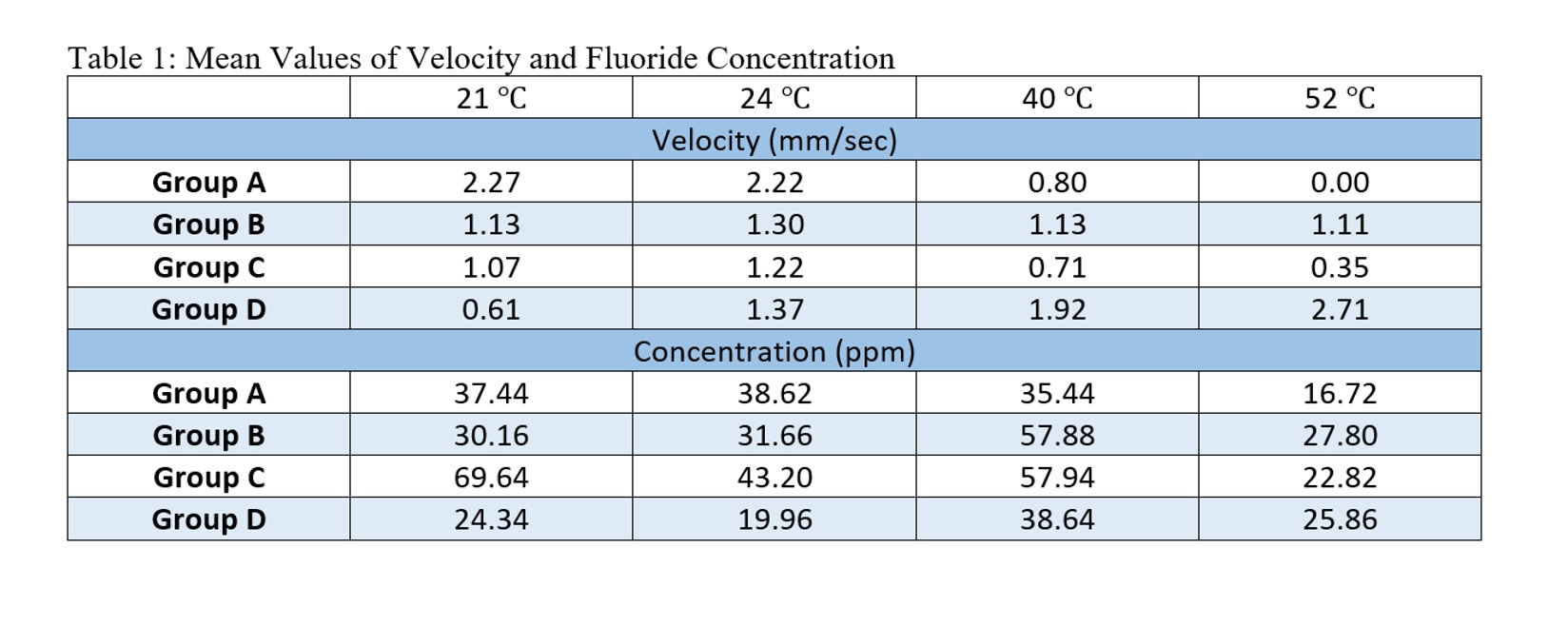
Results: Statistical significances were measured in increased viscosity from the storage temperatures 21°C to 52°C in groups A, C, and D (p= 0.0019, 0.0225, and 0.0003 respectively) (Table 1). Group A stored at 52°C became too viscous to be removed from the packaging and was deemed clinically unsuitable. Statistical significances were measured in decreased bioavailable fluoride when comparing storage temperatures of 52°C to lower temperatures in groups A, B, and C (p= 0.0360, 0.0192, and 0.0013 respectively). Varnishes except for group B experienced packaging leakage at 52°C.
Conclusions: Varnishes stored at 52°C had increased viscosity and decreased bioavailable fluoride. Group B demonstrated favorable characteristics due to the lack of package failures and retained flow. For all brands, decreased in bioavailable fluoride at 52°C compared to lower temperatures was observed. Further testing is required to determine clinical significance of decreased bioavailable fluoride.
Methods: To measure viscosity and fluoride concentrations, each test had twenty samples where 5 samples were from each brand of fluoride products (n=5). Group A: Acclean® 5% Sodium Fluoride Varnish (Young Dental Manufacturing™), Group B: Vanish™ 5% Sodium Fluoride (3M ESPE), Group C: VarnishAmerica™ (Medical Products Laboratories™), and Group D: Enamelast® 5% Sodium Fluoride Varnish (Ultradent). Samples were incubated at 21°C, 24°C, 40°C, and 52°C for 5 days. Viscosity was measured by allowing 0.3mL of varnish to flow on a 45-degree inclined plane. Velocity was calculated after 30 seconds by measuring the distance each material traveled. Fluoride concentrations were measured using Fluoride Ion Selective Electrode (ISE) by Thermo Scientific. Statistical analysis was performed using the Kruskal-Wallis Test and Dunn’s Test with Bonferroni correction to adjust p-values.
Results: Statistical significances were measured in increased viscosity from the storage temperatures 21°C to 52°C in groups A, C, and D (p= 0.0019, 0.0225, and 0.0003 respectively) (Table 1). Group A stored at 52°C became too viscous to be removed from the packaging and was deemed clinically unsuitable. Statistical significances were measured in decreased bioavailable fluoride when comparing storage temperatures of 52°C to lower temperatures in groups A, B, and C (p= 0.0360, 0.0192, and 0.0013 respectively). Varnishes except for group B experienced packaging leakage at 52°C.
Conclusions: Varnishes stored at 52°C had increased viscosity and decreased bioavailable fluoride. Group B demonstrated favorable characteristics due to the lack of package failures and retained flow. For all brands, decreased in bioavailable fluoride at 52°C compared to lower temperatures was observed. Further testing is required to determine clinical significance of decreased bioavailable fluoride.
IMAGES
2854831_File000000.jpg
2854831_File000000.jpg