IADR Abstract Archives
Material Flexural Strength Comparison Using Marketed and Experimental Automix Tips
Objectives:
Compare flexural strength of restorative materials using marketed and experimental automix tips.
Methods: Marketed and experimental automix tips for eleven restorative materials were compared according to ISO 4049: 2009. For each material, two groups of tips (n = 3 per group) were prepared with one being marketed and another being experimental automix tips. A total of sixty-six square prism samples, measuring 2x2x25mm, were prepared as follows: materials were dispensed into the mold with a Mylar® strip placed on top. Steady pressure was applied using a glass plate displacing excess material. Samples were cured (DEMI™, Kerr) in accordance with manufacturer’s instructions. Samples were placed in 37°C distilled water, following ISO instructions based on material classification, for 15 minutes for Core Paste® XP White [CPWhiteSy], Core Paste® XP Enamel [CPEnamelSy], Geristore® Syringeable Kit [G], Ultra-Bond® Plus [UBP], BLOCK-OUT® [BO], Infinity™ SE [ISE], Infinity™ [I], Core Paste® Syringeable Cartirdge Enamel [CPEnSyCart], and Core Paste® Syringeable Cartridge White [CPWhiteSyCart] and 1 hour for PERFEC Temp®II Cartridge [PTIIC] and Perfectemp10® Cartridge [PT10C]. Samples were taken out of the mold and wet-ground polished (EcoMet™250, Buehler) sequentially from coarse to smooth grit with final polishing done with 600 grit polishing paper to standardize the dimensions. Samples were stored in 37°C distilled water for 24 hours to ensure complete polymerization. Flexural strength was measured using a universal testing machine (Instron® 5566A Norwood, MA) with 1K load cell and 1 mm/min cross head speed. Comparisons of flexural strength between marketed and experimental tips were conducted using a t-test.
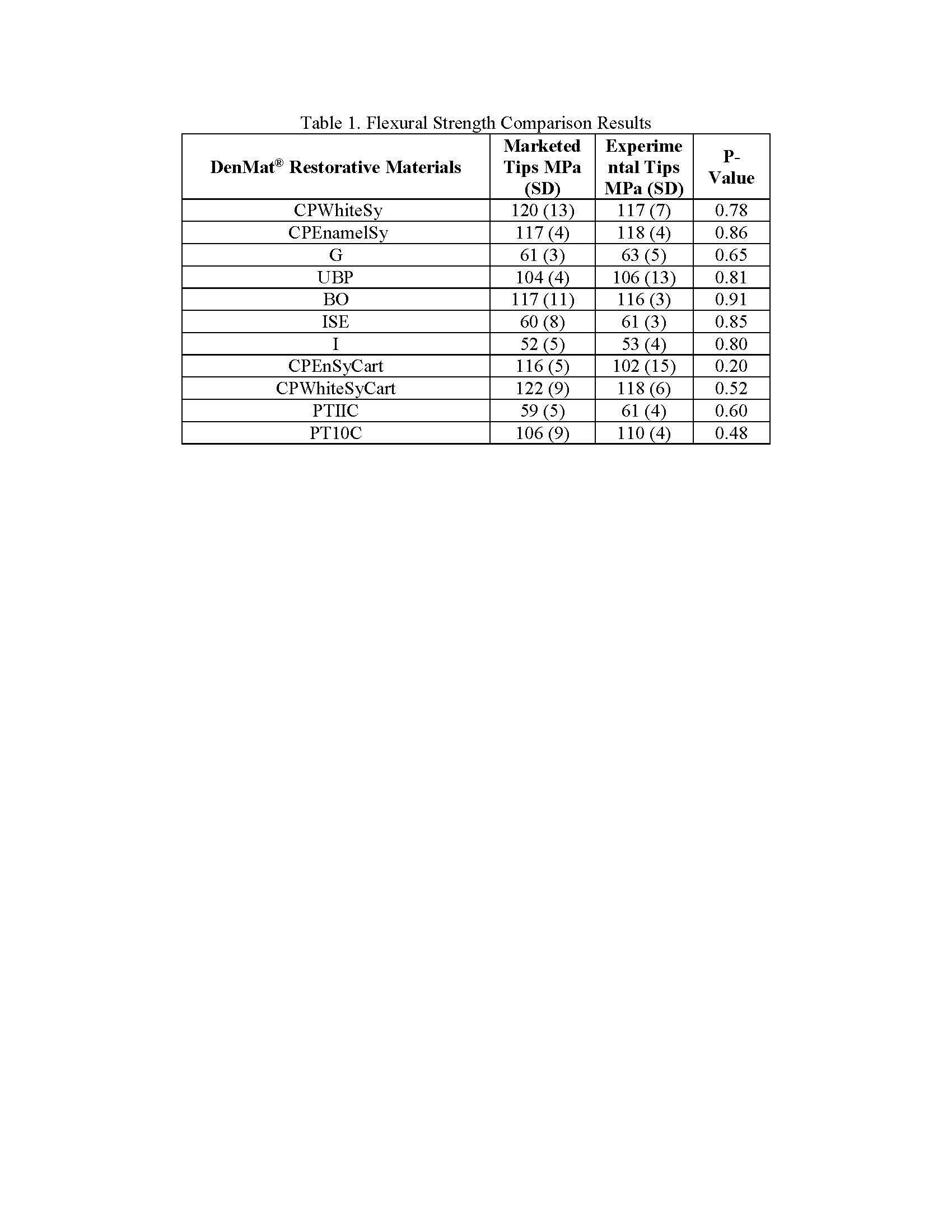
Results: Mean flexural strength ranged from 52 MPa (I) to 122 MPa (CPWhiteSyCart) for marketed tips and ranged from 53 MPa (I) to 118 MPa (CPEnamelSy) for experimental tips. P-values exceeded 0.05 for all t-tests (Table 1).
Conclusions: Flexural strengths were not significantly different when using marketed and experimental tips with all materials tested.
Compare flexural strength of restorative materials using marketed and experimental automix tips.
Methods: Marketed and experimental automix tips for eleven restorative materials were compared according to ISO 4049: 2009. For each material, two groups of tips (n = 3 per group) were prepared with one being marketed and another being experimental automix tips. A total of sixty-six square prism samples, measuring 2x2x25mm, were prepared as follows: materials were dispensed into the mold with a Mylar® strip placed on top. Steady pressure was applied using a glass plate displacing excess material. Samples were cured (DEMI™, Kerr) in accordance with manufacturer’s instructions. Samples were placed in 37°C distilled water, following ISO instructions based on material classification, for 15 minutes for Core Paste® XP White [CPWhiteSy], Core Paste® XP Enamel [CPEnamelSy], Geristore® Syringeable Kit [G], Ultra-Bond® Plus [UBP], BLOCK-OUT® [BO], Infinity™ SE [ISE], Infinity™ [I], Core Paste® Syringeable Cartirdge Enamel [CPEnSyCart], and Core Paste® Syringeable Cartridge White [CPWhiteSyCart] and 1 hour for PERFEC Temp®II Cartridge [PTIIC] and Perfectemp10® Cartridge [PT10C]. Samples were taken out of the mold and wet-ground polished (EcoMet™250, Buehler) sequentially from coarse to smooth grit with final polishing done with 600 grit polishing paper to standardize the dimensions. Samples were stored in 37°C distilled water for 24 hours to ensure complete polymerization. Flexural strength was measured using a universal testing machine (Instron® 5566A Norwood, MA) with 1K load cell and 1 mm/min cross head speed. Comparisons of flexural strength between marketed and experimental tips were conducted using a t-test.
Results: Mean flexural strength ranged from 52 MPa (I) to 122 MPa (CPWhiteSyCart) for marketed tips and ranged from 53 MPa (I) to 118 MPa (CPEnamelSy) for experimental tips. P-values exceeded 0.05 for all t-tests (Table 1).
Conclusions: Flexural strengths were not significantly different when using marketed and experimental tips with all materials tested.
IMAGES
2854478_File000000.jpg
2854478_File000000.jpg