IADR Abstract Archives
Mining the Electronic Health Record for Dental Adverse Events
Objectives: Adverse events (AEs) happen with regularity during patient care, as many episodes go unreported and some may result in injuries to patients. Unfortunately, conventional strategies employed to pinpoint AEs require considerable resources to audit random medical/dental charts. In order to streamline the retrospective chart review process, adverse event triggers for dentistry were developed and act as clues to help providers identify harmful incidents. To this end, the investigators report on the distribution of AEs uncovered by 7 newly constructed and unique triggers.
Methods: The electronic health records (EHR) of four dental institutions were audited by an investigative team of dental researchers. Under their purview, seven triggers (1. Extraction Following RCT/Crown/Filling, 2. Failed Implant, 3. Nerve Injury, 4. Post-Surgery Complication- Infection, 5. Soft tissue injury, 6. Allergy/toxicity, 7. Aspiration/Ingestions) were tested, refined, and implemented within each institution’s native EHR. Eleven independent, calibrated records reviewers with clinical backgrounds examined charts to determine the presence, medical type, and severity classification of all consensus AEs. Inter rater reliability was established using prevalence and bias adjusted kappa coefficient and the effectiveness of each trigger was estimated using standard diagnostic tests.
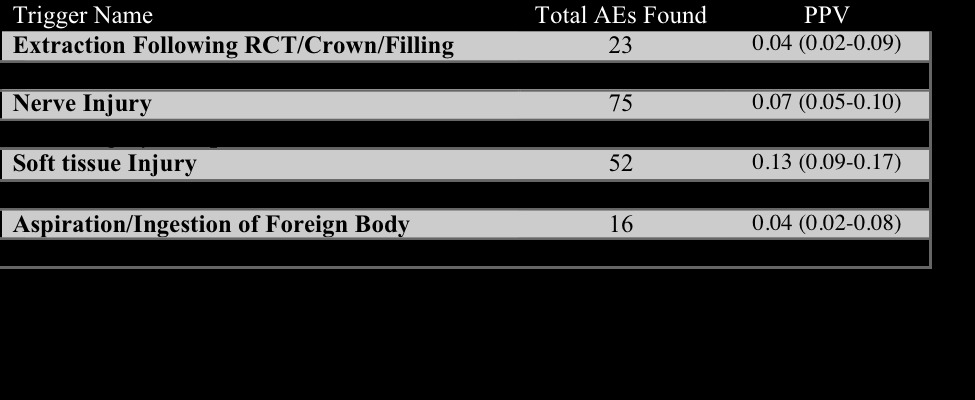
Results: 1885 charts were independently reviewed out of a total of 3658 triggered. Among the reviewed charts, 321 were verified as AEs through the consensus process. Among the AE cases reviewed, “pain” (29%) and “hard tissue damage” (16%) were the most commonly reported AE types while “other systemic harm” (3%) was the least likely. Nearly 9 in 10 AE cases were classified as temporary harm. Triggers 2 and 4 reported the highest PPVs of 21% (95% CI: 16%, 27%) and 20% (16%, 25%) respectively.
Conclusions: The results demonstrate that the adverse event trigger tool for dentistry provides an economical method for detecting harm and can play a key role in the self-evaluation efforts.
Methods: The electronic health records (EHR) of four dental institutions were audited by an investigative team of dental researchers. Under their purview, seven triggers (1. Extraction Following RCT/Crown/Filling, 2. Failed Implant, 3. Nerve Injury, 4. Post-Surgery Complication- Infection, 5. Soft tissue injury, 6. Allergy/toxicity, 7. Aspiration/Ingestions) were tested, refined, and implemented within each institution’s native EHR. Eleven independent, calibrated records reviewers with clinical backgrounds examined charts to determine the presence, medical type, and severity classification of all consensus AEs. Inter rater reliability was established using prevalence and bias adjusted kappa coefficient and the effectiveness of each trigger was estimated using standard diagnostic tests.
Results: 1885 charts were independently reviewed out of a total of 3658 triggered. Among the reviewed charts, 321 were verified as AEs through the consensus process. Among the AE cases reviewed, “pain” (29%) and “hard tissue damage” (16%) were the most commonly reported AE types while “other systemic harm” (3%) was the least likely. Nearly 9 in 10 AE cases were classified as temporary harm. Triggers 2 and 4 reported the highest PPVs of 21% (95% CI: 16%, 27%) and 20% (16%, 25%) respectively.
Conclusions: The results demonstrate that the adverse event trigger tool for dentistry provides an economical method for detecting harm and can play a key role in the self-evaluation efforts.
IMAGES
2853847_File000000.jpg
2853847_File000000.jpg