IADR Abstract Archives
Influence of Hand-Polished CAD/CAM Zirconia on Gingival Fibroblast Adhesion
Objectives: A large body of work exists examining the role of surface topography on soft-tissue responses to implant abutments. However, with the growing popularity of CAD/CAM abutments and their hand-polished surfaces, disparate surface topographies are being used in clinic. This study aimed to evaluate the effects of hand-polished zirconia topography, mimicking clinical adjustments of CAD/CAM abutments, on primary human gingival fibroblast (HGF) proliferation and adhesion.
Methods: Zirconia(ZirkonZahn) specimens (ø=5mm) were machined, rinsed in water, desiccated, sintered, and ground flat with #320 SiC paper until 2.0 mm thick. Three specimen groups were polished (15,000 RPM, 15s, at an approximately calibrated force of 3N): Coarse Polish Zilmaster(Shofu), Coarse plus Medium Zilmaster(Shofu), and Coarse plus Medium plus Fine Polish Zilmaster(Shofu). Unpolished disks were controls. Specimens were sonicated in ethanol and imaged with non-contact optical profilometer(OP), atomic force microscopy(AFM), and scanning electron microscopy(SEM). Surfaces were quantified in terms of roughness, kurtosis, skewness, and other surface topography measures. Disks were disinfected and plated with HGFs. At 24 and 48 hours, HGF proliferation was quantified with SEM and phosphorylation of focal adhesion kinase (FAK) was evaluated with an ELISA. ANOVA and Tukey's post hoc tests (α=0.05) were used for statistical analyses.
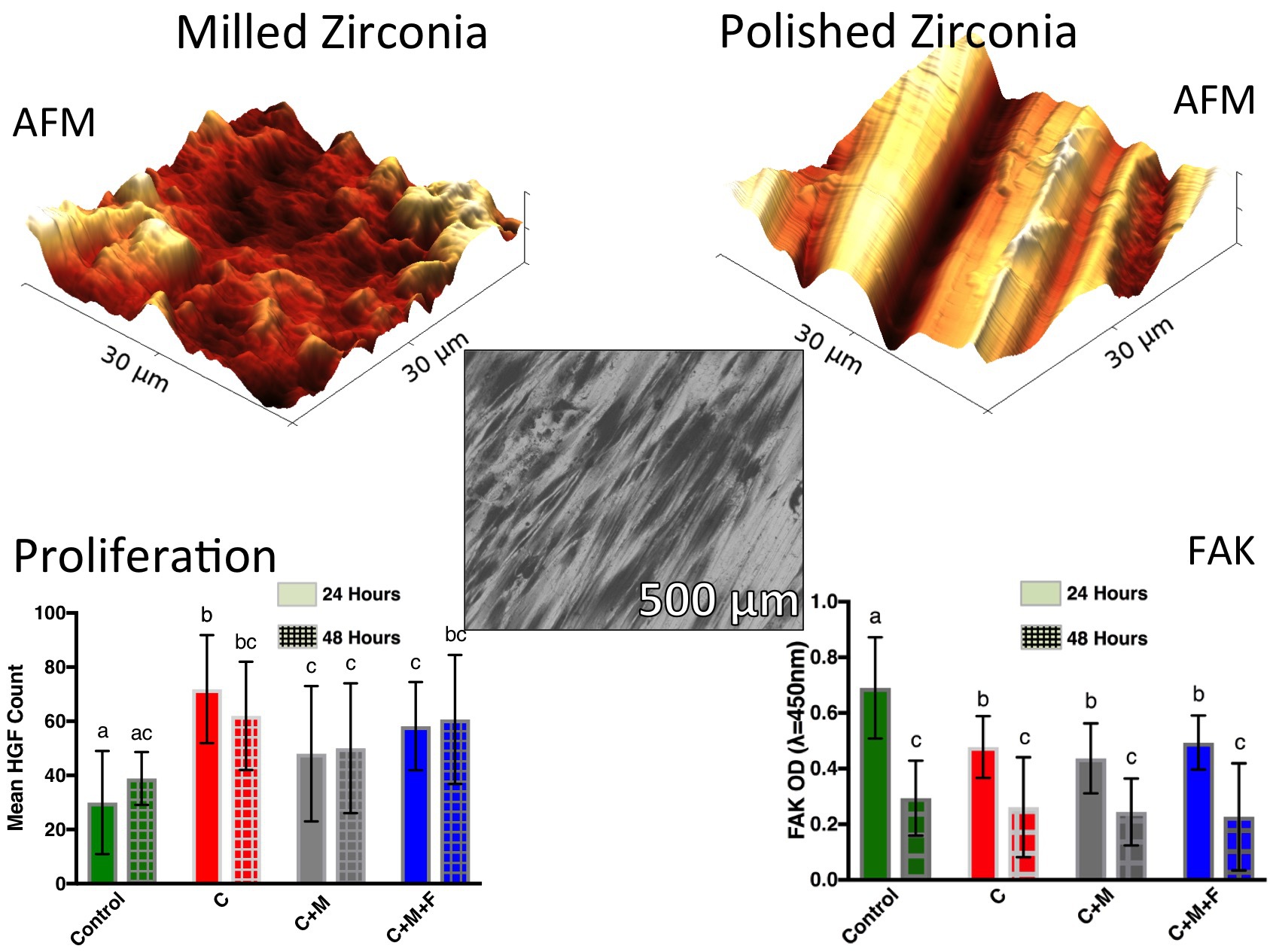
Results: Polishing produced statistically significantly (p<0.05) different surfaces following polishing, as compared to the control at both lateral length scales of OP and AFM. Proliferation increased (p<0.05) on polished surfaces as compared to the control. No differences in proliferation (p>0.05) were found between 24 and 48 hours. FAK phosphorylation was up-modulated (p<0.05) on the control surfaces. In all cases, FAK phosphorylation was down-modulated (p<0.05) at 48 hours as compared to 24 hours.
Conclusions: Within the bounds of this study, quantifiable surface adjustment following CAD/CAM processing is directly related to early cellular responses associated with mucosal seal formation, which may impact long-term implant survival.
Methods: Zirconia(ZirkonZahn) specimens (ø=5mm) were machined, rinsed in water, desiccated, sintered, and ground flat with #320 SiC paper until 2.0 mm thick. Three specimen groups were polished (15,000 RPM, 15s, at an approximately calibrated force of 3N): Coarse Polish Zilmaster(Shofu), Coarse plus Medium Zilmaster(Shofu), and Coarse plus Medium plus Fine Polish Zilmaster(Shofu). Unpolished disks were controls. Specimens were sonicated in ethanol and imaged with non-contact optical profilometer(OP), atomic force microscopy(AFM), and scanning electron microscopy(SEM). Surfaces were quantified in terms of roughness, kurtosis, skewness, and other surface topography measures. Disks were disinfected and plated with HGFs. At 24 and 48 hours, HGF proliferation was quantified with SEM and phosphorylation of focal adhesion kinase (FAK) was evaluated with an ELISA. ANOVA and Tukey's post hoc tests (α=0.05) were used for statistical analyses.
Results: Polishing produced statistically significantly (p<0.05) different surfaces following polishing, as compared to the control at both lateral length scales of OP and AFM. Proliferation increased (p<0.05) on polished surfaces as compared to the control. No differences in proliferation (p>0.05) were found between 24 and 48 hours. FAK phosphorylation was up-modulated (p<0.05) on the control surfaces. In all cases, FAK phosphorylation was down-modulated (p<0.05) at 48 hours as compared to 24 hours.
Conclusions: Within the bounds of this study, quantifiable surface adjustment following CAD/CAM processing is directly related to early cellular responses associated with mucosal seal formation, which may impact long-term implant survival.
IMAGES
2853735_File000000.jpg
2853735_File000000.jpg