IADR Abstract Archives
Enamel Surface Changes Observed in Gel and Light Activation Whitening
Objectives: To detect changes in enamel surface micro-structure and chemistry composition of teeth treated with gel only and with gel plus light activation whitening.
Methods: Thirty-five human extracted mandibular incisors stored in artificial saliva were assigned to one of seven groups (n=5): CON = control (artificial saliva only), BST = 40% hydrogen peroxide (Opalescence© Boost PF), C3D = Crest© 3D White strips, C3D+LA = C3D with blue light, ZM = 25% hydrogen peroxide (Philips Zoom!© gel), ZM+LA = Zoom! Gel plus light activation (Philips Zoom! White Speed©, high intensity), ZM+LA+ACP = Zoom! Gel plus light activation with Relief ACP© gel (Philips). All whitening treatments were completed based on manufacturers’ directions of use. Post-treatment samples were imaged using Scanning Electron Microscopy (SEM) and Energy-Dispersive X-ray Spectroscopy (EDS) to determine structural changes and chemistry composition alterations of enamel surface, respectively. Statistical analysis of EDS data to measure comparisons between groups was performed using Kruskal-Wallis test with median and interquartile ranges reported.
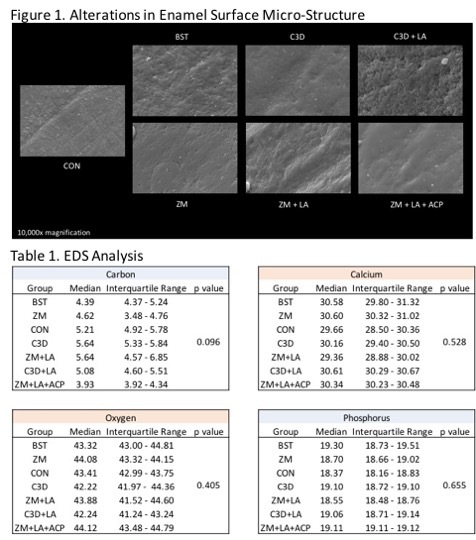
Results: SEM images demonstrated enamel surface alterations in all whitening groups compared to CON (Figure 1). C3D+LA and ZM+LA demonstrated the greatest severity of micro-structural changes compared to all groups, while ZM+LA+ACP showed improvement in enamel surface roughness compared to ZM+LA. BST showed increased structural changes over C3D and ZM. EDS analysis measuring eight elements showed no significant chemical compositional changes between whitening treatments and control (p>0.05). Four elements (Carbon, Oxygen, Calcium and Phosphorus) were consistently among the highest percent by weight demonstrated in all treatment groups as well as the control (Table 1).
Conclusions: Qualitative degradation of enamel surface is observed in whitening treatments, with the greatest severity found in whitening treatments using a light source. However, it appears remineralization treatment post-whitening can substantially reduce enamel surface degradation. The effects of whitening on surface enamel appear limited to structural integrity with insignificant alterations to chemical composition.
Methods: Thirty-five human extracted mandibular incisors stored in artificial saliva were assigned to one of seven groups (n=5): CON = control (artificial saliva only), BST = 40% hydrogen peroxide (Opalescence© Boost PF), C3D = Crest© 3D White strips, C3D+LA = C3D with blue light, ZM = 25% hydrogen peroxide (Philips Zoom!© gel), ZM+LA = Zoom! Gel plus light activation (Philips Zoom! White Speed©, high intensity), ZM+LA+ACP = Zoom! Gel plus light activation with Relief ACP© gel (Philips). All whitening treatments were completed based on manufacturers’ directions of use. Post-treatment samples were imaged using Scanning Electron Microscopy (SEM) and Energy-Dispersive X-ray Spectroscopy (EDS) to determine structural changes and chemistry composition alterations of enamel surface, respectively. Statistical analysis of EDS data to measure comparisons between groups was performed using Kruskal-Wallis test with median and interquartile ranges reported.
Results: SEM images demonstrated enamel surface alterations in all whitening groups compared to CON (Figure 1). C3D+LA and ZM+LA demonstrated the greatest severity of micro-structural changes compared to all groups, while ZM+LA+ACP showed improvement in enamel surface roughness compared to ZM+LA. BST showed increased structural changes over C3D and ZM. EDS analysis measuring eight elements showed no significant chemical compositional changes between whitening treatments and control (p>0.05). Four elements (Carbon, Oxygen, Calcium and Phosphorus) were consistently among the highest percent by weight demonstrated in all treatment groups as well as the control (Table 1).
Conclusions: Qualitative degradation of enamel surface is observed in whitening treatments, with the greatest severity found in whitening treatments using a light source. However, it appears remineralization treatment post-whitening can substantially reduce enamel surface degradation. The effects of whitening on surface enamel appear limited to structural integrity with insignificant alterations to chemical composition.
IMAGES
2853008_File000000.jpg
2853008_File000000.jpg