IADR Abstract Archives
Dynamic Model Distinguishes Effect of Fluoride Release and Remineralization
Objectives: To mimic a clinical application, a dynamic salivary-flow model is used to compare varnish effectiveness by measuring in-vitro fluoride-release (FR), enamel-fluoride-uptake (EFU), and surface-microhardness recovery (SMHR) in caries-like lesions compared to a control.
Methods: Bovine enamel specimens were potted, polished, and demineralized to produce artificial carious lesions. Baseline Vickers surface-microhardness was measured (4x200g-load-15sec); and specimens were placed into stratified treatment groups (n=10). Samples were treated with varnishes: A-3M™ESPE™Vanish™WhiteVarnish with TCP, B-Colgate PreviDent Varnish, C-control-non-treated and submerged in artificial-saliva. The artificial-saliva was removed and replaced with fresh saliva at 0.25, 0.50, 1.0, 2.0, 4.0, and 24.0-hours to simulate saliva turnover. Characterization included: fluoride-uptake (microdrill-biopsy 100μm-deepx1mm-diameter), Vickers surface-microhardness, and fluoride-release into extracted saliva. Samples were then challenged with acid for 24-hours and re-characterized using fluoride-uptake and Vickers-hardness to calculate the percent surface-microhardness recovery. Data were analyzed using one-way ANOVA (p<0.05) and two-sample T-tests.
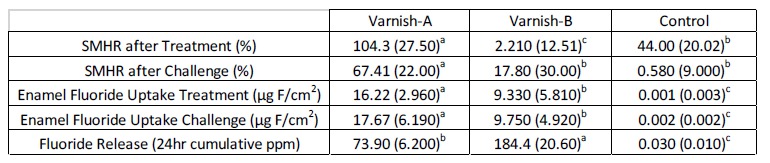
Results: See table below, superscript letters in each row denote groups that are not statistically different. Varnish-A had statistically greater %SMHR following treatment and acid challenge than Varnish-B and control. Similarly, after treatment and challenge, Varnish-A had statistically greater EFU than Varnish-B and control. Varnish-B had statistically greater cumulative FR at 24 hours than Varnish-A, but the higher release amount does not correlate to higher %SMHR or higher EFU.
Conclusions: Using the dynamic-model, high %SMHR and EFU does not correlate to high FR. This may be because fluoride released early in the study is removed from the system, so that sustained release of fluoride provides superior benefit. Thus, remineralization is enhanced in a system that has sustained fluoride release, allowing ions time to interact and build strong mineral. The dynamic-model provides insight into how fluoride may impact remineralization and caries protection in a clinical setting.
Methods: Bovine enamel specimens were potted, polished, and demineralized to produce artificial carious lesions. Baseline Vickers surface-microhardness was measured (4x200g-load-15sec); and specimens were placed into stratified treatment groups (n=10). Samples were treated with varnishes: A-3M™ESPE™Vanish™WhiteVarnish with TCP, B-Colgate PreviDent Varnish, C-control-non-treated and submerged in artificial-saliva. The artificial-saliva was removed and replaced with fresh saliva at 0.25, 0.50, 1.0, 2.0, 4.0, and 24.0-hours to simulate saliva turnover. Characterization included: fluoride-uptake (microdrill-biopsy 100μm-deepx1mm-diameter), Vickers surface-microhardness, and fluoride-release into extracted saliva. Samples were then challenged with acid for 24-hours and re-characterized using fluoride-uptake and Vickers-hardness to calculate the percent surface-microhardness recovery. Data were analyzed using one-way ANOVA (p<0.05) and two-sample T-tests.
Results: See table below, superscript letters in each row denote groups that are not statistically different. Varnish-A had statistically greater %SMHR following treatment and acid challenge than Varnish-B and control. Similarly, after treatment and challenge, Varnish-A had statistically greater EFU than Varnish-B and control. Varnish-B had statistically greater cumulative FR at 24 hours than Varnish-A, but the higher release amount does not correlate to higher %SMHR or higher EFU.
Conclusions: Using the dynamic-model, high %SMHR and EFU does not correlate to high FR. This may be because fluoride released early in the study is removed from the system, so that sustained release of fluoride provides superior benefit. Thus, remineralization is enhanced in a system that has sustained fluoride release, allowing ions time to interact and build strong mineral. The dynamic-model provides insight into how fluoride may impact remineralization and caries protection in a clinical setting.
IMAGES
2852906_File000001.jpg
2852906_File000001.jpg