IADR Abstract Archives
CAD/CAM Preparation Design Effects on Endodontically Treated Molars
Objectives:
To evaluate the fracture resistance of endodontically treated molars restored with the Endocrown technique versus composite cores with various level of ferrule.
Methods: 48 recently extracted human molars were endodontically accessed, pulp chamber debrided and canals instrumented by a board certified endodontist. Teeth were embedded in acrylic and randomly divided into 4 groups. 1 Endocrown group; 2mm pulp chamber extension design. 3 composite core groups: 2mm ferrule, 1mm ferrule, 0mm ferrule. Composite Cores placed according to assigned group and manufacturer instructions (ClearFil DC Bond and ClearFil DC Core Plus, Kuraray). After 24 hrs, all teeth were prepared to either 2mm, 1mm, 0mm ferrule or Endocrown preparation designs. Preparation surface area was determined using a digital microscope (Hirox).
An acrylic scanning jig, maxillary left quadrant, was made with an opening in area of 1st molar. Each tooth specimen was then placed within the 1st molar position of scanning jig and digitally captured with CEREC OmniCam. CEREC crowns were designed using “Biogeneric Copy” of a standard waxing. Lithium disilicate crowns were milled, crystallized, intaglio surfaces etched and coupling agent applied according to manufacturer instructions (e.max CAD, IPS Ceramic Etching Gel, Monobond Plus; Ivoclar Vivadent). Tooth preparations were cleansed with a pumice/water slurry. Crowns were cemented with a self-adhesive resin cement (RelyX Unicem2, 3M ESPE).
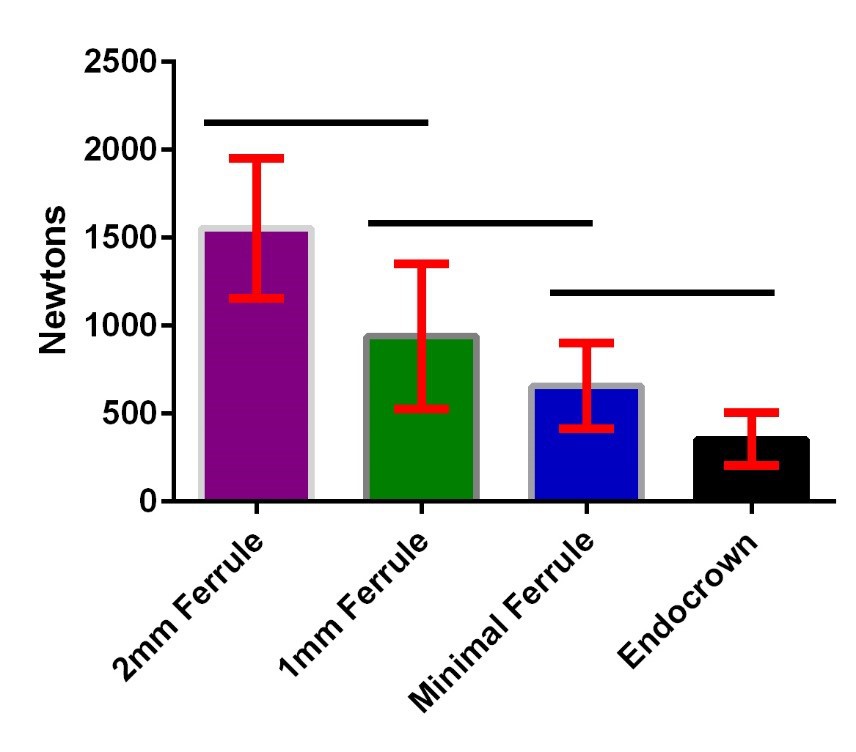
After 24 hours, specimens were loaded to failure on a universal testing machine (MTS Alliance RT-5); piston loaded on buccal cusps, 45 degrees to long axis of tooth, rate 0.5 mm/min. Peak Force (Newtons) recorded and failure stress (MPa) calculated based on preparation surface area.
Data analyzed using Kruskal-Wallis/Dunn’s post hoc (p=0.05)
Results: Graphs attached.
Conclusions:
Under this study’s conditions, Endocrown failures were less likely to be catastrophic, yet failed at a lower force than 1mm & 2mm ferrule groups.
To evaluate the fracture resistance of endodontically treated molars restored with the Endocrown technique versus composite cores with various level of ferrule.
Methods: 48 recently extracted human molars were endodontically accessed, pulp chamber debrided and canals instrumented by a board certified endodontist. Teeth were embedded in acrylic and randomly divided into 4 groups. 1 Endocrown group; 2mm pulp chamber extension design. 3 composite core groups: 2mm ferrule, 1mm ferrule, 0mm ferrule. Composite Cores placed according to assigned group and manufacturer instructions (ClearFil DC Bond and ClearFil DC Core Plus, Kuraray). After 24 hrs, all teeth were prepared to either 2mm, 1mm, 0mm ferrule or Endocrown preparation designs. Preparation surface area was determined using a digital microscope (Hirox).
An acrylic scanning jig, maxillary left quadrant, was made with an opening in area of 1st molar. Each tooth specimen was then placed within the 1st molar position of scanning jig and digitally captured with CEREC OmniCam. CEREC crowns were designed using “Biogeneric Copy” of a standard waxing. Lithium disilicate crowns were milled, crystallized, intaglio surfaces etched and coupling agent applied according to manufacturer instructions (e.max CAD, IPS Ceramic Etching Gel, Monobond Plus; Ivoclar Vivadent). Tooth preparations were cleansed with a pumice/water slurry. Crowns were cemented with a self-adhesive resin cement (RelyX Unicem2, 3M ESPE).
After 24 hours, specimens were loaded to failure on a universal testing machine (MTS Alliance RT-5); piston loaded on buccal cusps, 45 degrees to long axis of tooth, rate 0.5 mm/min. Peak Force (Newtons) recorded and failure stress (MPa) calculated based on preparation surface area.
Data analyzed using Kruskal-Wallis/Dunn’s post hoc (p=0.05)
Results: Graphs attached.
Conclusions:
Under this study’s conditions, Endocrown failures were less likely to be catastrophic, yet failed at a lower force than 1mm & 2mm ferrule groups.
IMAGES
2852751_File000000.jpg
2852751_File000000.jpg