IADR Abstract Archives
Bond Strength of Dual-Cured Resin Cements Using New Dual-Cured Adhesives
Objectives: New dual-cured adhesive agents have the reported advantages of not requiring light curing resulting in a lower film thickness and greater seating of bonded all-ceramic restorations. The purpose of this study was to determine the effect of new dual-cured adhesives on the bond strength of lithium-disilicate discs bonded to dentin with and without light curing of the adhesive or cement.
Methods: Ninety molars were mounted in dental stone and sectioned with a saw to remove coronal tooth structure. The specimens were randomly divided into three groups based on the use of three adhesives: Clearfil SE Bond 2 (Kuraray), Excite F DSC (Ivoclar Vivadent), and Universal Primer (Bisco). The three groups were further divided into three subgroups of ten specimens each with or without light-cure activation of the adhesive or cement. Discs (5-mm diameter, 2-mm thick) of lithium disilicate (IPS e.max.CAD, Ivoclar Vivadent) were designed and milled (InLAB, MCXL, Dentsply/Sirona), crystallized, etched (HF), rinsed, dried, and silanated. The adhesive agents were applied to the dentin surface with and without light activation. A dual-cure resin cement (Calibra, Dentsply) was applied to the discs, placed onto the dentin surface and light-cured from top surface of the disc or allowed to self-cure. Shear bond strength (Instron) was tested after storage for 24 hours in distilled water (37 degree C). Data were analyzed with Kruskal-Wallis/Mann-Whitney U.
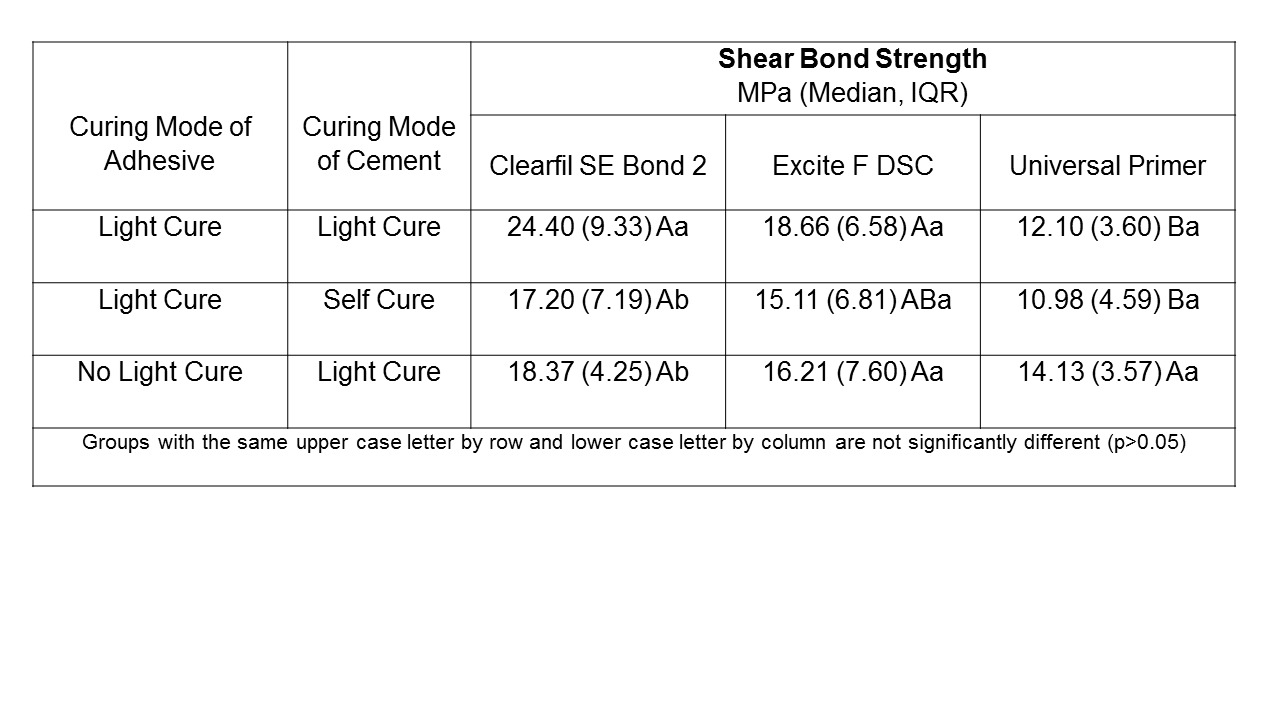
Results: Significant differences were found between groups based on curing mode and adhesive. See table.
Conclusions: Clearfil SE Bond 2 and Excite F DSC resulted in significantly greater bond strength of the lithium-disilicate discs compared to Universal Primer when the adhesives and cement were light cured (p<0.016). There was no significant difference in bond strength between the three adhesives if the adhesive was not light cured and the cement was light cured (p>0.05).
Methods: Ninety molars were mounted in dental stone and sectioned with a saw to remove coronal tooth structure. The specimens were randomly divided into three groups based on the use of three adhesives: Clearfil SE Bond 2 (Kuraray), Excite F DSC (Ivoclar Vivadent), and Universal Primer (Bisco). The three groups were further divided into three subgroups of ten specimens each with or without light-cure activation of the adhesive or cement. Discs (5-mm diameter, 2-mm thick) of lithium disilicate (IPS e.max.CAD, Ivoclar Vivadent) were designed and milled (InLAB, MCXL, Dentsply/Sirona), crystallized, etched (HF), rinsed, dried, and silanated. The adhesive agents were applied to the dentin surface with and without light activation. A dual-cure resin cement (Calibra, Dentsply) was applied to the discs, placed onto the dentin surface and light-cured from top surface of the disc or allowed to self-cure. Shear bond strength (Instron) was tested after storage for 24 hours in distilled water (37 degree C). Data were analyzed with Kruskal-Wallis/Mann-Whitney U.
Results: Significant differences were found between groups based on curing mode and adhesive. See table.
Conclusions: Clearfil SE Bond 2 and Excite F DSC resulted in significantly greater bond strength of the lithium-disilicate discs compared to Universal Primer when the adhesives and cement were light cured (p<0.016). There was no significant difference in bond strength between the three adhesives if the adhesive was not light cured and the cement was light cured (p>0.05).
IMAGES
2847504_File000004.jpg
2847504_File000004.jpg