IADR Abstract Archives
Properties of New Glass-Ionomer Restorative Materials Marketed for Stress-Bearing Areas
Objectives: The purpose of this study was to evaluate the properties (fracture toughness, surface hardness) of newer conventional glass-ionomer restorative materials which are marketed for posterior stress-bearing areas: ChemFil Rock, Dentsply; Fuji IX GP Extra, GC; Ketac Universal, 3M/ESPE; Ionostar Molar, VOCO; and Equia Forte, GC (with and without a surface coating of GC Coat) compared to more traditional composite-resin restorative materials (Filtek Z250, 3M/ESPE; Filtek Supreme Ultra, 3M/ESPE).
Methods: For fracture toughness, single-edge notched-beam specimens were created with each material in a mold (2.5x5x25mm), light-cured, and stored for 24 hours in a humidified environment at 37°C in a laboratory oven prior to testing (n=10). The specimens were fractured using a universal testing machine (Instron) at a crosshead speed of 1.0 mm/min. For surface hardness, Knoop Hardness values (KHN) were determined on the surface (Leco) of the fractured toughness specimens (n=10). A mean and standard deviation was determined per group. Data were analyzed with a one-way ANOVA/Tukey’s per property (alpha=0.05).
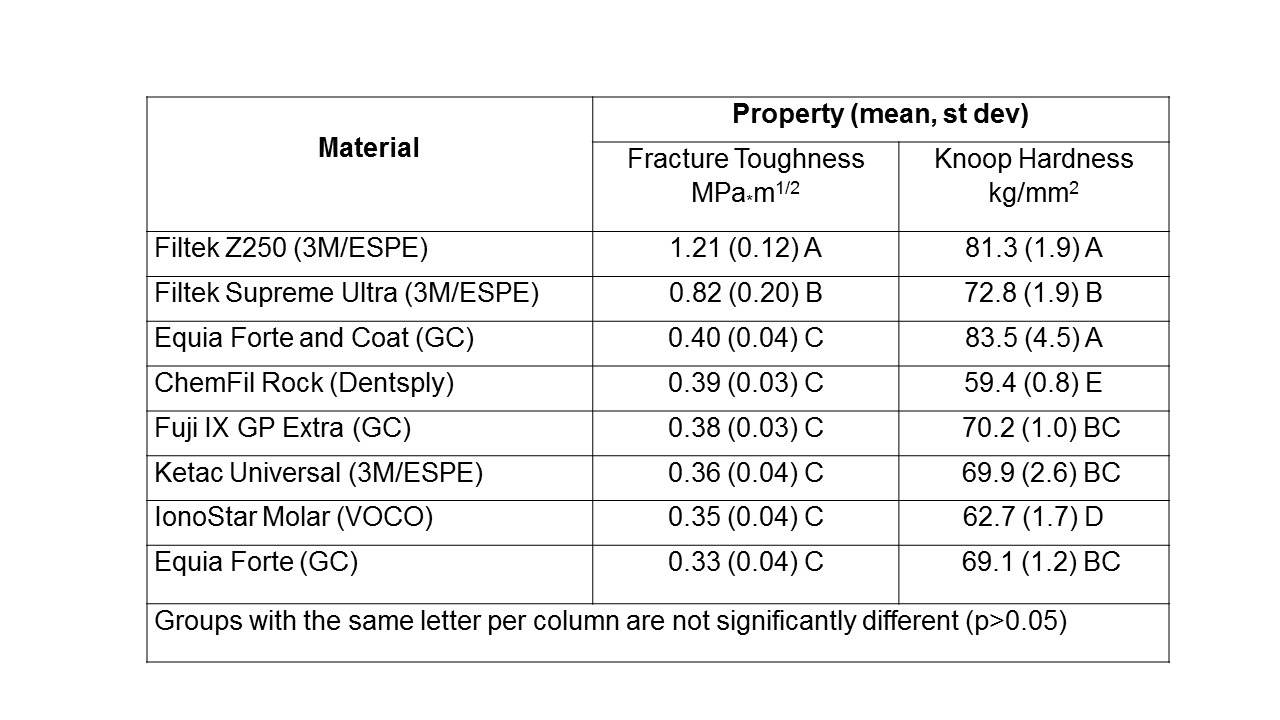
Results: Significant differences were found between the materials based on fracture toughness (p<0.001) and surface hardness (p<0.001). Filtek Z250 had significantly greater fracture toughness than Filtek Supreme Ultra, which was significantly greater than glass-ionomer materials. There was no significant difference in fracture toughness between the glass-ionomer materials. Equia Forte with GC Coat and Filtek Z250 had the greatest surface hardness and were not significantly different from each other. Filtek Supreme Ultra, Fuji IX GP Extra, Ketac Universal and Equia Forte (uncoated) performed more moderately. ChemFil Rock and IonoStar Molar had the lowest surface hardness. Coating the surface of Equia Forte with GC Coat significantly improved the surface hardness, but not the fracture toughness.
Conclusions: In general, the composite-resin materials had greater fracture toughness and surface hardness than the glass-ionomer materials marketed for posterior stress-bearing areas.
Methods: For fracture toughness, single-edge notched-beam specimens were created with each material in a mold (2.5x5x25mm), light-cured, and stored for 24 hours in a humidified environment at 37°C in a laboratory oven prior to testing (n=10). The specimens were fractured using a universal testing machine (Instron) at a crosshead speed of 1.0 mm/min. For surface hardness, Knoop Hardness values (KHN) were determined on the surface (Leco) of the fractured toughness specimens (n=10). A mean and standard deviation was determined per group. Data were analyzed with a one-way ANOVA/Tukey’s per property (alpha=0.05).
Results: Significant differences were found between the materials based on fracture toughness (p<0.001) and surface hardness (p<0.001). Filtek Z250 had significantly greater fracture toughness than Filtek Supreme Ultra, which was significantly greater than glass-ionomer materials. There was no significant difference in fracture toughness between the glass-ionomer materials. Equia Forte with GC Coat and Filtek Z250 had the greatest surface hardness and were not significantly different from each other. Filtek Supreme Ultra, Fuji IX GP Extra, Ketac Universal and Equia Forte (uncoated) performed more moderately. ChemFil Rock and IonoStar Molar had the lowest surface hardness. Coating the surface of Equia Forte with GC Coat significantly improved the surface hardness, but not the fracture toughness.
Conclusions: In general, the composite-resin materials had greater fracture toughness and surface hardness than the glass-ionomer materials marketed for posterior stress-bearing areas.
IMAGES
2846302_File000000.jpg
2846302_File000000.jpg