IADR Abstract Archives
Fracture Toughness, Flexural Strength and Modulus of CAD-CAM Blocks
Objectives: The development and introduction in the market of resin-composite (RC) CAD-CAM block has been rapidly evolving. However, independent assessment of their mechanical properties remains scarce, representing a challenge for clinicians who wish to base selection of materials on evidence.
Objective: The aim of this study was to determine and compare the fracture toughness (KIC), flexural strength (σf) and modulus (Ef) of four commercially-available RC and one lithium disilicate glass-ceramic CAD/CAM block, tested under dry and aged conditions.
Methods: Methods: Four RC, Vita Enamic (VE), Cerasmart (CER), KZR-CAD-HR2 (KZR), and CAMouflage Now (CAM), along with Obsidian (OBS), a glass-ceramic, were characterized. Blocks were cut into bars (10:1 span to thickness ratio) and [(6x6x6x12) mm)] prisms (n=25/group); half of RC specimens were aged in 37°C distilled water for 30 days before testing. σf and Ef were determined through a three-point bending test, whereas KIC using the notchless triangular prism specimen KIC test. Fractured KIC surfaces were characterized with scanning electron microscope. Results were analyzed by Weibull statistics and two-way ANOVA, followed by Scheffé multiple mean comparisons (α=0.05).
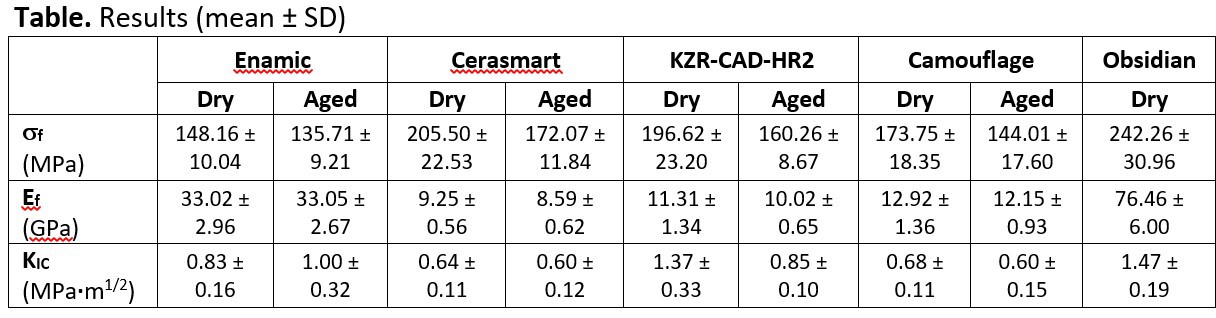
Results: Results: The results are summarized in Table. With regards to σf, OBS>CER=KZR>CAM>VE; σf of RC was lowered by ageing. VE was found to have the highest Ef among RC (33.0GPa), but significantly lower than OBS (76.5GPa); Ef was not affected by ageing. With regards to KIC, KZR stood out among RC with a dry value of 1.4MPa●m1/2, which was significantly affected by ageing while KIC of the other RC was not. OBS had the highest KIC (1.5MPa●m1/2).
Conclusions: Conclusions: The mechanical properties of the tested materials differed and the impact of ageing on σf of RC materials was found to be significant. Overall, the tested ceramic CAD/CAM block exhibited superior mechanical properties that may better suit clinical application.
Objective: The aim of this study was to determine and compare the fracture toughness (KIC), flexural strength (σf) and modulus (Ef) of four commercially-available RC and one lithium disilicate glass-ceramic CAD/CAM block, tested under dry and aged conditions.
Methods: Methods: Four RC, Vita Enamic (VE), Cerasmart (CER), KZR-CAD-HR2 (KZR), and CAMouflage Now (CAM), along with Obsidian (OBS), a glass-ceramic, were characterized. Blocks were cut into bars (10:1 span to thickness ratio) and [(6x6x6x12) mm)] prisms (n=25/group); half of RC specimens were aged in 37°C distilled water for 30 days before testing. σf and Ef were determined through a three-point bending test, whereas KIC using the notchless triangular prism specimen KIC test. Fractured KIC surfaces were characterized with scanning electron microscope. Results were analyzed by Weibull statistics and two-way ANOVA, followed by Scheffé multiple mean comparisons (α=0.05).
Results: Results: The results are summarized in Table. With regards to σf, OBS>CER=KZR>CAM>VE; σf of RC was lowered by ageing. VE was found to have the highest Ef among RC (33.0GPa), but significantly lower than OBS (76.5GPa); Ef was not affected by ageing. With regards to KIC, KZR stood out among RC with a dry value of 1.4MPa●m1/2, which was significantly affected by ageing while KIC of the other RC was not. OBS had the highest KIC (1.5MPa●m1/2).
Conclusions: Conclusions: The mechanical properties of the tested materials differed and the impact of ageing on σf of RC materials was found to be significant. Overall, the tested ceramic CAD/CAM block exhibited superior mechanical properties that may better suit clinical application.
IMAGES
2841389_File000000.jpg
2841389_File000000.jpg